The Moment You Stop Trying to Make the Photo (and make it)
There’s a moment in almost every shoot when effort reaches its peak.
You’ve walked the perimeter. You’ve circled the scene. You’ve tried the obvious angle, then the safer one, then something slightly experimental. You’ve adjusted exposure, stepped left, stepped right, checked the back of the camera, and told yourself there has to be something here worth photographing.
That moment is uncomfortable. It feels like resistance.
And it’s usually right before the photograph appears.
The Push Phase
Most photography sessions begin with pushing.
You push for a subject that feels strong enough.
You push for a composition that feels justified.
You push for a frame that proves the stop was worth it.
This phase is not a mistake. It’s part of learning a scene. By pushing, you eliminate what doesn’t work. You discover where the light falls apart. You find out which angles collapse under scrutiny. You exhaust the easy answers.
But pushing takes energy. And if it becomes the only mode you know, photography starts to feel like effort instead of exploration.
——>That’s when frustration creeps in.
When Effort Starts to Soften
At some point, often out of mild exhaustion, something changes.
You stop moving so much.
You stop adjusting constantly.
You stand still a little longer than before.
Your breathing slows. Your eyes stop darting. Instead of scanning for possibilities, you begin noticing relationships. How one shape leans toward another. How light touches one surface and ignores the rest. How the scene behaves when you’re not interrupting it.
This is where the photograph begins to organize itself. Not because the scene changed dramatically, but because you did.
Why This Shift Matters So Much
When you stop trying to force a photograph, expectation loosens its grip.
You’re no longer racing toward a result.
You’re no longer measuring success by speed or quantity.
You’re no longer asking the scene to impress you.
Instead, you’re listening.
This is why some photographs feel calm even when they contain motion. The photographer wasn’t tense when they made them. Their attention was open instead of narrow. Their timing came from presence, not urgency.
That calm shows up in the image.
A Camera Date for Practicing Stillness
The next time you feel yourself pushing for a photograph, try something simple and slightly uncomfortable.
Pick a spot and stay there. Do not change position for several minutes. Do not touch your settings unless the light truly forces your hand. Let the scene move around you instead of chasing it.
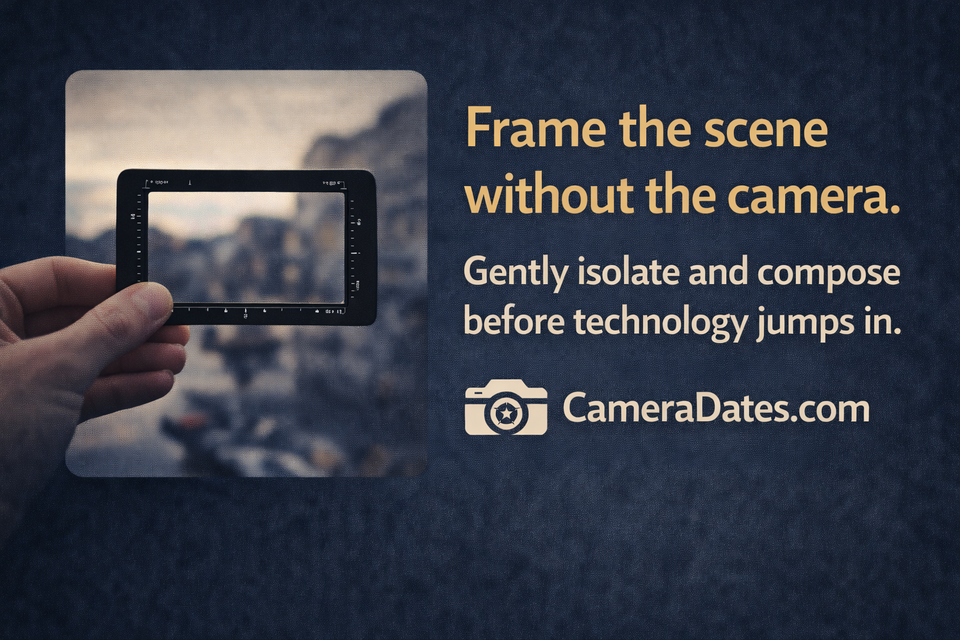
Before you even raise the camera, take a moment to frame the scene without it. Some photographers do this with their hands. Others cut a simple rectangle out of cardboard or an index card. There are even small framing tools made for this exact purpose that you can hold out in front of you to isolate the scene and study composition without distraction.
The method doesn’t matter. The habit does.
By removing the camera from your hands, you remove the urge to adjust. You stop thinking about exposure and start paying attention to relationships. What enters the frame without invitation. What leaves when you stop following it. How alignment happens on its own when you’re patient enough to wait.
Hold the frame steady. Let people pass through it. Let light shift. Let shadows stretch and collapse. Notice how often the photograph improves when you do nothing at all.
Only after the frame feels settled should you bring the camera back into the process.
Make fewer photographs.
Make them slower.
Let them come to you.
The Deeper Lesson Beneath the Habit
Photography isn’t only about decisiveness and control. It’s also about restraint.
About knowing when to act and when to wait. About trusting that not every moment needs to be manufactured.
Some photographs arrive only after you stop trying to make them happen.
And learning to recognize that moment is one of the quiet skills that separates busy shooting from meaningful seeing.
Shoot what matters.
Jonathan Charles
Cameradates.com