The Moment Manual Mode Stopped Being Scary
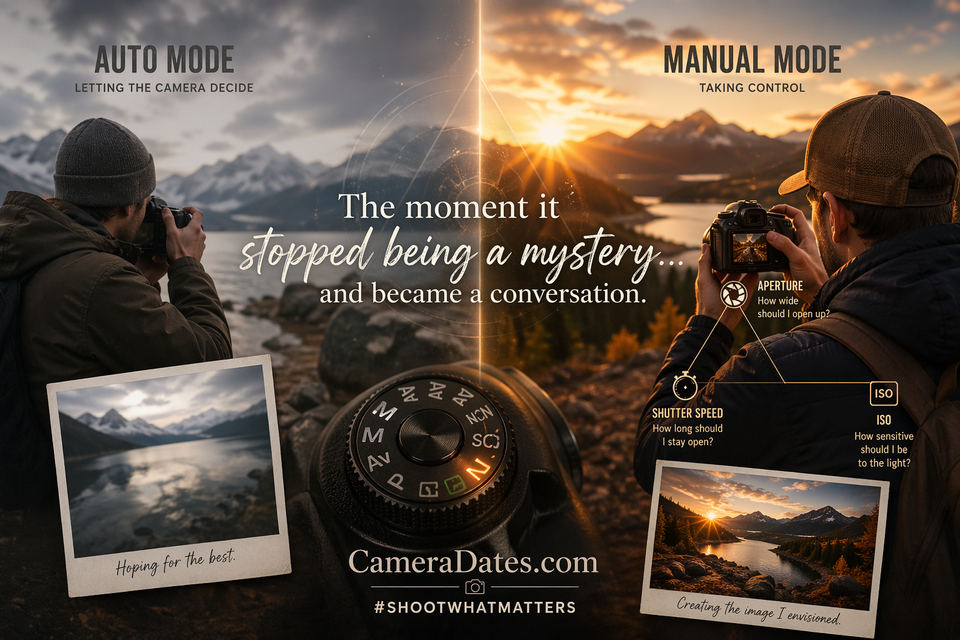
Every photographer has a moment when the camera begins to feel different. Before that moment, the controls can feel like obstacles between you and the photograph. There are numbers changing everywhere, unfamiliar abbreviations on the screen, dials that seem capable of ruining everything, and a nagging suspicion that the camera understands photography better than you do.
Then something changes.
Maybe you are photographing someone near a window and realize you can decide how much of the room stays sharp. Maybe you are standing beside moving water and discover that changing shutter speed does not simply make the photograph brighter or darker. It changes how the water feels. Maybe you raise the ISO because the light is disappearing and realize that a little noise is far less important than getting the photograph at all.
The camera has not changed. You have.
You begin to understand that shutter speed, aperture, and ISO are not three technical hurdles you have to conquer before you are allowed to call yourself a photographer. They are three ways of making decisions about the photograph.
That is usually the moment Manual mode stops being scary.
What the Exposure Triangle Actually Means
The exposure triangle is often introduced as a diagram showing shutter speed, aperture, and ISO connected to one another. That is useful, but it can also make exposure seem more complicated than it really is. Forget the triangle for a moment. Think about what each control actually changes.
Shutter speed determines how long the camera records light. That makes it a decision about time and motion. A fast shutter can freeze a bird's wings, a child running across the yard, or droplets exploding from a waterfall. A slower shutter allows movement to travel through the frame, turning water soft, headlights into streaks, or a moving person into a blur.
Aperture determines the size of the opening through which light enters the lens, but photographically its most important effect is often depth of field. It helps determine how much of the scene appears acceptably sharp. A wide aperture can help separate a subject from its surroundings. A smaller aperture can keep more of a landscape, building, or group of people in focus.
ISO works differently. It does not make the sensor physically more sensitive to light. Instead, it changes how strongly the camera amplifies the signal it records. Raising ISO can help you use the shutter speed and aperture the photograph needs when light is limited, but the tradeoff can be more visible noise and less usable dynamic range.
Those are not merely exposure controls. They are photographic choices. Once that sinks in, the triangle stops feeling like math and starts feeling like a toolbox.
Why Manual Mode Feels Hard
Manual mode is intimidating because the camera suddenly stops quietly making several decisions for you. In Auto mode, you point the camera toward something and press the shutter. Somewhere inside the camera, it decides aperture, shutter speed, ISO, metering, and sometimes much more. You may not agree with those decisions, but you do not have to think about them.
Move into Manual mode, and suddenly the camera asks you. How much motion do you want? How much depth do you want? How much noise are you willing to accept? How bright should this photograph actually be?
That can feel like being handed the controls of an airplane after spending years sitting in the passenger seat. But many photographers make a mistake when they try to learn Manual mode. They believe they need to think equally hard about all three settings on every photograph. You usually do not. Most photographs have a priority.
If you are photographing sports, shutter speed may lead because freezing motion matters most. If you are photographing a portrait, aperture may lead because depth of field matters more. If you are photographing a landscape from a tripod, aperture may again lead while shutter speed becomes much less important.
ISO often supports whatever decision matters most. That changes the problem completely. Instead of asking, "What should all three settings be?" you can begin by asking a much easier question:
What does this photograph need most? That question is far more useful than memorizing number combinations.
You Do Not Have to Earn Manual Mode
There is also a strange culture around Manual mode in photography. Some photographers talk about it as though it were the final level of a video game. Auto is for beginners. Aperture Priority is acceptable while you are learning. Manual mode is where the serious photographers live.
That idea has probably intimidated more people than Manual mode itself. Manual mode is not a badge of competence. It is simply a tool.
Sometimes I would rather use Aperture Priority. Sometimes Auto ISO makes perfect sense. Sometimes the light changes quickly, and letting the camera handle part of the exposure lets me focus more on timing, composition, or the subject.
The goal isn't to prove you can control everything manually. The goal is to understand the controls well enough to know when to use them. That distinction matters.
A photographer who blindly uses Manual mode because someone told them professionals do it is not necessarily more intentional than a photographer using Aperture Priority because depth of field is the only variable they need to control. Understanding the decision is more important than the mode printed on the dial.
Learn One Decision at a Time
The easiest way to understand exposure is not to sit down and memorize the entire triangle. Separate it. Take one control and take photos with it until you start seeing its effect before you even press the shutter.
Start with shutter speed. Photograph moving water, traffic, someone walking, a dog running across the yard, or even a ceiling fan. Try 1/30 second, 1/125, 1/500, and faster if the subject allows it. Do not worry about making masterpieces. Watch what happens to motion.
Then spend some time with aperture. Find a subject with some distance between it and the background. Photograph it at f/2.8 or f/4 if your lens allows it, then f/8, then f/16. Keep your position as consistent as possible. Look beyond brightness and pay attention to how the relationships inside the frame change.
Then experiment with ISO. Use the same general scene and gradually raise it. Look closely at the files afterward. Find out what ISO 1600, 3200, 6400, or higher actually looks like on your camera. This part matters because photographers sometimes fear ISO numbers they have never actually tested.
Your camera may handle ISO 6400 far better than you expect. Or you may decide you prefer staying below ISO 3200 when possible. Either way, now you know because you saw it yourself. That is more valuable than somebody on the internet telling you what number is "too high."
The Moment It Starts to Click
Eventually something subtle happens. You stop looking at the scene and thinking about settings first. You start looking at the photograph you want. You see someone walking through a shaft of light and think, I need enough shutter speed to catch that step. You see a flower against a cluttered background and think, I want less of that background competing with it. You see evening settling over a street and think, I would rather raise the ISO than lose the shutter speed I need.
The numbers come afterward. That is a major shift.
The camera is no longer telling you what photograph it can make. You are telling the camera what photograph you are trying to make. Manual mode becomes much less intimidating at that point because you stop thinking of it as operating three controls simultaneously. You are simply translating visual decisions into settings.
Exposure Is Usually a Negotiation
One more thing is worth understanding early. There is rarely a perfect exposure setting where shutter speed, aperture, and ISO all give you exactly what you want without compromise. Photography often requires negotiation.
You may want f/1.8 for a soft background, but find the depth of field too shallow to keep both eyes sharp. You may want ISO 100 for the cleanest possible file, but need ISO 3200 because your subject is moving and you cannot afford a slow shutter. You may want f/16 for enormous depth of field, but the resulting shutter speed becomes too slow to handhold.
This is not the camera fighting you. This is photography.
Every setting gives you something and costs you something. Learning exposure is largely learning which compromise the photograph can afford. That is why asking what matters most is so powerful. Once you know what you are protecting, the other decisions become easier.
Manual Mode Is Not the Destination
And here is the funny part. Once you become comfortable with Manual mode, you may find yourself using other modes more confidently too.
Aperture Priority becomes more useful because now you understand what the camera is doing when it changes shutter speed.
Shutter Priority makes more sense because you understand what aperture and ISO may have to do in response.
Auto ISO becomes a deliberate choice rather than something you leave on because you are afraid to touch it.
Understanding Manual mode does not mean you have to live there forever. It means you understand the conversation.
Take a Camera Date
Pick one ordinary subject somewhere you can work without rushing. It could be a person sitting near a window, a plant on a table, water moving through a fountain, traffic on your street, or something as simple as a coffee mug in afternoon light.
Do not try to practice everything at once. Choose one question. What happens if shutter speed leads? What happens if aperture leads? What happens when ISO has to rise to protect the other two?
Make several photographs. Change one important thing at a time. Compare the results afterward.
Then, when you are comfortable, switch the camera to Manual mode and build one exposure deliberately. Start with the setting that matters most to the photograph. Set the second based on what you need visually. Let ISO solve the remaining exposure problem if necessary, or adjust it yourself. Do not worry about whether your settings would impress another photographer.
Look at the photograph. Did the motion behave the way you wanted? Is the depth where you wanted it? Did you preserve the moment? If so, you are already doing the thing Manual mode was supposed to teach you.
You are making decisions.
And once that happens, the camera stops feeling like a machine full of mysterious numbers. It starts feeling like a tool you know how to use to get what you want.
Shoot What Matters.
Jonathan Charles