If You Don't See It, Don't Shoot It.
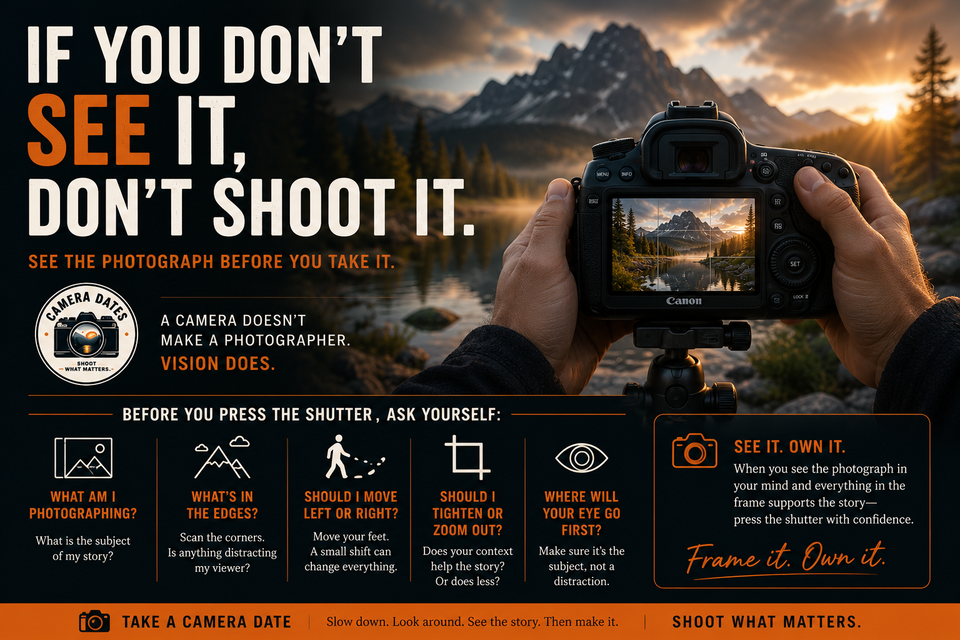
I have said this for years, and the more I photograph, the more convinced I become that it is true. If you do not see it, do not shoot it. Now this is certainly true for deer hunting, but let's stick to photography here LOL.
I'm not talking about physically seeing it. Of course you can see your subject. I am talking about something different. I am talking about seeing the photograph before you ever press the shutter. Seeing it completely, in your mind, before the camera is even thought about.
There is a meaningful difference between those two things. One is taking a picture. The other is making a photograph. And that gap, small as it sounds, is where most of the really interesting work in photography actually happens.
Seeing Is Not the Same as Looking
We have all done it. You arrive somewhere beautiful, the light is doing something wonderful, the subject is right there in front of you, and you raise the camera almost immediately because you do not want to miss it. You shoot. You come home. You sit down with the images and something feels off. The camera captured exactly what was in front of you, but it did not capture what you felt standing there. It did not capture why you raised the camera in the first place.
The reason is almost always the same. You photographed what you looked at instead of what you saw.
Looking is automatic. It happens whether you want it to or not. You open your eyes and the world arrives. Seeing is something else entirely. Seeing is intentional. It is the act of noticing not just that something is there but why it matters, what it means, what story it is trying to tell, and how a rectangle drawn around it at exactly the right moment might make someone else feel what you felt when you stopped walking and said, quietly, there it is.
That is seeing. And it is the whole game.
See the Photograph Before You Take It
Before I press the shutter I try to hold the finished photograph in my mind first. Not perfectly, not with complete certainty, but clearly enough to answer a few honest questions.
Where do I want someone's eye to go when they first look at this? What in the frame is supporting that intention and what is competing with it? Is the background strengthening the story or is it simply there because I did not take five more seconds to move? Does the frame I am looking at right now feel inevitable, like this is the only way this photograph could exist, or does it feel like the first draft of something that could be better?
If I cannot answer those questions with any confidence, I am usually not ready to press the shutter. The camera is ready. I am not. And the camera's readiness does not count for much without mine.
A camera records everything in front of it without judgment or preference. A photographer decides what deserves to be remembered, and how, and why. That decision is the entire job.
The Scene Reveals Itself to the Patient
One of the most common mistakes photographers make is assuming the first composition they see is the best one available. Sometimes it is. Most of the time there is something better waiting just a few steps away, visible only to the person who took the time to look for it.
Walk left. Walk right. Drop to one knee and see what the world looks like from down there. Stand taller than feels natural. Move closer than feels comfortable. Back away until the subject sits small in something larger and see if that changes the feeling entirely.
Watch how the background shifts as you move or frame up. Notice how a distracting element that was front and center from your original position disappears entirely when you take three steps to the side. Pay attention to how light falls differently across your subject from a slightly different angle, how a shadow appears or a highlight moves or the whole mood of the scene changes simply because you were willing to keep exploring instead of settling for the first thing you saw.
The scene you are standing in front of is not a single fixed photograph waiting to be taken. It is a collection of possibilities, and the ones worth making are almost never the most obvious ones. They reveal themselves to the patient, to the curious, to the photographer who treats the scene as something to be discovered rather than simply documented.
Photograph the Feeling, Not the Scene
Imagine you are standing beside a quiet lake at sunrise. The mountain across the water is extraordinary. Most people raise their camera and photograph the mountain, which is a completely reasonable thing to do.
But then something else catches your eye. The reflection of the mountain stretching across the still water. An old wooden dock leading the eye into the scene. A fisherman standing alone in the morning mist at the far edge of the frame, so small against everything around him that you almost missed him entirely.
Suddenly the mountain is not really the subject anymore. The feeling is the subject. The solitude. The stillness. The particular quality of early morning light on water when the world has not woken up yet and everything is suspended in quiet.
The scene did not change. The mountain is still there, the water is still there, the dock and the fisherman are still there. What changed is the way you are seeing it. You stopped recording scenery and started creating a photograph. That shift, from documenting what is there to expressing what it feels like to be there, is one of the most important transitions a photographer can make.
Do not photograph what everyone else is looking at. Photograph what everyone else is overlooking.
The Best Photographs Are Built, Not Found
People often talk about finding great photographs, stumbling onto the right scene at the right moment with the right light. And luck is real, there is no point pretending otherwise. But the photographers who make consistently strong work are not relying on luck. They are building.
They build by choosing what belongs in the frame and ruthlessly removing what does not. They build by waiting for the right expression, the right light, the right moment when every element in the scene is pulling in the same direction. They build by moving their feet instead of settling for the first viewpoint, by asking better questions before they press the shutter, by staying in a scene long enough for it to reveal something it would not have shown to someone less patient.
Most importantly, they build by deciding what story they want to tell before the camera is ever involved. That decision, made quietly before the shutter fires, is what separates a photograph from a snapshot. Not the gear. Not the settings. The intention.
Sometimes the Best Thing You Can Do Is Lower the Camera
Here is something that might sound strange coming from a photography website. Sometimes the single most useful thing you can do when you arrive at a scene is put the camera down entirely.
Take a breath. Look around without framing. Ask yourself what caught your attention in the first place. What made you stop? Was it the light? The color? The mood? The relationship between two people? The way something ordinary was doing something unexpected?
The answer to that question is almost always the beginning of your photograph. Once you know what you are actually trying to say, every other decision falls into place around it. Your composition, your focal length, where you stand, how much you include or exclude, all of it begins working toward the same goal instead of pulling in separate directions.
You are no longer taking random photographs and hoping one of them works. You are creating one on purpose. That is an entirely different experience, and it produces entirely different results.
Before You Press the Shutter
The next time you raise your camera, do not ask yourself whether the scene is worth photographing. Almost every scene is worth photographing in the right hands with the right intention.
Ask yourself something better instead.
Have I actually seen the photograph yet?
If the answer is no, wait. Move. Explore. Think. Let the scene reveal itself a little more before you ask the camera to record it. When the photograph finally becomes clear in your mind, not perfect, not certain, but clear enough that you know what you are making and why, press the shutter with confidence.
Not because you got lucky. Because you saw it first.
Camera Date Challenge
Find one scene today that stops you. Before you take a single photograph, spend a few full minutes just observing it. Walk around it. Study it from high and low. Look at the edges. Notice the light. Ask yourself what story you are actually trying to tell and whether the frame you are looking at right now is the best version of it.
Only then, when you have truly seen it, lift the camera and make your photograph.
When you get home, ask yourself one honest question. Did I photograph what I saw, or only what I looked at?
Want to make it a little more interesting? Try this with a friend or your spouse.
We call it Freeze Frame. Here is how it works. While you are out together, your companion picks the moment, no warning, no setup, they simply say "Freeze Frame" and you stop walking. Right there. Whatever is within five feet of where your feet just stopped is your entire world for the next little while. No cheating by drifting toward something better. No wandering six feet to the left because the light looks nicer over there.
You work with exactly what you have. You study it. You move within your five foot radius. You get low, get high, look for the angle nobody would think to try. Then you make one great photograph from that exact spot.
It sounds limiting. That is the whole point. Constraints have a funny way of unlocking creativity that an open field of options never quite manages. Some of the most surprising photographs come from the spots you never would have chosen yourself.
Try it once and see what happens. You might discover that your best photograph of the day came from a patch of sidewalk your companion picked completely at random.
Shoot What Matters.