Five Seconds Before the Shutter That Change Everything
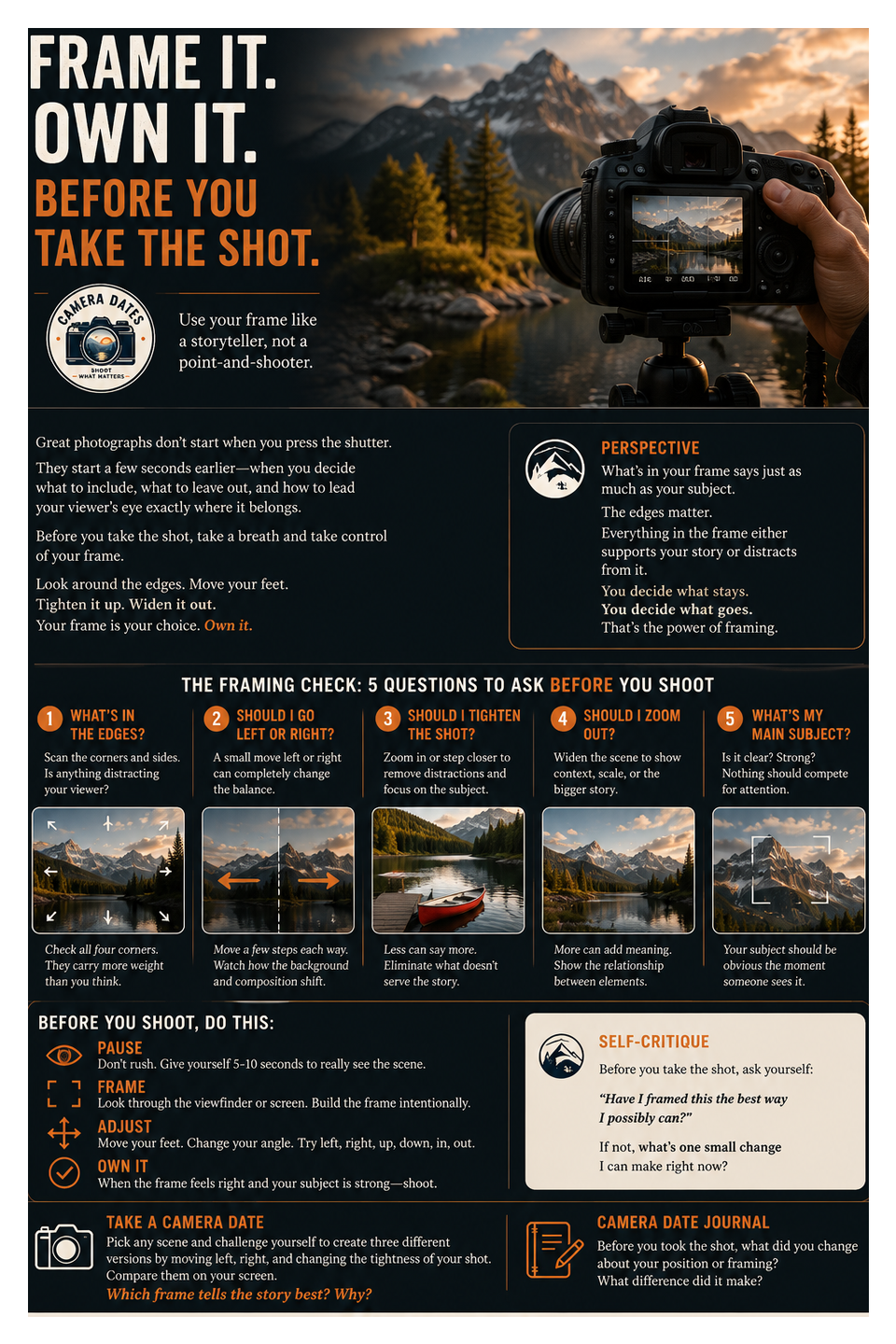
One of the biggest improvements I ever made as a photographer had nothing to do with buying a new camera. It did not involve learning a complicated editing technique or finally mastering a setting I had been avoiding. It cost nothing and required no new gear.
I simply slowed down.
I stopped treating photography like a race to press the shutter first and started asking myself one quiet question before every single photograph I made. Is this really the best frame I can make right now? That one question, asked honestly and consistently, changed everything about the way I shoot.
The Shutter Is the Last Step
Most photographers think the photograph begins when they press the shutter. It does not. The photograph begins the moment you raise the camera to your eye, and those few seconds before the shutter fires are where most great photographs are either created or quietly lost.
In those seconds you decide what stays and what goes. You decide where your viewer's eye will travel first, and where it will go next, and whether it ever finds its way to the thing you actually wanted them to see. You decide whether the frame feels intentional or accidental. Once you press the shutter, you've already made every one of those decisions and locked them in forever.
The shutter is the last step. Everything before it is the photograph.
Start With the Edges
When most photographers raise the camera, their eye goes immediately to the subject. Mine does too, and that instinct is not wrong. But after I find my subject, I force myself to look away and scan the frame's edges instead.
What is creeping in from the left? Is there a bright white car in the background pulling attention away from where I want it? Is a tree branch growing out of someone's head? Is there a trash can in the lower corner that I simply did not notice because I was so focused on the person in the middle? Is half of a stranger accidentally entering the frame from the right?
These edge details feel insignificant when you are standing there in the moment. But later, sitting at home reviewing the image on a larger screen, they become the very first thing your eye notices. A single distracting element at the edge of the frame can quietly undo an otherwise strong photograph, not by ruining it dramatically but by simply diluting it, pulling the viewer's attention just enough off course that the image never fully lands.
The edges of your frame tell the viewer something important. They tell them whether you made this photograph with intention or took it by accident. Train yourself to check every corner before you press the shutter. It takes five seconds, and it will save more photographs than almost any other habit you can build.
Move Your Feet Before You Move Your Zoom
Here is one of the easiest traps in photography. The moment something feels slightly off about a composition, the instinct is to reach for the zoom ring. Sometimes that is exactly the right call. Often it is not.
Before you change your focal length, try moving first. Take two steps left. Take two steps right. Drop to one knee. Raise the camera higher than feels natural. Get lower than feels comfortable. Move toward your subject or back away from it. You do not need to go far. Often two or three steps in any direction is all it takes to transform a composition entirely.
When you move, the background changes. Leading lines appear that were not visible from your original position. Distracting objects shift out of the frame or disappear behind something else. The relationship between your subject and everything around it changes completely. New possibilities open up that you could not have seen from where you were standing.
Professional photographers do not simply find photographs waiting to be taken. They build them. And that construction process often begins with nothing more than taking three deliberate steps to the left and seeing what happens.
Your camera can zoom. Your feet can compose. The best photographers use both, and they reach for their feet first.
What Belongs in the Frame and What Does Not
Every photograph asks one question. What is important here? And once you have answered that, a second question follows naturally. Does everything else in the frame deserve to be there?
Tightening the frame, whether by moving closer or zooming in, removes distractions and simplifies the story. It focuses the viewer's attention exactly where you intended and gives your subject room to breathe without competing for space. Many photographs become significantly stronger simply by including less.
But tightening is not always the answer, and this is where photographers often overcorrect. Sometimes the surroundings are not distractions at all. They are the story.
A lone wildflower pushing through a crack in a sidewalk says something completely different than a close-up of that flower alone. A fisherman standing small against a vast quiet lake tells a richer story than a tight portrait of his face. A child splashing in a puddle becomes something more when you can see that it is happening in front of Grandma's farmhouse on a summer afternoon.
Context has weight. The trick is deciding whether the context in your frame adds to the story or competes with it. There is no universal answer. There is only the honest question, asked before you press the shutter, of whether what surrounds your subject helps it or hurts it.
Follow Your Viewer's Eye
Before you take any photograph, try this. Imagine you are seeing it for the very first time, completely cold, with no knowledge of what you were trying to capture. Where does your eye go first? Does it land directly on your subject, or does it wander toward a bright patch of blown-out sky in the corner? A colorful sign in the background? A parked car that catches the light? A distracting branch cutting across the frame?
If your eye does not immediately travel where you intended it to go, neither will your viewer's. And a viewer whose eye wanders isn't feeling what you wanted them to feel. Your composition should do the work of guiding the eye gently but deliberately toward what matters. Not through tricks or formulas, but through the conscious removal of anything that competes, and the intentional placement of everything that stays. Every element in your frame either helps tell the story or makes it harder to tell. There is rarely a neutral third option.
Five More Seconds
Most photographs aren't ruined because the photographer didn't know enough. They are ruined because the photographer was in a hurry. Five more seconds before you press the shutter can completely transform what you come home with. Five seconds to scan the edges one more time. Five seconds to take two steps left and see if something better reveals itself. Five seconds to wait for a stranger to walk out of the background. Five seconds to notice that the light just shifted and the shot improved. Five seconds to realize that the real photograph was actually behind you the whole time.
Those five seconds are not lost time. They are the difference between a snapshot and a photograph you will still be proud of years from now. Between an image that almost worked and one that genuinely does.
Slow down. The shutter will still be there.
Own Your Frame
When you finally press the shutter, do it with confidence. Not because the photograph is perfect, because no photograph ever is, but because you took ownership of every decision you could control. You checked the edges. You moved your feet. You decided what belonged and removed what did not. You thought about where the viewer's eye would go and whether the frame would take it there.
That is what separates a photograph from a snapshot. Not the camera. Not the settings. Not the light, though light always matters. It is the intention behind the frame, the evidence that someone stood there and thought carefully about what they were making before they made it.
Frame it. Own it. Then press the shutter.
A Camera Date Challenge:
Choose one subject today: a flower, a doorway, a person, a coffee mug, anything at all. Before you press the shutter even once, give yourself a full thirty seconds (or whatever) to work the frame. Move left and right. Try higher and lower. Step closer and back away. Study every edge and every corner. Ask yourself whether everything in the frame is earning its place, and whether your subject is unmistakably the first thing a stranger would notice. Take some real time at first, and this will become habit like many things, and five seconds will be all you ever need.
Then ask one more question. Is there a version of this shot that is ten percent better than what I am looking at right now? If the answer is yes, go find it before you shoot.
When you get home, do not judge the photograph by its sharpness or its technical settings. Judge it by one honest question.
Did I truly own my frame?
Shoot What Matters | CameraDates.com