Camera Date: Three Levels of Explanation
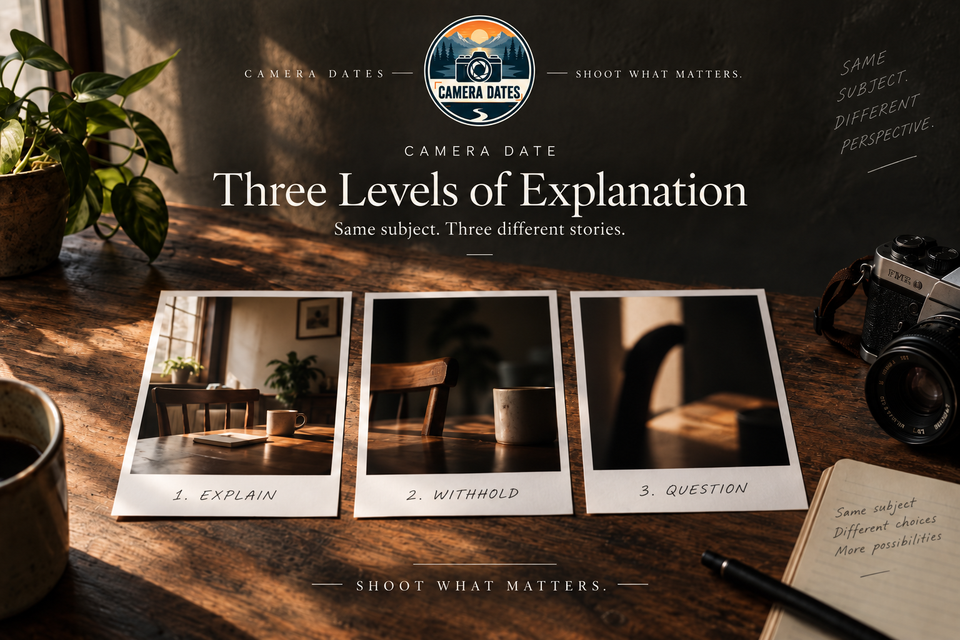
The Assignment: A Guided Camera Date in Controlling What the Viewer Knows
For this Camera Date, you will photograph the same subject three times, but each photograph will convey information differently. The first will clearly explain the subject. The second will withhold something important while still giving the viewer enough to understand the scene. The third will remove much of the explanation and leave the viewer with a question. Which one do you like the best? Let's find out.
The subject stays the same. What changes is how much you allow the viewer to know. This matters because composition does more than arrange objects inside the frame. Position, framing, focus, timing, light, and the edge of the photograph all control what information you share. They determine what the viewer understands immediately, what they have to discover, and what may remain unresolved.
You are not trying to prove that mystery is somehow better than clarity. The point is to discover what changes when you deliberately control how much the photograph reveals, what it withholds, and what it leaves open to interpretation. By the end, you should have three genuinely different interpretations of the same subject, each shaped by the choices you made about what to show and what to leave unsaid. All three approaches can produce a strong photograph. The lesson is learning to control those choices so the photograph communicates the way you want it to.
Choose a Subject With Layers
Choose something that can support more than one interpretation. A person is ideal because expression, gesture, position, context, and light can all change without changing the person. A room can work beautifully if it contains interesting objects or relationships. A street scene may offer people entering and leaving, reflections, signs, shadows, or small unexplained moments. A still life can work if the objects suggest a story. Even a landscape can work if it contains elements that raise questions about place, distance, history, or human presence.
Try to avoid subjects that give you almost nothing to work with. A single apple on a white background can certainly be photographed mysteriously, but you will have to manufacture most of the ambiguity yourself. A cluttered desk, a person in a doorway, an old chair beside a window, or a street corner with several visual relationships gives you much more material.
Keep the subject consistent across all three photographs. You may move yourself, change focal length, alter framing, wait for a different moment, change focus, or work with different light. Those are your Composition Levers. The subject remains the constant so you can see how your decisions change the level of explanation.
Before you make the first photograph, spend a few minutes looking. Ask yourself what information is available in the scene, what could be obvious, what could be hidden, and what might become a question. Do not raise the camera immediately. Analyze what you want to accomplish and identify the elements you will need. Then you are ready to shoot.
Photograph One: The Explainer
Your first photograph should communicate clearly and quickly. The viewer should recognize the subject, understand what it is doing, and see how the important elements inside the frame relate to one another without searching for the image's basic meaning.
Again, before you shoot, decide exactly what you want this photograph to explain. This step is very important. If you are photographing a person, look for the expression, gesture, or activity that makes the moment easiest to understand. If you are photographing a room or small scene, identify the objects and relationships that tell the viewer what kind of place they are looking at and what matters within it. Outdoors, include enough environmental information to establish the setting and give the subject useful context.
Build the composition around clarity. Give the subject enough Subject Weight that the viewer knows where to look first, and keep an eye on Frame Competition so secondary elements don't start fighting for attention. Watch Shape Separation too. If two important forms overlap awkwardly, a small positional change may make the scene much easier to read. Include enough context to explain the photograph, but do not confuse clarity with cramming every available detail into the frame. The goal is not more information. It is the right information presented clearly.
Use focus deliberately. If several elements are important to understanding the photograph, choose enough depth of field to keep those relationships readable. If one element carries most of the message, make sure focus helps establish that priority. Pay close attention to the background and the edges of the frame, too. A bright distraction, awkward crop, or unrelated object can weaken clarity even when the subject itself is obvious.
Timing matters just as much as composition. Wait for the expression, gesture, arrangement, or light quality that makes the scene feel complete. Look for the moment when the photograph explains itself naturally, rather than feeling like it was taken too early or too late.
Then review the image before moving on. Could someone describe what is happening in a single sentence without having to guess very much? Is the subject clear? Are the important relationships understandable? Is anything unintentionally hidden, distracting, or confusing? If the answer is no, then diagnose the problem before taking another frame. Move your position. Reframe. Change your height or angle. Simplify the background. Wait for a stronger moment. Pull the Composition Lever that addresses the actual weakness and try again.
Keep working until the photograph clearly says what you intended it to say.
That is your Explainer.
Photograph Two: The Partial Mystery
Now make the photograph explain less. Do not simply make a weaker version of Photograph One. Decide deliberately what information you will remove.
Choose one thing the first photograph explained clearly and withhold it. Maybe the viewer no longer sees the person’s full expression. Maybe the context disappears. Perhaps the relationship between two objects becomes uncertain. Maybe you withhold the outcome of an action. Perhaps something important moves outside the frame. The key is to remove an answer without removing the photograph.
This is where your Composition Levers become especially useful. Move closer and context disappears. Change your angle and part of the subject becomes concealed. Use the edge of the frame to cut away an explaining detail. Lower the camera so one object blocks another. Change focal length so the surroundings become less important. Wait until someone begins turning away instead of photographing the obvious expression.
Light can help too. You might allow part of the subject to fall into shadow rather than recovering all the detail. You might use a bright reflection to obscure something that was previously obvious. Shallow depth of field can make an explanatory detail less readable, while deeper focus can introduce another element whose relationship is not immediately clear.
Remember what you learned in Issue VIII: mystery does not require a weak photograph. Your Visual Path can still be clear. Subject Weight can still be controlled. The frame can still feel intentional. What changes is the amount of information.
When you review the photograph, ask what question it creates. Does the viewer understand enough to become interested while still having something unresolved? Does the withholding feel purposeful, or does it simply look like you missed the shot? A useful test is the kind of question the photograph creates. “I wonder what happened next” can be productive. “I wonder who that person is looking at” can be productive. “I wonder why that object is there” can be productive. “What am I even supposed to be looking at?” usually means the photograph has lost too much structure.
If the mystery feels accidental, do not defend it. Fix it. Keep working until the photograph feels complete even though the explanation is not.
That is your Partial Mystery.
Photograph Three: The Question
For the third photograph, push the experiment much farther. Remove most of the obvious explanation and build the image around one strong visual presence. It might be a gesture, a shadow, a shape, a reflection, a patch of light, a fragment of the subject, an unexplained relationship, or some other element that can carry the frame without explaining the whole situation.
This photograph should not depend on the viewer understanding the complete story immediately. But it still needs structure. That distinction matters.
Look at your subject again and ask what could survive if most of the explanation disappeared. Maybe it is the curve of a person’s hand against a dark doorway. Maybe it is the shadow of someone whose body is outside the frame. Perhaps it is a reflection that reveals only part of the scene. Maybe it is a detail that becomes hard to identify once you remove scale and context. Move in closer if necessary. Change your angle dramatically. Use foreground obstruction. Let the edge of the frame remove information. Work with shadow. Photograph through glass. Use shallow depth of field to isolate a fragment. Allow recognition to arrive slowly.
This is where delayed recognition can become interesting. The viewer may see shape before subject, light before location, gesture before identity, or texture before object. That small delay can make understanding part of the photograph.
Do not confuse abstraction with randomness. The viewer should still have a reason to stay. Visual Path matters. Subject Weight matters. Light matters. Shape Separation may matter even more because the viewer has fewer contextual clues available. If the frame becomes so obscure that nothing seems intentional, you have gone too far.
The goal is not for someone to say, “I have absolutely no idea what this is.” A better reaction is, “I know something is happening here, but I am not completely sure what it means.” That is a very different kind of uncertainty. Keep working until the photograph has enough visual structure to hold attention while refusing to give away the entire answer.
That is your Question.
When You Get Home
When you get home, do not judge the photographs separately at first. Put all three on the screen together and give yourself fifteen minutes with them.
Start with the Explainer. Notice how quickly you understand it. Does that clarity make the photograph satisfying? Does it feel complete? Does it still contain enough visual interest to keep you looking after you understand what is happening? Do not assume that a clear photograph is automatically boring. Sometimes the most direct version will also be the strongest.
Then look at the Partial Mystery. Identify exactly what information disappeared between Photograph One and Photograph Two. Did removing it create curiosity? Did it strengthen another visual relationship? Did the viewer gain room to interpret the scene, or did the photograph simply lose something it needed?
Finally, study the Question. For a moment, forget that you know the subject. Try to look at it as though you had never seen the original scene. Does the photograph still hold together? Is there enough structure to guide your attention? Is there something that makes you want to stay, or does the image collapse without the missing information?
This comparison is the real Camera Date. You are not looking for the mysterious photograph to win. You are looking for the photograph that needs exactly the amount of explanation you gave it.
Diagnose What Changed
Now go beyond preference and look specifically at what your decisions changed. Did moving closer remove context? Did the frame edge create a question? Did shadow hide something useful? Did shallower depth of field reduce Frame Competition or simply make important information unreadable? Did a different position improve Shape Separation while also changing the story? Did withholding the face make gesture more important? Did removing the environment increase Subject Weight? Did a reflection delay recognition? Did timing change the photograph from an answer into a question?
This is where the exercise becomes more than an interesting experiment. You are learning that Composition Levers do not simply rearrange objects. They control information.
Find the Keeper Candidate
Now choose the strongest of the three photographs. Don't automatically choose the most mysterious version, and don't automatically choose the clearest one. Choose the photograph where the amount of information feels right for what you wanted the image to communicate. That becomes your Keeper Candidate.
Now diagnose it one more time. What is the biggest remaining weakness? Is there still too much explanation? Did you remove something the photograph actually needed? Does Frame Competition weaken the idea? Does the eye wander because the Visual Path is unclear? Does the shadow conceal the wrong information? Does an edge feel accidental rather than deliberate?
If the subject and conditions are still available, go back and pull one more lever. Change only what you diagnosed. Make another frame and compare it to your Keeper Candidate. Protect what is already working and fix only what is not.
If the situation is gone, write down the exact change you would make next time. That still matters. The lesson is not lost because the moment has passed. Part of becoming more deliberate is learning to recognize what you would change even when you no longer have the chance to change it.
When the photograph finally says what you intended without needing more added or taken away, you have your Keeper.
What You Learned
You photographed one subject three times and changed something a camera setting cannot measure: how much information the viewer receives.
One photograph explained. One withheld. One asked.
More importantly, you saw how dramatically the meaning of a photograph can shift even when the subject itself stays the same. Framing changed what the viewer could see. Position changed relationships. Timing changed what was revealed. Focus changed what mattered. Light decided what became visible and what disappeared. The edge of the frame decided what stayed inside the story and what was left outside it. Those are not small differences. They are authorship.
You may have discovered that you naturally explain too much because you want the viewer to understand. You may have discovered the opposite and realized that you sometimes remove so much information that the photograph becomes difficult rather than intriguing. Perhaps the clearest version became your Keeper. Maybe the Partial Mystery gave you exactly the balance you were looking for. Maybe the Question surprised you because the photograph became stronger when you stopped trying to explain it. Any of those results are valuable.
The goal was never to prove that mystery makes better photographs. It was to show you that explanation itself is something you can control. You decide what the viewer sees immediately, what they have to discover, what remains unresolved, and how much room you want to leave for interpretation. That gives you another deliberate choice inside the frame.
The next time you raise your camera, ask yourself one more question before pressing the shutter: What do I want the viewer to know, and what am I willing to leave unsaid? Sometimes the answer will be everything. Sometimes the photograph will be stronger because one part of the story remains outside the frame. Sometimes the best decision will be to reveal less, and sometimes the strongest thing you can do is make the meaning unmistakably clear.
No one wins by choosing one over the other. The skill is knowing that you have the choice. The more aware you become of what you reveal, what you hide, and what you leave open, the more control you gain over what your photographs communicate and one step closer to developing your personal style. That is the real lesson from this Camera Date. You are not just learning to compose the things inside the frame. You are learning to compose the information itself. And once you begin seeing that, photographs stop feeling like something you simply capture. They become something you decide.
Shoot What Matters.
Jonathan Charles
CameraDates.com