The Subject Is Not the Photograph. ‹› Issue VI
From the Editor: Welcome to Issue VI
This Issue matters to me because it marks a small shift in how I want Camera Dates to grow.
I don't want this project to become just another place for photographers to collect tips, read a list of rules, and move on. I want it to become more practical than that. More personal too. I want us to spend more time looking at what actually happens while a photograph is being made, including the uncertainty, the wrong turns, the small adjustments, and the moments when a picture finally begins to make sense. I want it to be like a nice conversation with someone you genuinely love.
That means I am going to put more of my own process on the pages of many future issues. Not because every photograph I make deserves to be held up as an example, but because showing the work behind the frame has value. Sometimes the most useful photograph is not the finished one. It is the one that reveals what still needs to change.
Over time, I hope this helps Camera Dates develop a clearer way of talking about composition: not as a pile of rules, but as a set of practical ideas we can recognize, test, and use in the field. I expect that language to grow gradually, because I would rather earn it through real photographs than announce a grand system before it has been tested.
The larger goal is simple. I want every Camera Date to move us toward making photographs more deliberately and, whenever possible, coming home with one frame that truly feels worth keeping.
Issue VI is one more step in that direction.
Jonathan Charles
Featured Article: The Subject Is Not the Photograph
So, I have photographed quite a few covered bridges over the years, and for some reason I have never come away with one that completely satisfied me. That may be what frustrates me most: covered bridges look like they ought to photograph themselves. They are practically built to attract a photographer. They have history, texture, color, repetition, geometry, shadow, often water, usually trees, and sometimes beautiful old stonework holding everything together. You can see one from the road and immediately feel like a photograph must be waiting there. I certainly do. I have stopped for them more times than I can remember. And yet the photograph I imagine and the photograph I actually make rarely seem the same.
Maybe part of the problem is that a covered bridge can turn into a giant red wall surprisingly quickly. From the side, you get a long rectangle of siding. From the entrance, you get a dark hole. From farther away, the bridge can shrink into something small and insignificant against its surroundings. In bright summer light, you often end up with a red bridge, green trees, and a blue sky. That combination is fine, but an interesting subject doesn't automatically make an interesting photograph.
I still have a covered bridge photograph floating around in my head that I would love to make someday. It probably involves colder weather. A few patches of snow sit along the roof, and fog moves slowly down the creek underneath. The light would be soft, perhaps early in the morning, and the bridge would feel like it was emerging from the landscape instead of simply sitting in front of me. There is even a covered bridge far out in Oregon that has been on my photographic wish list for a long time: the Goodpasture Covered Bridge over the McKenzie River. It is still a working bridge, and around Christmas it is even decorated with lights. Someday I would love to get that far west in winter and see what photograph I could make of it.
So, A few days ago I pulled over beside the road as I spotted another covered bridge. It was not winter. There was no snow, no fog, and no soft early-morning light. It was the middle of a bright summer day. The sky was intensely blue, the trees were green, and the bridge was sitting there doing what covered bridges do.
I decided to photograph it anyway. What happened over the next little while taught me more than the bridge itself.
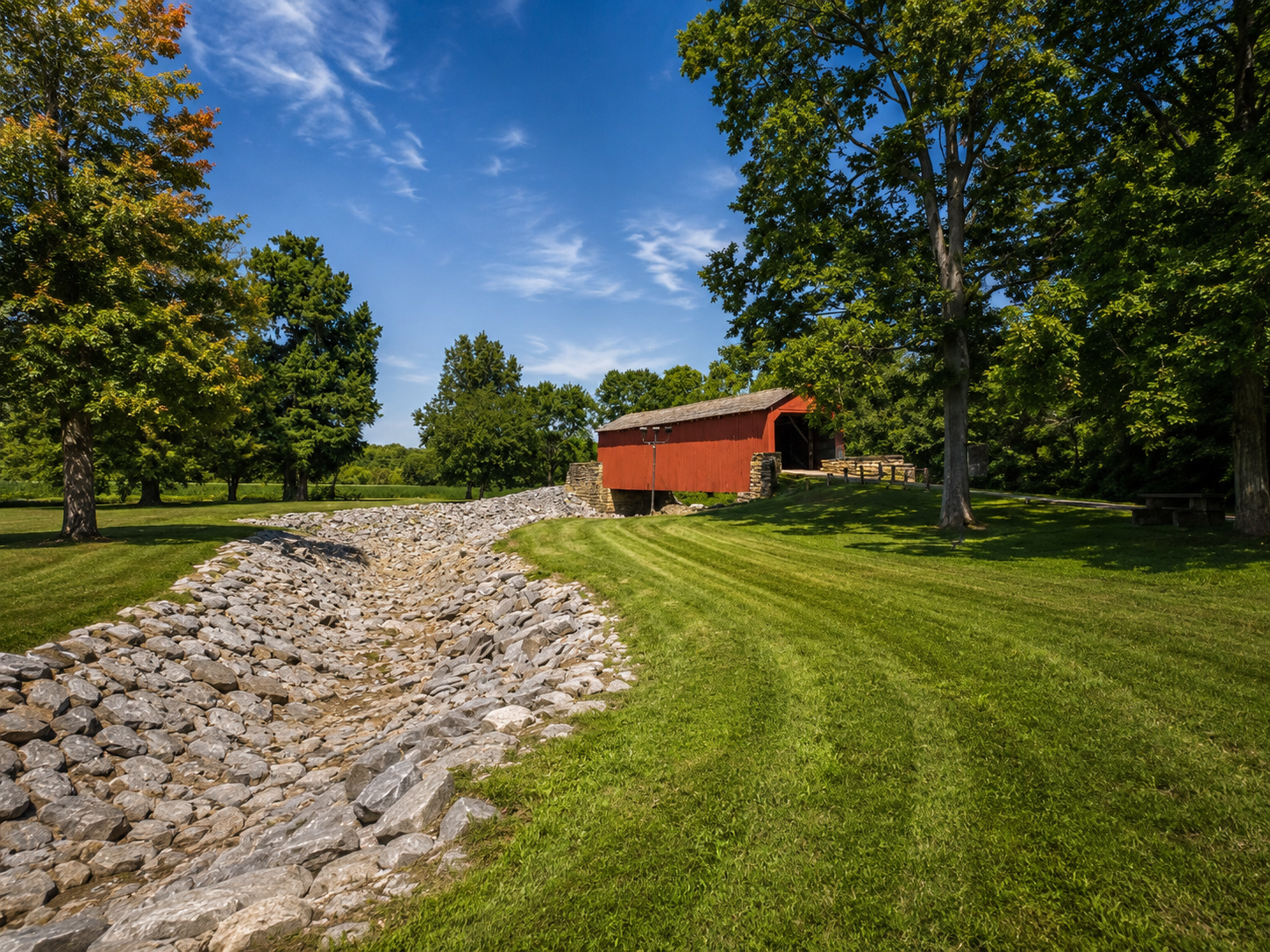
The first photograph was deliberately rough. But honestly, I kind of liked it. I made a very wide scouting frame so I could see the entire scene at once. The bridge was relatively small, surrounded by a huge amount of blue sky, open freshly-mowed grass, a rocky drainage area, trees, road, and plenty of visual information competing for attention. Nobody would mistake it for a finished photograph, but that was not its job. It did exactly what I needed it to do: it showed me the scene.
More importantly, it showed me something I think photographers forget all the time: what made me stop is not necessarily the photograph. The bridge was my subject. I had not yet figured out what the photograph was. That distinction sounds too simple to matter, but it sits very close to the heart of composition. We see something interesting and assume that discovering the subject has done most of the work. There is a mountain, so we photograph the mountain. There is a flower, so we photograph the flower. There is an old truck, a person, a horse, a waterfall, or a covered bridge, and we point the camera toward it. We found the subject. Click.
Then we wonder why the photograph does not feel like what we saw. The subject is only raw material. Composition begins when we decide what, specifically, we want the photograph to say. I moved closer to the bridge.
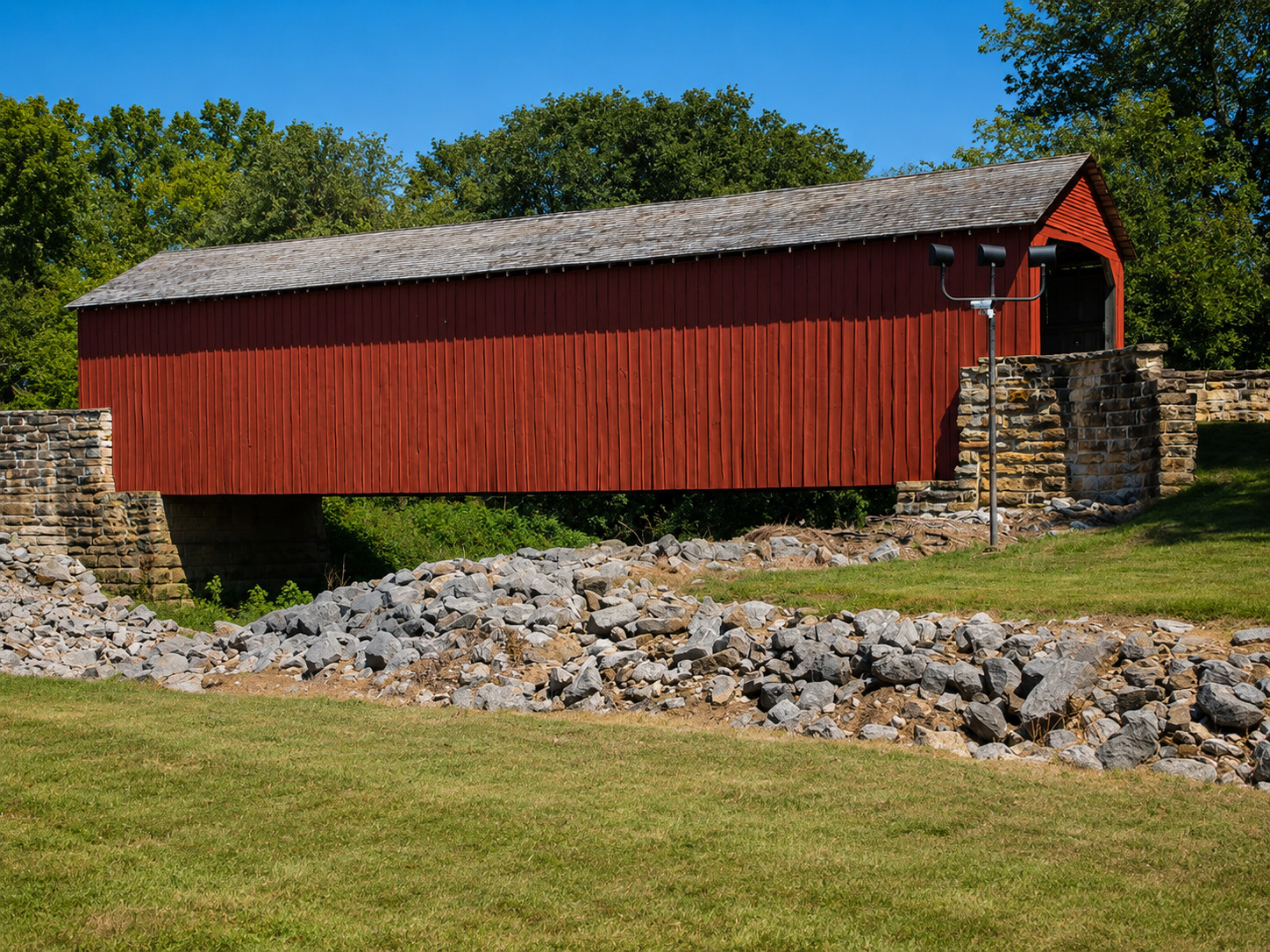
Immediately, the bridge gained importance. Its red siding became stronger in the frame, the stone supports became more obvious, and there was no longer much doubt about what I wanted you to look at.
That was better. It still was not good enough. A lot of the foreground grass was doing absolutely nothing. The rocky area was interesting but not particularly useful. Distractions cluttered the edges, and the photograph still felt like I had walked closer to an interesting object and photographed it. Remember that making the subject larger does not automatically improve the composition.
A photograph is not made stronger simply because the thing you care about occupies more pixels. Everything else inside the frame has to be considered too. A background can help or hurt. Empty space can breathe or simply sit there. A foreground can create depth or become an obstacle. A bright object can steal attention. A line can lead the eye somewhere useful or send it wandering directly out of the photograph. The rest of the frame needs a job. So I kept moving.
Eventually I worked my way toward the creek running underneath the bridge.
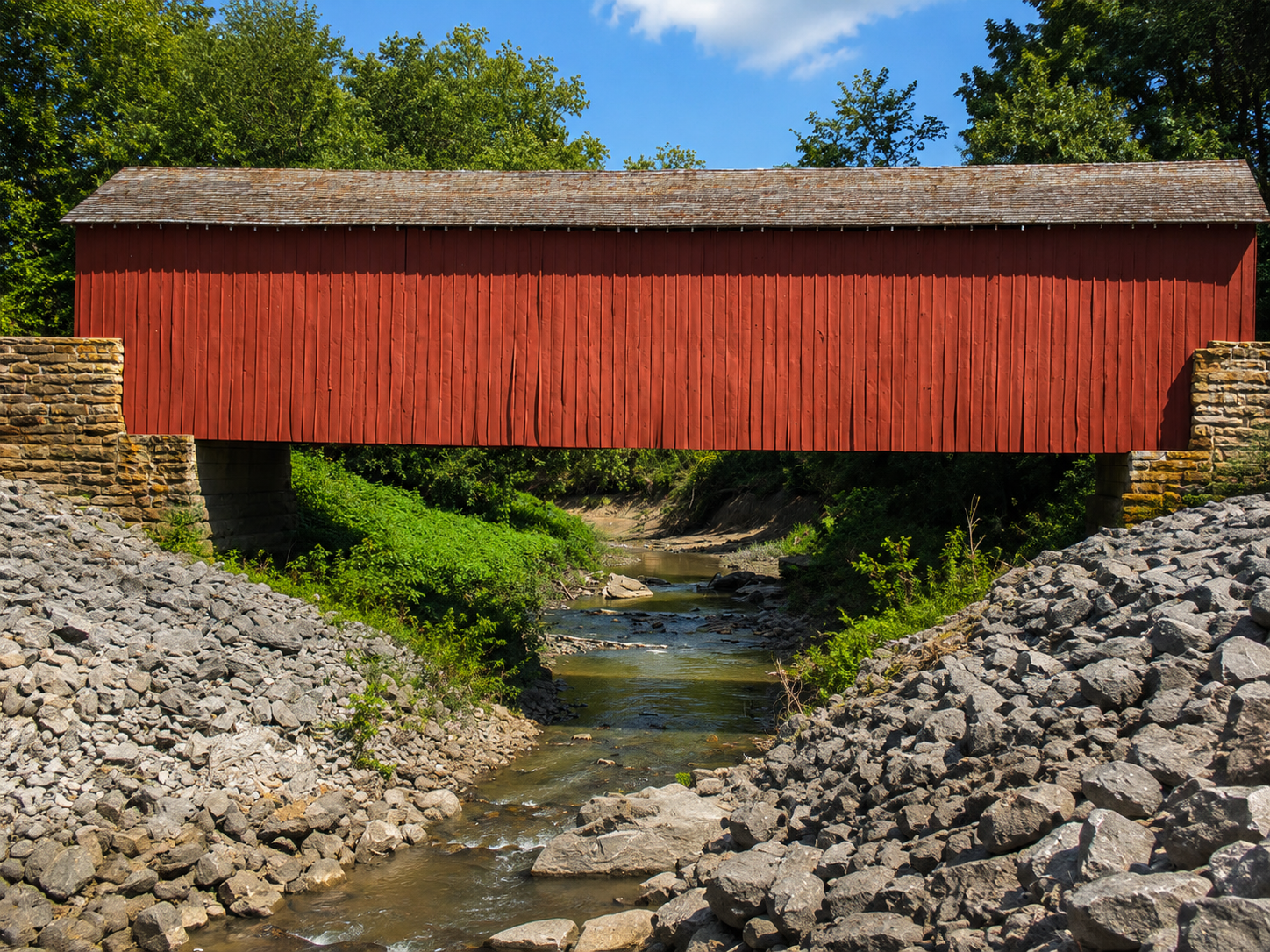
This was the first point where the picture started to feel different. The creek gave the photograph movement. Not literal movement in the sense of shutter speed, but visual movement. My eyes had somewhere to go. They entered near the foreground, followed the water between the rocks, and eventually disappeared beneath the bridge. The bridge was still the obvious subject, but now the scene had a relationship. That is one of the ideas I want to begin exploring more deliberately in Camera Dates, and I am going to call it Visual Path.
I am not trying to reinvent leading lines. Photographers have been talking about leading lines forever, and there is nothing wrong with the term. But Visual Path is a little broader than that. A photograph can have a path even without an obvious line. Your eye can move because of brightness, repeated shapes, faces, color, contrast, spacing, gesture, gaze, or changes in depth.
The question is not merely, “Do I have a leading line?” The better question is, “Where does my eye go?” Where does it enter the frame? What pulls it next? Does it eventually reach the thing I care about? Does it stop somewhere useful, or does it get dragged toward some irrelevant bright object in a corner?
In this particular frame, the creek had finally begun doing useful compositional work. It was no longer merely water under the bridge (pun intended). It was helping guide me through the picture.
Unfortunately, fixing one problem often reveals another. The rocks on the right side of the creek began becoming too important. They were close, bright, sharp, and full of texture. All of those things give an object visual weight. The foreground was helping create depth, but it was also starting to demand more attention than it deserved.
This is another concept I want us to keep revisiting: Foreground Weight. Photography advice often tells us to “add foreground interest.” That can be good advice, but it is incomplete. A foreground can add depth, create context, or pull the viewer into the scene. It can also become a giant distracting lump that dominates the picture. The lesson is not that foregrounds are good. The lesson is that foregrounds have weight. We need to decide how much.
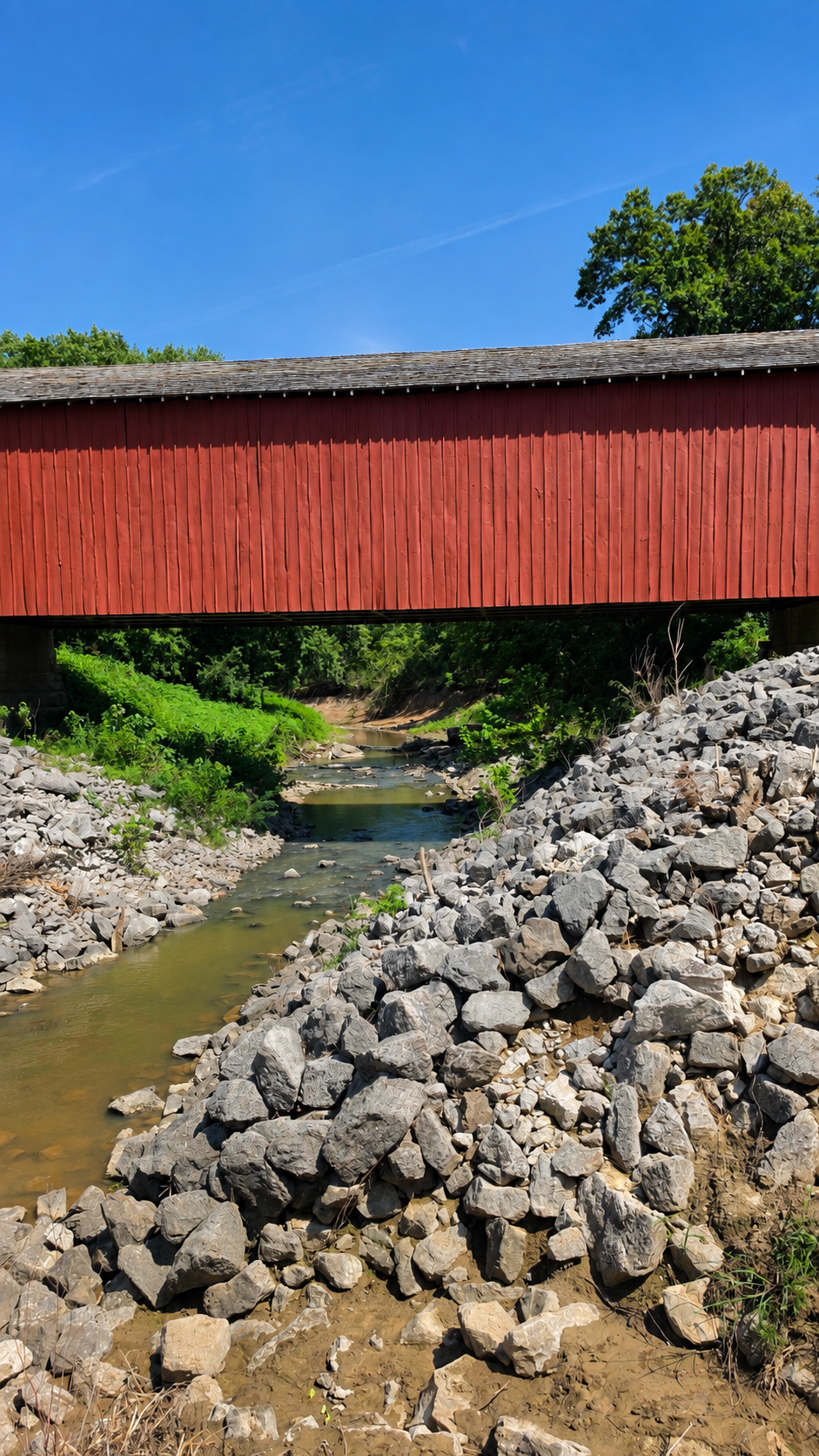
At one point I turned the camera vertically. The creek might benefit from the taller frame because it would have more room to travel from the foreground toward the bridge. That did happen. But something else happened too.
The vertical frame gave more importance to the rock bank and the sky. The bridge-and-creek relationship that had been working fairly well in the horizontal frame suddenly became less concentrated. This is why orientation is more than a formatting decision. Turning the camera vertically doesn't just remove the left and right sides. It changes every relationship inside the rectangle. The subject becomes bigger or smaller relative to the frame. Empty areas change. Foreground objects grow or shrink. Visual paths become longer or shorter. Things that felt balanced horizontally can suddenly feel awkward vertically. I went back to horizontal. Then I ran into another very sophisticated compositional obstacle: the creek.
I wanted to move farther left to reduce the visual weight of the rocks on the right and improve the angle of the water. The problem was that another step or two left would have put me onto some steep, jagged rocks, and if I wasn't too careful, directly in the creek with a broken camera. Sometimes reality blocks the ideal compositional move.
There are fences, roads, cliffs, private property, rivers, mud, traffic, people, and things with teeth. Photography advice can sound wonderfully simple when someone explains it from behind a desk. “Just move left.” “Just back up.” “Just get lower.” Sometimes you cannot. That does not mean the photograph is finished. It means you need another tool or process.
I am starting to think of these as Compositional Levers. Position is one lever. Camera height is another. Distance is another. Focal length, framing, depth of field, and timing can all become compositional tools too. The important part is that the tool follows the diagnosis. You do not change focal length because you are bored.
You change focal length because changing position would alter the relationship in a way you do not want, or because you need to change how much of the scene the frame includes. You do not open the aperture because shallow depth of field looks professional. You open the aperture because the background competes with the subject, and reduced depth of field may solve that specific problem. Diagnose the problem first. Then choose the lever most likely to change it.
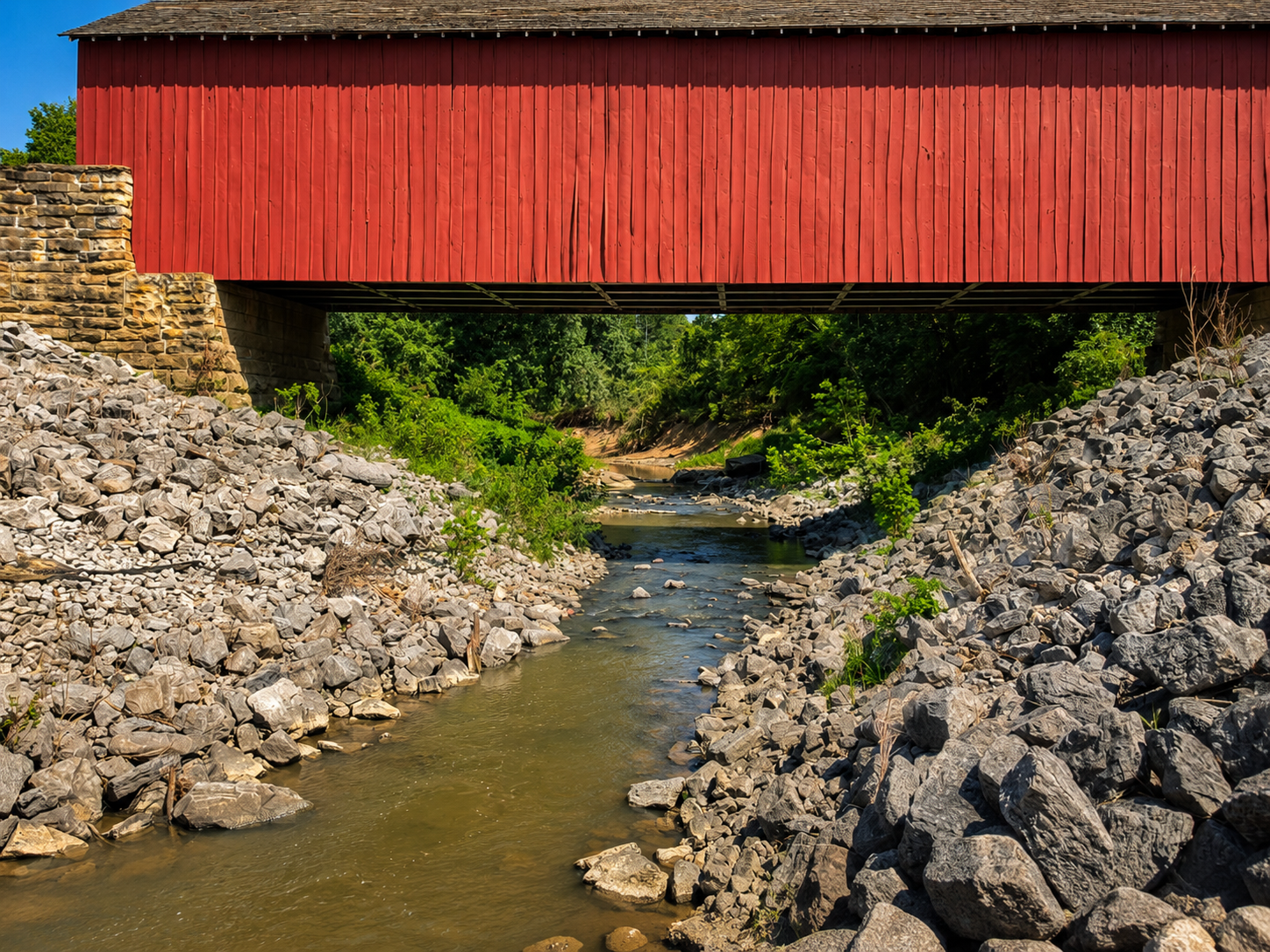
Since I could not safely move farther left, I tightened the framing instead. That became my favorite version of that particular idea. And that phrase matters: that particular idea. I was still not sure it was my favorite photograph of the bridge. So instead of endlessly refining the same composition by inches, I stopped and walked around. That changed everything.
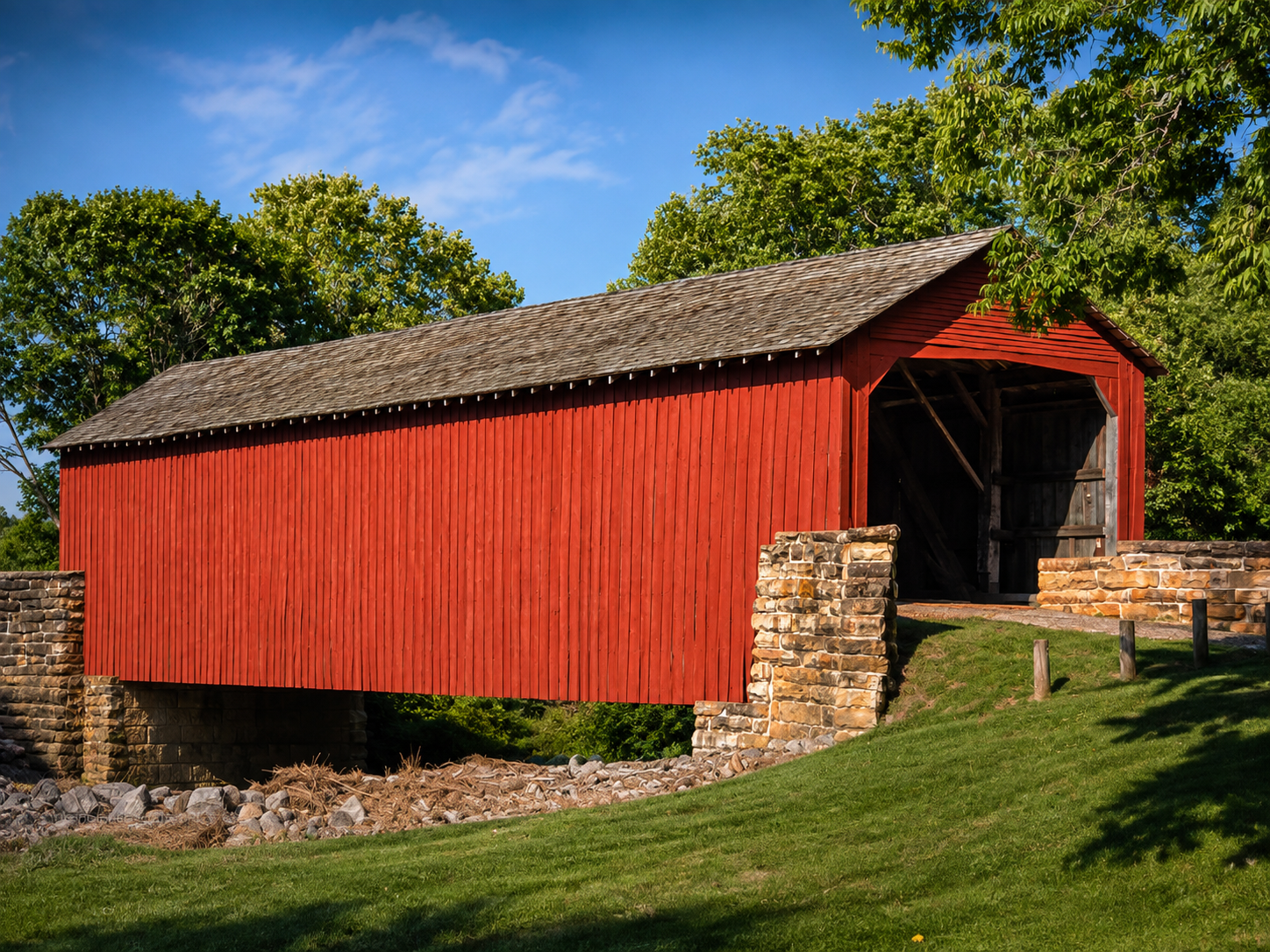
From a different position, the bridge stopped being a structure above a creek and became a portrait of itself. The long red siding, the stone support, the dark entrance, and the surrounding summer trees all started working together in a new way. The bridge had more personality. It felt less like a wall and more like a place. Then I walked toward the entrance.
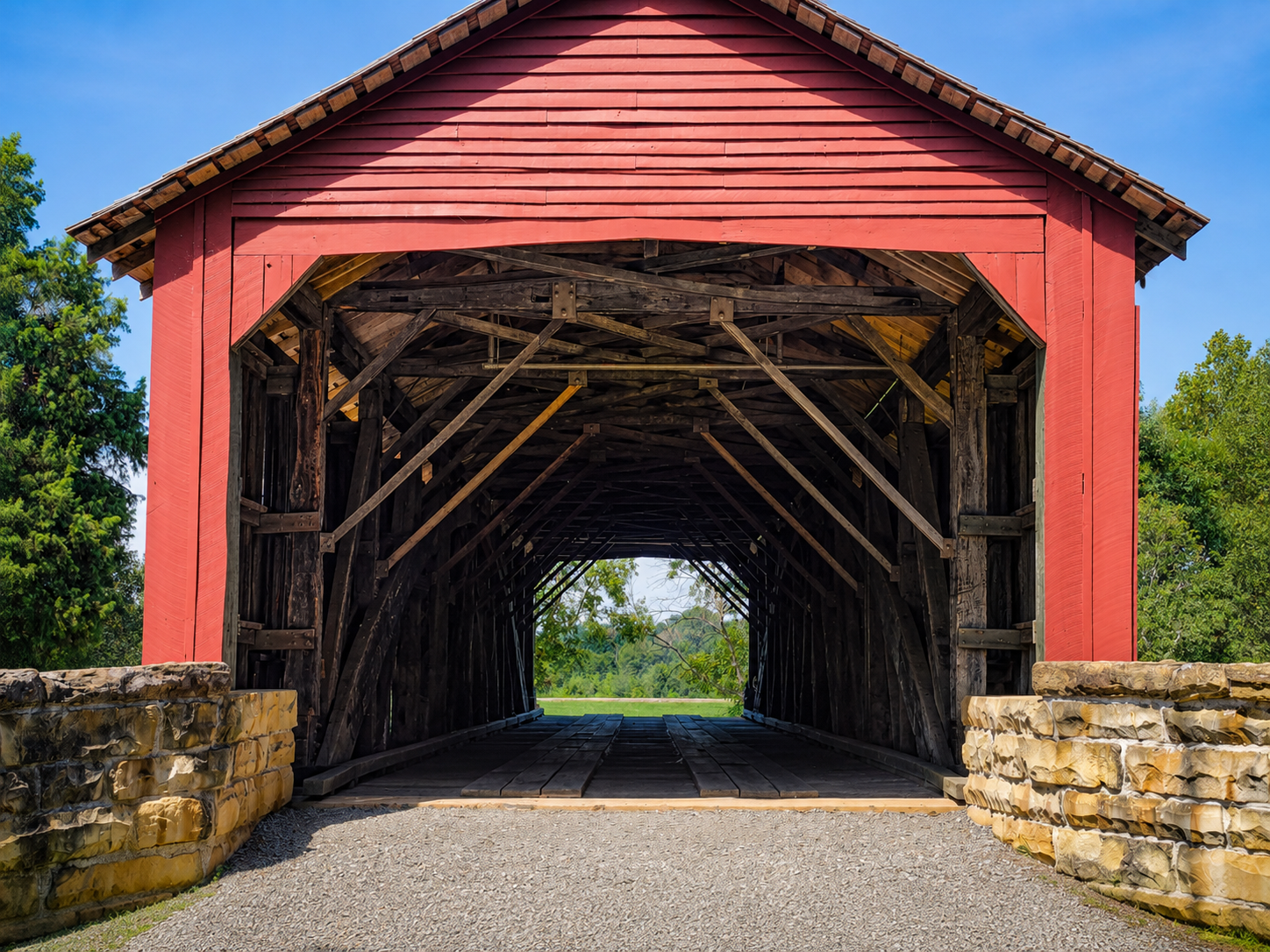
Now I had another photograph entirely. The dark opening became important. Repeating timber braces created rhythm and direction inside the structure. The bright rectangle at the opposite end gave the eye a destination. Same bridge. Different photograph. Later I made a tighter photograph of the creek underneath.
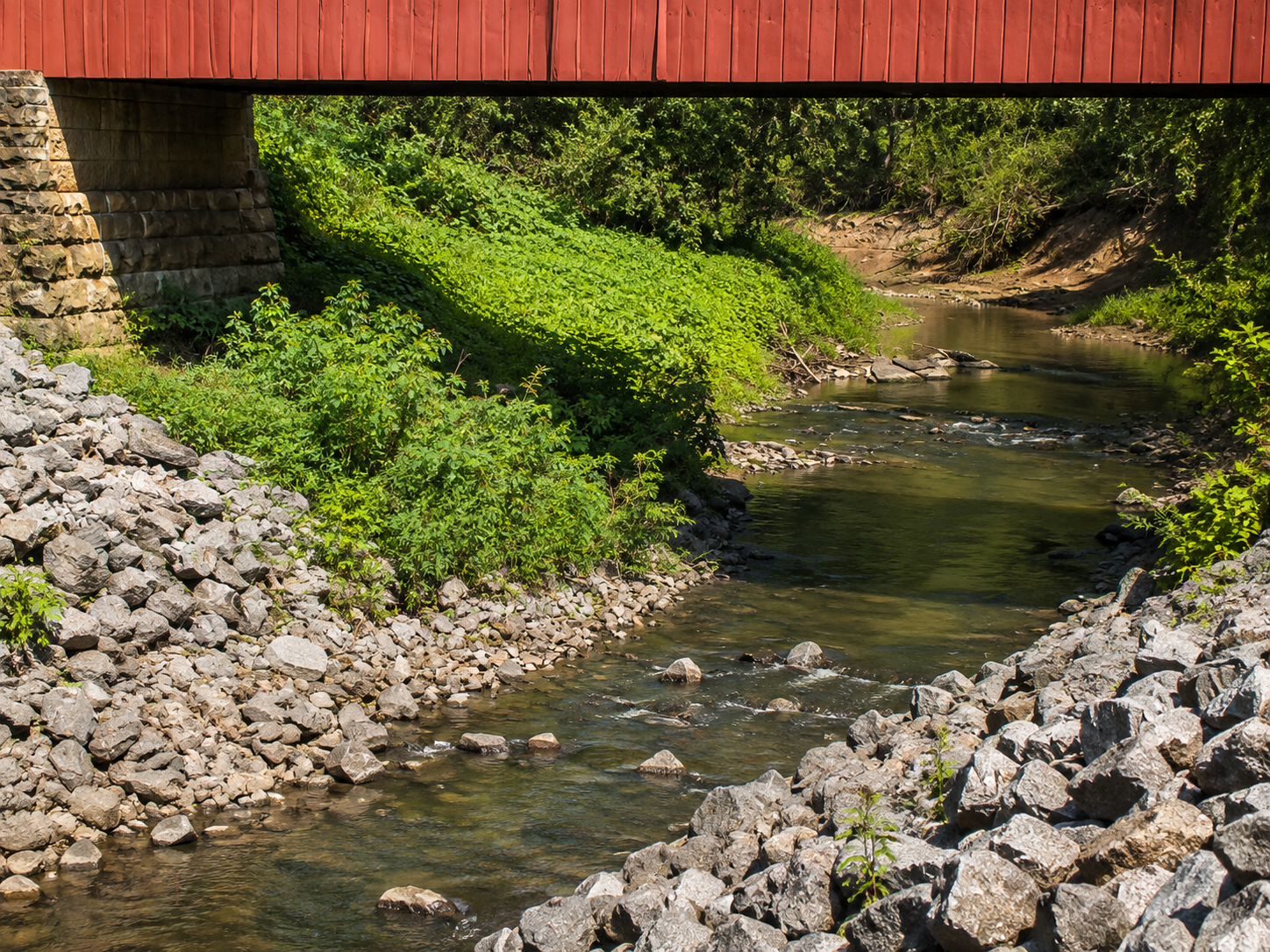
Now the bridge was barely the subject at all. It had become context. The creek was the photograph. That was the moment when the lesson finally became clear to me, because I had spent the entire time thinking I was trying to make a better photograph of a covered bridge. Somewhere along the way, without really planning it, I had stopped photographing the bridge and started looking for photographs within the scene around it.
One Subject Can Hold Many Photographs
A covered bridge is a subject, but a subject can contain dozens of possible photographs. The creek disappearing beneath the red bridge is one photograph. The dark wooden tunnel ending in a small patch of daylight is another. The long red structure surrounded by summer-green trees is another. The stone foundation might become the photograph if the light catches it correctly. The weathered wood and repeating boards could become a study in texture and pattern. A reflection in still water might completely change the scene's balance. Snow sitting on the roof could simplify everything around it, while fog moving beneath the bridge might soften the landscape and turn an otherwise ordinary view into something entirely different.
The Photograph Changes When the Decision Changes
None of those photographs requires the bridge itself to change. What changes is what the photographer decides. That distinction matters, because we often approach a subject as though there must be one correct way to photograph it. We look for the best angle, the best side, or the classic view. But perhaps the better question is not, “What is the best photograph of this bridge?” Maybe it is, “What is interesting here right now?” The answer can change with our position, the light, the weather, the season, the people around us, and even with what happens to catch our attention that particular day.
That also explains why simply finding a beautiful or interesting subject is never quite enough. A photographer can stand in front of something extraordinary and still make an ordinary photograph. The subject supplies the raw material, but it does not make the decisions for us. We still have to decide what deserves emphasis, what to exclude, how the elements should relate to one another, where the viewer's eye should travel, and how much of the surrounding environment helps tell the story we are trying to show.
The tighter creek photograph made that especially obvious to me. If I had become obsessed with making sure everyone could clearly see this was a covered bridge, I would never have made that frame. I would have backed up, included more red siding, shown more of the roof, and made the bridge recognizable again. Instead, I allowed most of the bridge to disappear. Just enough remained to give the water a setting and a little mystery. In that photograph, the bridge was doing an important job without needing to be the star.
I want us to grow more comfortable with this idea in Camera Dates: that the main subject doesn't always have to be the most obvious element in the frame. Instead, it can serve as context, with details or the environment taking center stage. Often, an environment can be more compelling than the initial object that caught our attention. Sometimes, the best choice is to abandon the original concept of the photograph we had in mind.
The subject gives us possibilities. Composition is the process of choosing among them. It decides which relationships matter, which details deserve attention, what gets included, what gets left outside the rectangle, and ultimately what the photograph is actually about. The covered bridge gave me a reason to pull over. It gave me the raw material. But I had to stay with it long enough to discover that the bridge itself was only the beginning.
The Subject Is Not the Photograph
This is where composition begins. Not with the rule of thirds, not with leading lines, and not by deciding that a landscape automatically needs foreground interest because somebody online told you it does. Those ideas can be useful, and they can become part of the Compositional Levers available to you, but they should come after the more important question: what matters in this photograph?
That may sound almost embarrassingly simple, but look at what happened during this little roadside stop. I started with a bridge. The first frame basically said, “There is a covered bridge over there.” Then I moved closer; the creek became important, the foreground eventually became too important, the orientation changed the relationships, and finally my physical position reached its limit. I could not keep moving left without falling into the creek, so I had to change another variable. Later I stopped trying to perfect that one composition altogether and walked around the bridge, where completely different photographs began to appear.
At each stage, the picture became stronger when the purpose became more specific. The more clearly I understood what I wanted the photograph to be about, the easier it became to decide what to keep, what to cut, and what needed to change. That is the direction I want Camera Dates to keep exploring.
I do not want composition to become another giant collection of rules photographers are expected to memorize. Photography already has plenty of those. Instead, I would rather spend more time noticing what is actually happening inside the frame and finding practical ways to describe it.
In this shoot, two ideas kept coming back. One was Visual Path: where the eye enters the photograph, how it moves through the frame, and where it eventually settles. The other was Foreground Weight: how a foreground can help create depth and direction, but can also become so large, bright, or detailed that it begins competing with the subject.
Those are not rules. They are simply things to notice. And the more clearly we can recognize what is happening inside a photograph, the easier it becomes to decide what to change.
That is how composition starts feeling less like luck and more like something we can actively build. And that is where I want Camera Dates to go a little deeper. The information itself is not the destination. The doing is. You can read about foregrounds all day long, memorize ten composition rules, or watch thirty videos explaining leading lines. Eventually you still have to stand somewhere with a camera and decide what belongs inside the rectangle.
Then you have to make the photograph.
Work the Subject Until You Find the Photograph
One of the things I liked most about this little experiment was that I did not leave with one definitive answer. I left with several possible photographs hiding inside one subject, and that changed the way I think about the phrase “work the scene.”
Working a scene does not always mean finding one composition and polishing it until you cannot move another inch. Sometimes it means staying with a subject long enough to discover what photographs it contains. The first frame says, “Something here caught my attention.” The next question is, “What exactly?” From there, the decisions begin.
What is helping the idea? What is weakening it? What carries too much visual weight? Where does the eye travel? What can I change? Where can I move? What happens if I change orientation? Is this empty area helping the photograph breathe, or is it simply empty? Is that foreground pulling me into the frame, or blocking me from getting there?
Those questions are not rules. They are ways of looking. And eventually, they lead to another question that I think will become increasingly important around Camera Dates.
Which one is the Keeper?
Every Camera Date should ultimately move toward that. Not twenty photographs because the assignment required twenty. Not proof that you successfully demonstrated the rule of thirds. Not a technically clean file you don't actually care about. The goal is to make one photograph that you deliberately constructed and genuinely want to keep. That was my original intent. To guide you to see that one keeper and get it.
Sometimes the Keeper will happen quickly. Sometimes it will take twenty frames. Sometimes you may stay with a subject for half an hour and finally admit the photograph you wanted wasn't there that day. That does not mean you wasted your time. Learning when a composition isn't working, and why, is part of becoming a better photographer too.
I still have not made my great covered bridge Keeper. At least I do not think I have. Maybe someday I will find myself standing beside the Goodpasture Covered Bridge in Oregon with snow on its roof, Christmas lights glowing against the red wood, and fog drifting along the McKenzie River. The conditions I have imagined for years will finally come together, and the photograph will be waiting exactly where I hoped it would be. Or I may get there and discover that the photograph I imagined is not the photograph at all.
Maybe the snow will not come. Maybe the fog will be somewhere else. The light may fall on a piece of stonework instead of the bridge. The photograph may be inside the structure, looking outward, or down beside the river where the bridge becomes only a small piece of something larger. I hope, by then, I will know not to force it. Because the subject is only where the photograph begins, the real work starts when you decide what matters, what belongs, and what you are actually trying to make.
Shoot What Matters
Jonathan Charles
Camera Dates