Make It Yours
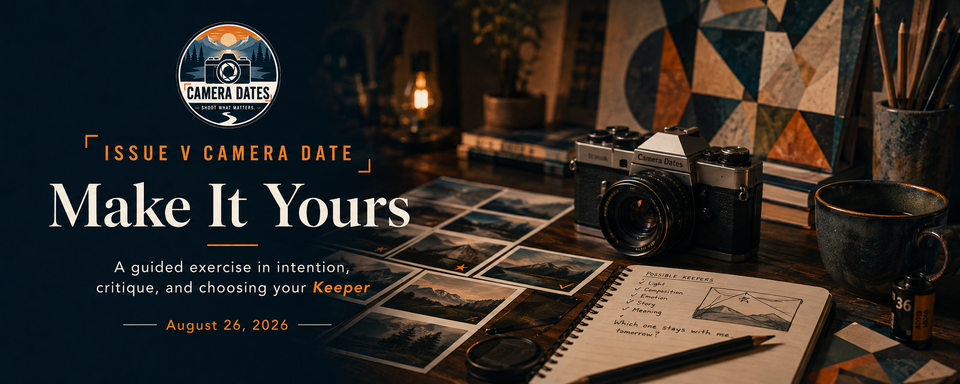
At a point in photography, the question begins to change. At first, we spend a lot of time wondering whether the photograph is technically correct. Is it sharp? Is the exposure right? Did I use the correct aperture? Is the horizon straight? Those questions matter, especially while we are learning, and I do not want to dismiss any of them. Technical knowledge gives us control. It helps us make the photograph we intended instead of accepting whatever the camera happened to give us. Eventually, though, another question begins to matter even more:
Is this actually the photograph I wanted to make?
That is where this Camera Date begins.
In Issue V, Did Picasso Need Your Approval? I explored the difference between useful criticism and somebody else’s personal preference. Other people are allowed to dislike your photographs, but they are also capable of seeing real weaknesses that you missed. Those two truths can exist at the same time. Learning to tell the difference takes more than becoming confident enough to ignore everybody. You need to understand your own photograph well enough to recognize what you were trying to accomplish, which decisions helped you get there, and which parts aren't working.
Today we are going to work toward that by slowing the photographic process down. You will notice what attracted you, decide what matters, make a photograph, study what happened, refine your choices, and eventually choose one frame that you genuinely want to keep. None of those ideas is especially complicated on its own, and I don't want this to feel like some rigid six-step formula you must memorize before you are allowed to photograph anything. What I do want is for a useful rhythm to begin forming. You may notice that rhythm showing up more often in Camera Dates from here on because it gives us something practical to fall back on when the picture in front of us is not quite there yet. For now, forget about memorizing a system. Take your camera, give yourself some time, and work through the process with me.
Start With Something You Actually Care About
Use whatever camera you normally photograph with. A dedicated camera is wonderful, but your phone is completely acceptable. This Camera Date has very little to do with what equipment you own and a great deal to do with what happens before and after you press the shutter. In fact, if the camera you know best is the one in your pocket, use it. I want your attention on the photograph, not on learning unfamiliar equipment.
Give yourself enough time so you don't feel rushed. Forty-five minutes to an hour would be excellent, although there is nothing magical about that number. If you become interested in what you are doing and an hour turns into two, congratulations, you have apparently discovered one of the hazards of a Camera Date. Choose a person, landscape, pet, flower, building, street scene, still life, something around your house, or almost anything else that genuinely makes you want to pick up the camera. Avoid choosing something merely because it seems easy for an assignment. If the whole point of this exercise is learning to trust and develop your own photographic judgment, we should begin with something you actually want to photograph.
Once you find it, resist the familiar reflex to immediately raise the camera. Stay where you are for a moment and simply look. You'll have plenty of time to take photographs. Right now, I want you to understand why you are about to make one.
Notice Before You Decide
Spend a few minutes with the subject before making the first frame, and try to identify what made you stop. Perhaps the light is beautiful. Maybe there is an expression you want to capture, an unusual shape, an interesting relationship between two objects, a color that seems to dominate the scene, or simply a feeling you cannot explain very well yet. You do not need to produce an artist statement. You are only trying to catch yourself in the act of noticing.
Try finishing this sentence in your head or writing it down if that helps: I want this photograph to feel __________. “Quiet” is perfectly good. So are “funny,” “warm,” “lonely,” “huge,” “simple,” “chaotic,” “old,” “joyful,” “uncomfortable,” or whatever else honestly describes what pulled you toward the scene. Then answer one more question: What matters most in this photograph?
Those two answers give you direction. Without direction, photography can easily become a pile of random adjustments. Move here, change aperture, zoom in, zoom out, brighten it, crop it, try another angle, and eventually one of the frames looks pretty good. There is nothing wrong with discovering a photograph through experimentation, and we are going to experiment plenty today. The difference is that we will begin asking whether each change moves the image closer to the photograph you were trying to make. That is where experimentation starts becoming decision-making.
Make the Photograph You Would Normally Make
Now pick up the camera and make the photograph as you normally would. Do not deliberately become artistic, strange, unconventional, or rebellious because this issue happens to be about personal taste. You do not earn extra credit for placing the horizon at forty-seven degrees and turning everything purple. Make the sensible photograph you would have made if I had never given you this assignment. It isn't really about Pablo Picasso at all.
Choose your position, and compose carefully. Put focus where you believe it belongs, check the background and edges, and set exposure appropriately for the scene. If something is obviously wrong, correct it and make another frame. This first photograph becomes your baseline, so give it a fair chance. We are not trying to create a weak version just so the later one can look clever by comparison.
Once you have it, study the photograph for a while. Don't ask whether it is “good” yet, because that question is too broad to help us much. Ask whether it represents what first caught your attention. Does it feel the way you hoped it would feel? Is the thing you decided matters most actually receiving enough attention? Has something else unexpectedly become dominant? Is anything inside the frame fighting against the idea you had before raising the camera?
This is a process we'll return to often in Camera Dates: make the photograph, then let the photograph tell you what it knows.
Use the back screen for more than checking whether the camera fired. If the display shuts off too quickly, most cameras allow you to increase the review time, or you can simply press the playback button and take as long as you need. If you really enjoy slowing down and studying what is happening like me, bring a tablet or laptop and transfer a few images during the session. You don't need to do that every time you photograph, but there is something valuable about seeing a larger frame while the subject is still standing in front of you. However you choose to review it, give yourself enough time to actually see what the camera recorded rather than glancing at the screen for half a second and moving on.
Decide What Needs to Change
Now look at that first photograph and identify the single change most likely to move it closer to your original intention. The subject may need more room, or perhaps less. Moving closer could create intimacy, while stepping farther away could make the subject feel isolated or small. Darkening the exposure might strengthen a quiet or dramatic mood, while raising it could make the scene feel lighter and more inviting. A different camera position may clean up the background. A slower shutter might introduce useful motion. A wider aperture may simplify the surroundings, while greater depth of field could make the environment part of the story. Don't rush this!
Also, do not change all of those things at once. Choose one.
That restraint is important because we want to know what each change actually did. Make one deliberate move or adjustment and photograph again, and put the new frame beside your starting image. Did it take you closer to what you wanted? If it did, you now know something useful about the scene. If it made the picture worse, you know something useful too. Go back, protect what was already working, and try another solution. If you are sure, you can also delete frames directly in the camera body, but be cautious if you practice this.
This is not a contest where every new frame has to improve on the last one. Sometimes the best thing a photograph can teach you is, “Nope, don't do that again.” The important part is that the next decision now has a reason behind it.
Find the Edge of Your Own Taste
Once you find a change that seems to improve the photograph, push that idea a little farther than you normally would. Give yourself permission to test the limit. Add more negative space. Go darker. Move closer. Shift the subject farther off-center. Then compare the results and notice where the choice stops helping and starts hurting the photograph. Sometimes the easiest way to understand what you like is to go slightly too far and then come back.
If more negative space improved the photograph, make another frame with noticeably more. If darker felt better, go darker. If getting close created intimacy, move surprisingly close. If placing the subject away from the center created tension or direction, keep moving it until you start wondering whether you have gone too far. Then look at the photographs together instead of judging each one in isolation.
You are not trying to make a deliberately bad photograph. You are finding the boundary of your own taste. Perhaps the original now looks too cautious. Maybe the extreme version is ridiculous. Somewhere between those two may be a balance that feels unmistakably right to you. On the other hand, you may discover that your first, safer choice was stronger all along, and you finally understand why.
Either outcome is useful. The purpose of this exercise is not to turn you into an unconventional photographer. It is to stop making “conventional” or “unconventional” the goal at all. We are trying to understand what a choice does to the photograph and whether you actually want that result.
Let the Photograph Show You What Every Choice Costs
Now choose one photographic decision people commonly have strong opinions about and give both sides a fair chance. You might compare centered and off-center composition, brighter and darker exposure, shallow and deeper depth of field, strong and restrained contrast, generous negative space and a tighter frame, frozen motion and intentional blur, or quieter color against something more vivid.
Make both versions seriously. Do not secretly sabotage one so the answer comes out the way you expected. Give each photograph enough attention that you could honestly choose either one if it worked. The trick here is to slow down with intent to learn what you truly like. You must, or this will never work.
Study what each choice gives you and what it takes away. More negative space may increase isolation but reduce immediate visual impact. Centering the subject might produce wonderful stillness while removing a sense of movement. A darker exposure can strengthen atmosphere but sacrifice information you ultimately need. Blur can add energy and life while obscuring the exact expression or gesture that matters most. Shallow depth of field can simplify a background beautifully, but it can also remove context that helped explain why the subject mattered in the first place.
Almost every photographic decision is a trade. That is something I want Camera Dates to keep exploring because it moves us beyond asking whether a technique is “good” or “bad.” A technique does something. Once you understand what it gives the photograph and what it asks you to surrender in return, you can decide whether the trade is worth making.
Separate Your Choices From Your Mistakes
Now we need to become a little less forgiving. Take the photographs you currently like best and examine them for anything you did not choose. Maybe focus missed slightly, a bright object near the edge escaped your attention, or a pole merged awkwardly with someone’s head. Your shutter speed may have allowed movement you never intended, the horizon could be drifting when you wanted it level, highlights may have disappeared because exposure got away from you, or an odd color cast may have come from white balance rather than from any deliberate creative choice.
Slow down and scan the frame methodically, almost the way you would work through a spreadsheet: top to bottom, left to right, then back again. Pay attention to anything that grabs your eye for the wrong reason. When something bothers you, do not just register that it feels off. Ask why it is pulling your attention and whether it is interfering with the photograph you meant to make.
The goal here is not to hunt for flaws until you ruin the picture for yourself. Quite the opposite actually. It is to separate the things you deliberately chose from the things that simply slipped past you. This is way different from another person simply disliking your composition.
This distinction is at the heart of this Issue. Personal style does not require pretending every accident was a brave creative decision. The more comfortable you become recognizing genuine mistakes, the more confidently you can stand behind the things you really did choose. You no longer need “art is subjective” as armor because you are willing to say, “Yes, I missed that,” when you actually did.
When you discover something accidental that weakens the photograph, fix it if the scene still allows you to. Make another frame and look carefully at what changed. You did not alter the photograph because someone gave you a rule to obey. You recognized that something interfered with your own intention, and you corrected it. That is the kind of judgment we are trying to build.
Now Stop Experimenting and Build the Photograph
Eventually, experimentation has to give way to commitment. Look at everything the subject has taught you so far. Return to the reason you stopped in the first place, the feeling you wanted, and the element you decided mattered most. Think about which experiments strengthened those ideas and which ones merely created different photographs without actually improving the one you wanted.
Now build a photograph deliberately. Choose where the camera belongs and how close you should be. Decide how much of the environment deserves to remain in the frame. Check the background and all four edges. Pay attention to the light and decide what needs to be sharp. Consider whether movement adds anything. Choose how bright or dark the photograph should feel. If you make an unconventional choice, you don't need permission, but you should know what it contributes. You do not need to explain any of this to anyone standing beside you. You do not need a paragraph defending why the subject is centered or why the shadows are dark. But you should know.
Make the photograph and study it. If something still needs attention, make another. Maybe a small adjustment will finish it. Maybe the light changes. Perhaps an expression finally arrives. Maybe the version you thought was finished reveals one annoying object at the edge when you slow down and look again. Keep working until you believe you have taken the idea as far as you reasonably can today, not until some arbitrary frame count says you are finished.
This is where the Camera Date begins moving toward something I want us to pursue more intentionally: The Keeper.
The Keeper is not the photograph proving that you completed an assignment. It is the frame you deliberately worked toward and genuinely want to keep. Some you will find quickly. Other times you will work for an hour and discover that the photograph you imagined simply is not available under the conditions you want. That is okay too. Learning to recognize when the Keeper is not there is much more useful than forcing yourself to declare one simply because the exercise has reached the bottom of the page.
Before Anybody Else Gets a Vote
When you think you have your Keeper, don't post it immediately. Before social media, a camera club, a spouse, or anyone else gets a say, give yourself the first critique. You spent the whole session learning to understand the photograph, so don't hand that job away at the finish line.
If you can, step away from the image and come back with fresher eyes. A larger screen helps, and even twenty minutes of distance can reveal things you missed while still caught up in making it. Start with what's working. Be specific. Maybe the expression landed exactly right. Maybe the empty space creates the loneliness you were after, or the darker exposure supports the mood, or the background finally feels quiet enough to let the subject carry the frame.
Then look for uncertainty. What still bothers you? Does your eye keep returning somewhere for the wrong reason? Is the frame a little loose? Is an edge carrying information you no longer need? Does the photo feel flat because the contrast isn't supporting the mood? Would a small change in exposure, color, or crop help it say what you intended more clearly?
This is where editing comes in, carefully. The goal isn't to rebuild a weak photograph on the computer or rescue decisions you could have made better at the scene. You already did the hard work. Now you're finishing. A crop can tighten relationships that are already there, but it can't invent space you never captured. An exposure tweak can refine mood, but it can't recreate light that never existed. Editing strengthens a photograph best when the photograph already knows what it wants to be.
Ask yourself one more question before making any change: would I still want this adjustment if nobody else were ever going to see the photograph? Sometimes you already know what needs to change before anyone says a word. Other times, you like the image just fine until someone else's preference makes you doubt a choice you were perfectly comfortable with.
Before moving on, answer a few things for yourself. What is the photograph actually about? What should someone notice first? What should it feel like? Which decision contributes most to its success? What, if anything, would you still change because you believe it would make the photo stronger? Now you know what you believe before anyone else starts telling you what they believe.
Give Someone Else a Look
If possible, find one person whose opinion you respect and show them the Keeper. They do not need to be a photographer. In fact, somebody who knows absolutely nothing about photography rules can provide wonderful feedback because they respond to the picture instead of immediately diagnosing it with a composition chart. Do not explain the photograph before they see it. Let them meet it cold. Then, instead of asking the nearly useless question “Do you like it?”, ask what they noticed first. Ask what kind of feeling the photograph gives them and whether anything keeps pulling their attention away. If the conversation feels useful, ask what they might change.
Then listen.
Suppose you wanted the subject to feel isolated and they tell you there is far too much empty space. That is worth hearing, but it may simply mean they prefer tighter compositions. The empty space may be doing exactly what you intended. Now suppose they say, “I keep looking at that bright red sign in the corner.” That deserves another kind of attention. You wanted the eye to settle on an isolated subject, but another element is winning the competition. Their reaction may have uncovered something you genuinely missed.
That is why all the work we did at the beginning matters. Without an intention, both comments are merely opinions. Once you understand what you were trying to accomplish, you have something useful to judge the feedback against.
You Still Make the Final Decision
Return to your photograph after you have heard what they had to say. Perhaps their reaction exposed something you cannot unsee now. Great. If the criticism reveals a real weakness and you can fix it, fix it. Maybe their suggestion produces a version that communicates your original idea more clearly than yours did. Use it. There is no prize for stubbornness, and refusing every suggestion is no more artistic than accepting all of them.
At the same time, you are under no obligation to alter the photograph simply because another person would have made it differently. They may prefer brighter images, tighter crops, shallow depth of field, smiling portraits, centered subjects, muted colors, saturated colors, or any of a thousand other things. Those preferences are real and perfectly legitimate. So are yours.
The important part is that you now have a reason for whichever decision you make. You listened, examined the photograph honestly, compared the feedback with what you were trying to accomplish, and then decided whether anything actually needed to change.
That is authorship. It is not shouting everyone else down. It is keeping responsibility for the final photograph where it belongs.
Look at Where You Started
Before ending the Camera Date, put your original baseline photograph beside the Keeper. This comparison can teach you far more than simply asking which one is better. Look at what happened as the idea became clearer. Perhaps the final photograph looks dramatically different from the first. Perhaps it barely looks different at all. You may even have worked your way through ten experiments only to return almost to the original composition, except now you understand exactly why that composition works, and that is what counts. Camera Dates should never force a predetermined result. I am not trying to make every final photograph strange, artistic, rule-breaking, or visibly transformed. I am building your ability to understand the decisions that produced it. There is a meaningful difference between stumbling onto a photograph you happen to like and recognizing why it works well enough to make another deliberate decision afterward. We are moving toward the latter.
Your Keeper
Save the photograph you chose and live with it a while. You may still love it in six months, or wonder next year what you were thinking. Both are normal. Developing taste means your judgment changes as you grow. A photo doesn't have to stay your favorite forever to have taught you something today.
What matters is the process that got you here. You noticed something worth photographing, stopped to decide what attracted you, and made a starting frame instead of guessing endlessly. You let that photo inform you, changed things for a reason, and explored far enough to find the edges of your own taste. You weighed what your choices gave you against what they cost. You told genuine mistakes apart from deliberate decisions, refined the shot, critiqued it yourself, listened to another view, and still owned the final call. That's worth a lot more than just asking if someone likes your picture.
We'll keep building on this. Over time, Camera Dates will develop a practical rhythm: notice, decide, make, review, refine, and get better at knowing when a photo is done. I don't want this to become a rigid formula. Photography is too alive for that, and different subjects and photographers will always ask for different things. What I want is for you to have somewhere to go mentally when a photo is almost working and you're not sure what's next. Confidence isn't knowing a frame will work beforehand. It's knowing what to do when it doesn't.
One more lesson from this Camera Date. Other people can help you see, pointing out mistakes, challenging a choice, or catching a distraction you stared past for forty five minutes. Let them. Listen closely, then return to the image and make the call that's yours to make. If the Keeper still feels like yours after the noise settles, keep it.
Last thought: this is still supposed to be fun. All this slowing down and comparing exists to make photography more satisfying, not to turn it into homework. If it starts feeling heavier than the photo itself, ease up. Curiosity and play are still core to Camera Dates.
And this deliberateness won't last forever. We're slowing things down now so you can see the decisions being made. The more you work this way, the less effort it will take. Checking edges, spotting what pulls your eye, knowing what to change, these will become instinctive. What takes minutes of conscious thought today may soon happen almost automatically through the viewfinder.
The goal isn't to analyze the life out of photography. It's to practice these decisions until they stop feeling like a process, so you simply start seeing more clearly, reacting more confidently, and having more fun.