Did I Use the Right Aperture?
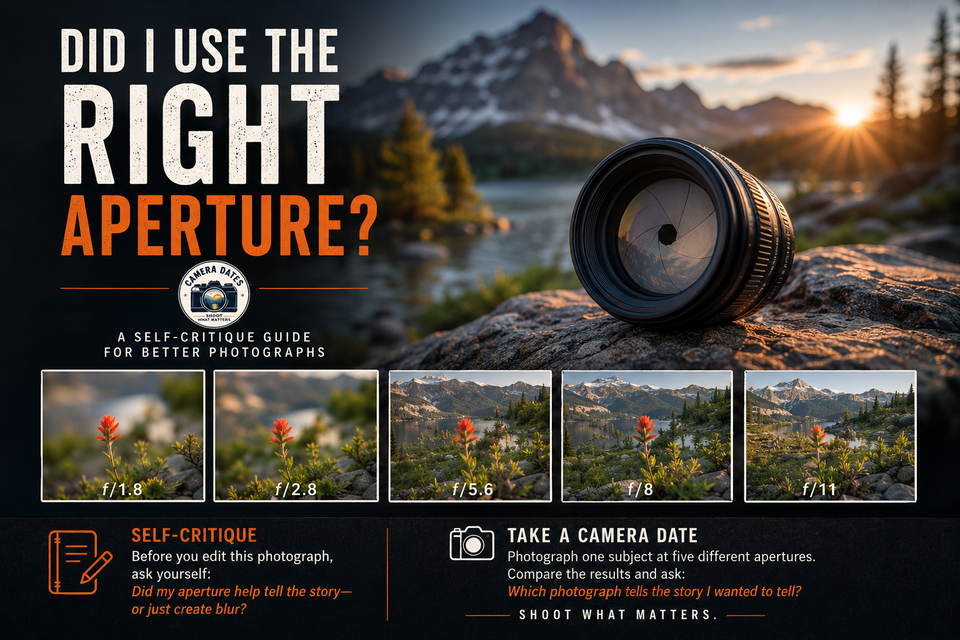
One of the most important questions I have learned to ask myself does not happen before I press the shutter. It happens after.
Not: Was this a good photograph? Not even: Do I like this image? Instead, I ask something much simpler, and on the surface much more technical.
Did I use the right aperture?
Here is the thing, though. It only sounds like a technical question. What it actually is, once you sit with it long enough, is a storytelling question. And that distinction changes everything about how you learn from your own photography.
Every Aperture Tells a Different Story
One of the biggest mistakes photographers make early on is believing there is a correct aperture for every situation. A magic number that produces the right result if you can just figure out what it is. Photography forums are full of questions like this. What is the best aperture for landscapes? What aperture should I use for portraits? What number should I always use?
The honest answer is that those questions do not have a single answer, and chasing one will hold you back longer than almost anything else.
There is no correct aperture. There is only the aperture that best supports the story you are trying to tell. And only you know what that story is, because the camera certainly does not.
Here is a simple example that makes this real. Imagine you are photographing a single daisy growing in a field.
At f/2.8, the flower stands completely alone against a soft, creamy background. Every distraction melts away. The petals are sharp, and the world behind them disappears into a gentle blur. Your eye has nowhere to go but the flower itself.
Now photograph the exact same daisy at f/11. Suddenly the surrounding meadow becomes part of the story. The wildflowers scattered nearby, the distant fence line, the rolling hills behind it, and all of it comes into focus and begins to explain where this flower actually lives and what kind of world it belongs to.
Neither photograph is wrong. They are simply two different stories about the same subject, taken on the same afternoon in the same light. The only thing that changed was a single number on a dial, and the result is two completely different photographs with two completely different feelings.
That is the power of aperture. Not as a technical setting but as a storytelling tool.
The Question Worth Asking
Here is a habit that has helped me grow more than almost anything else I have tried.
Before I touch a single editing slider after a shoot, I sit with the photographs first. I study them. I look at where the sharpness begins and where it falls away. I notice where my eye lands when I first look at the image, and whether that is where I actually intended it to go.
And then I ask myself one honest question. If I could go back thirty seconds before I pressed the shutter, would I choose the same aperture again? Sometimes the answer is yes, and that is genuinely useful to know. It means the instinct was right and the decision was sound.
But sometimes I look at an image and realize I blurred a background that actually would have added important context to the story. Other times I see that too much was in focus and my subject had to compete with everything else in the frame for the viewer's attention, a battle my subject did not win.
That single question, asked honestly and without judgment, teaches me more than simply deleting a weak image and moving on ever could. Every photograph becomes a small lesson in the decision that made it, for better or worse.
Learn From the Photograph You Already Took
The most underused tool in digital photography is not a setting or a piece of gear. It is the photograph you already made, sitting right there on your screen, full of information about what you decided, why, and whether it worked.
Zoom in. Study the details. Notice where sharpness begins and where it fades. Ask yourself whether your eye naturally travels to where you intended it to go when you pressed the shutter. If it does, understand why. If it does not, get curious about that instead of frustrated.
The goal of this kind of review is not self-criticism. It is educating yourself. There is a significant difference between those two things, and the photographers who grow consistently are the ones who have learned to sit in that difference without letting one slide into the other.
The best photographers do not just celebrate their favorite images. They learn the most from the ones that almost worked, the photographs where something was close but not quite right, where the story was there but the aperture told a slightly different one than intended. Those almost images are where the real education lives.
The Photograph Is Finished. The Lesson Is Not.
When I come home from a Camera Date, I do not just review my photographs. I review my decisions. Every composition. Every lens choice. Every aperture. Not because I enjoy second-guessing myself, but because every decision I made out there contains something I can take with me next time.
That is how experience actually builds. Not by taking thousands of photographs and calling it practice. But by learning something genuine from every one of them, even the quiet, ordinary ones that will never leave your hard drive.
One thoughtful question at a time.
Camera Date Challenge
Find a single subject today. A flower, a coffee mug, a mailbox, a bicycle leaning against a wall, anything will do. Without changing your position or your composition, photograph it at five different apertures, from as wide open as your lens will go to as closed down as it will allow.
When you get home, do not ask which photograph is the sharpest. Sharpness is not the point here. Ask yourself something better. Which photograph tells the story I actually wanted to tell? And then, more importantly, write down why.
The lesson is not in the aperture. The lesson is learning to see what your aperture did, and understanding for the first time that you were always in control of that decision.
Shoot What Matters.
Jonathan Charles