What Is Composition? Start Here. Come Back Often.
Close your eyes for a second and think about the last image that genuinely stopped you. Maybe it was a photograph. Maybe it was a painting hanging in a room you were just passing through. Maybe it was a scene through a window on a drive somewhere that made you wish you had pulled over.
Something about it landed. Something made you look longer than you meant to. And I would be willing to bet that if you tried to explain why, the words came slowly. Because the thing that made it work was not something you could easily name. It was something you felt first.
That feeling has a name. It is composition. And it is older than photography by several thousand years. Long before a camera existed, mankind was making deliberate decisions about what to put inside a frame and what to leave out.
Painters agonized over it. Architects built entire careers on understanding it. Sculptors thought as carefully about the empty space around a form as they did about the form itself. The principles that made Michelangelo step back from a ceiling and know in his bones that something was working are the exact same principles that make a photograph reach through a screen and grab you by the collar.
You inherited all of that the moment you picked up a camera. Every great image ever made was built on this foundation. The question is not whether composition matters. The question is whether you are ready to take it seriously.
Because once you do, everything changes.
What Composition Actually Is
Composition is not a checklist. It is not a set of rules you apply like a filter after the fact. It is the act of deciding, consciously or instinctively, what goes inside the frame and what stays outside it. Every photograph you have ever taken was a compositional decision, whether you made it deliberately or not.
When you raise the camera, you are drawing a rectangle around a piece of the world and saying this. This part matters. Everything outside this rectangle can wait.
That is an extraordinary act when you think about it. You are editing reality in real time. You are making an argument about what deserves attention. You are, in the most fundamental sense of the word, creating something that did not exist before you stood in that exact spot and looked in that exact direction.
Composition is how you make that argument as powerfully as possible.
The Rule of Thirds. Where Everyone Starts and Nobody Should Stop.
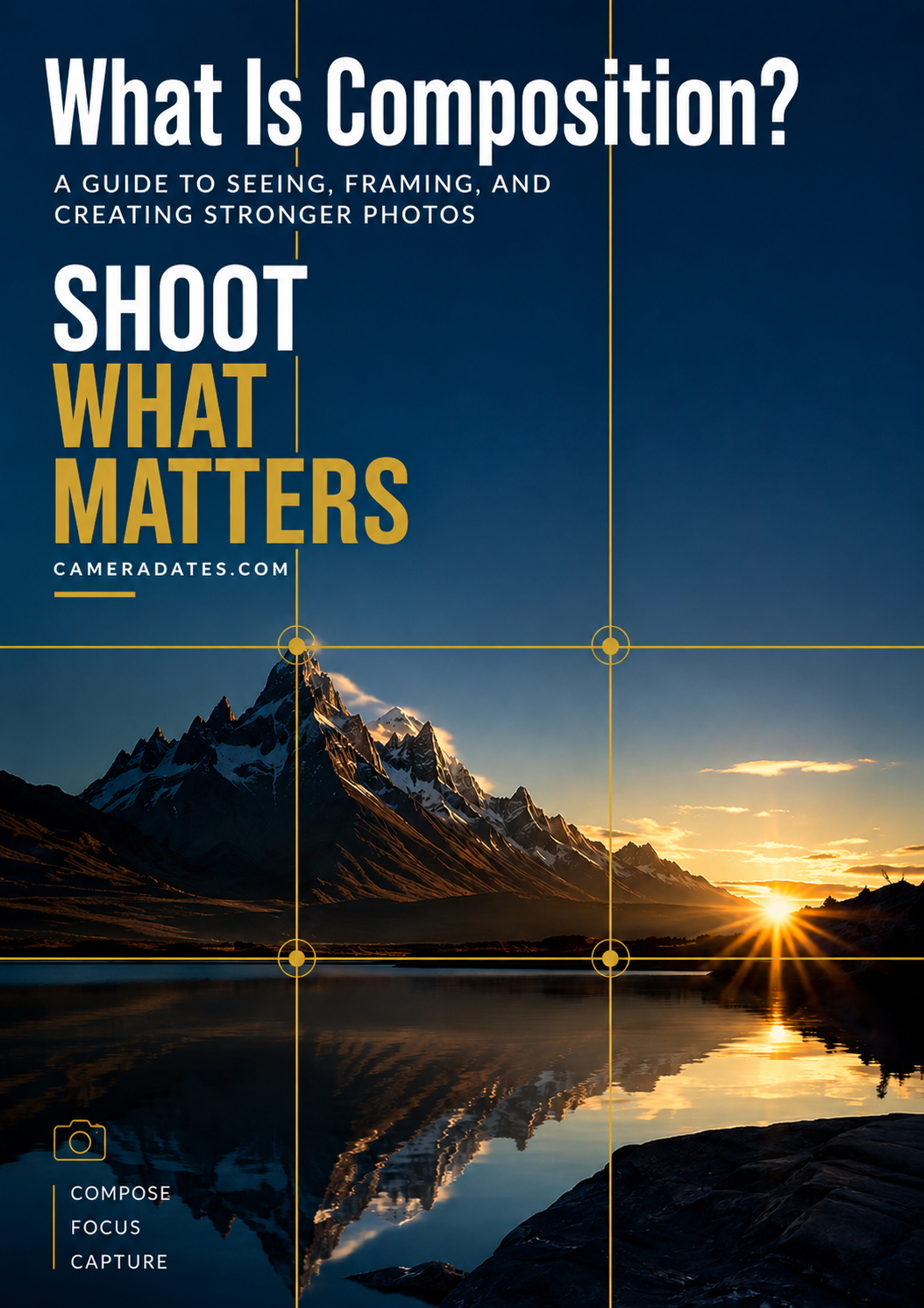
If you have spent any time learning photography you have heard of the rule of thirds. Divide your frame into a grid of nine equal rectangles, three across and three down. The four points where those lines intersect are called the power points, and placing your subject on or near one of them tends to create a more dynamic, visually interesting image than placing it dead center.
This works. It genuinely works, and it works because of something deep in the way human eyes move across a visual field. We do not look at images the way we look at spreadsheets, left to right, top to bottom, orderly and sequential. Our eyes jump. They are drawn to contrast, to edges, to faces, to the brightest part of the frame. The rule of thirds puts your subject somewhere our eyes are naturally inclined to travel.
But here is what the rule of thirds is not. It is not a guarantee. It is not a substitute for actually seeing. It is a starting point, a training wheel that teaches your eye to stop defaulting to the center of the frame for no better reason than that the center is easy to find.
Use it until it becomes instinct. Then start breaking it on purpose and see what happens.
A centered subject, held with confidence and the right framing around it, can be one of the most powerful compositions in photography. Symmetry has an authority that the rule of thirds cannot always match. The rule exists to serve the photograph. Not the other way around.
Balance and Tension. The Push and Pull of a Great Frame.
Every element you place inside your frame has visual weight. A bright object feels heavier than a dark one. A large shape feels heavier than a small one. A face feels heavier than almost anything else because the human eye is wired from birth to find and fixate on faces.
Balance in composition means distributing that visual weight in a way that feels intentional. A large subject on the left needs something on the right to keep the frame from feeling like it is tipping over. A bright sky needs something in the foreground to anchor it. A face looking out of frame creates tension because the eye follows the gaze and finds nothing, which is either deeply unsettling or quietly poetic depending on what you are going for.
Both balance and tension are valid. Both can serve a photograph beautifully. The difference is intention. A frame that feels unbalanced because you did not notice is a mistake. A frame that feels unbalanced because you chose it is a statement.
Know which one you are making before you press the shutter.
Lines. The Most Underestimated Tool You Have.
Lines are everywhere in photography and most photographers treat them as background furniture rather than compositional tools. A road. A fence. A river. The edge of a building. The horizon. The way a person's arm points across the frame. All of these are lines and all of them are doing something to the eye whether you acknowledge it or not.
Lines lead. That is their primary job in a composition. They pick up the eye at one point in the frame and carry it somewhere else. A well placed leading line brings the viewer into the image and deposits them exactly where you want them. A poorly considered line drags the eye right out of the frame before it ever finds the subject.
Diagonal lines create energy and movement. Horizontal lines create calm and stability. Vertical lines create strength and authority. Curved lines create grace and flow. These are not arbitrary associations. They are deeply embedded in the way we read the physical world, and they transfer directly into how we read photographs.
Before you take a shot, look for the lines in your scene. Ask where they are going. Ask whether they are helping you tell the story or quietly working against it.
Depth. Making a Flat Image Feel Three Dimensional.
A photograph is a two dimensional object trying to represent a three dimensional world. One of the great challenges of composition is creating the illusion of depth in a medium that does not actually have any.
The tools available to you are many. Foreground interest is one of the most powerful. Placing something in the near foreground, a rock, a flower, a person, anything with visual substance, immediately creates a sense of distance between the viewer and the background. The eye reads near and far and the brain fills in the space between them.
Overlapping elements do the same thing. When one object partially obscures another our brain interprets that as depth. Near things cover far things. That is how the physical world works and our visual system is so thoroughly trained on it that it reads the same logic instantly in a flat image.
Atmospheric perspective works over longer distances. Haze, fog, and the natural softening of distant objects all signal depth in a way that clear, sharp backgrounds do not. The further something is, the less contrast and detail it tends to have, and a photograph that captures that gradient feels genuinely three dimensional in a way that a perfectly sharp scene from edge to edge sometimes does not.
Simplicity. The Hardest Thing to Learn.
Here is the compositional lesson that takes the longest to sink in and matters the most once it does.
Less is almost always more.
Every element in your frame is competing for attention. Every bright patch, every busy background, every stray branch entering the corner of the image is asking the viewer to look at it instead of your subject. The more you allow into the frame, the harder your subject has to work to hold the attention it deserves.
The best photographers are ruthless about simplicity. They do not include something in the frame just because it was there. They include it because it earns its place. Because it adds to the story rather than muddying it. Because removing it would make the photograph weaker rather than cleaner.
Before you press the shutter, ask yourself one question about every significant element in your frame. Is this helping? If the answer is no, or even maybe, move your feet. Change your angle. Find the version of the shot where everything inside the rectangle is pulling in the same direction.
A simple photograph with a clear subject and intentional framing will always outlast a complicated one where interesting things are happening in too many places at once.
Put It All Together. Then Forget It.
Here is the paradox at the heart of compositional mastery. You have to learn all of this consciously, deliberately, almost academically, and then you have to let go of it entirely.
The goal is not to stand in front of a scene running through a mental checklist. Rule of thirds, check. Leading lines, check. Foreground interest, check. That is not photography. That is homework with a camera.
The goal is to internalise these principles so completely that they become the way you see. So that when something catches your eye you already know, before you fully understand why, whether the frame is working. So that your feet move instinctively to the better angle. So that your eye goes to the corners without being told.
That level of instinct takes time. It takes thousands of frames and honest self assessment and the willingness to look at your own work critically without letting it discourage you. But it comes. It always comes for the people who keep showing up.
Start with the basics. Come back to them often. They are not beginner material that you graduate from on the way to something more advanced.
They are the foundation that everything else is built on. And the foundation never stops mattering.
Shoot What Matters.