Why Great Photographers See in Rectangles, and You Probably Don't Yet
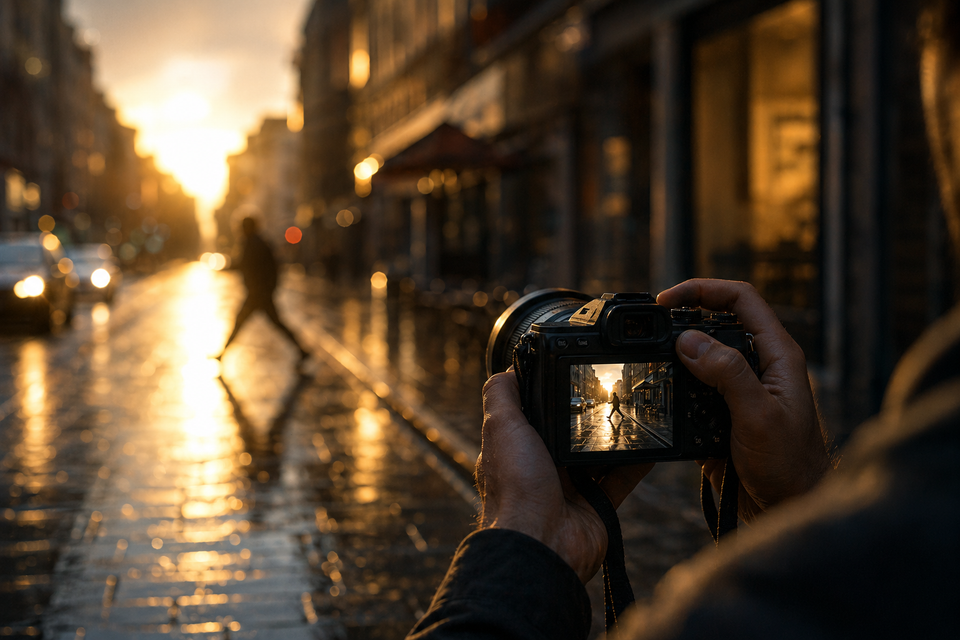
Most people look at the world in a general, sweeping, immersive way. Your eyes move. Your attention drifts. You take in a scene the way you take in a conversation, all at once, loosely, with your brain filling in the gaps.
A camera does not work that way. A camera sees a rectangle. A fixed, unforgiving, four cornered box with edges that do not care about your intentions. Everything inside those edges is the photograph. Everything outside them never existed.
Be honest, Have you ever truly thought in this manner?
Learning to see the way your camera sees is one of the most underrated skills in photography. And most people never fully develop it or think about the topic.
The Edge Problem
Here is where most photographs fall apart, not in the middle of the frame but at the edges.
Amateur photographers look at the center of their frame. They find their subject, they place it more or less where they want it, they press the shutter. What they forget to do is look at the corners. The edges. The places where the frame ends and the world gets cropped away.
And that is where the problems hide. The telephone pole growing out of someone's head. The bright patch of blown out sky in the upper left corner pulling the eye away from the subject. The stranger's arm entering the bottom right of the frame just enough to be distracting without being intentional.
Before you press the shutter, train yourself to do one thing. Look at every corner of your frame. Every single one. Ask yourself what is happening there and whether it is helping or hurting.
That habit alone will improve your photography more than any new piece of gear ever could.
Positive and Negative Space Are Having a Conversation
Every frame contains two kinds of space. The space occupied by your subject and the space that is not. Most photographers think about the first kind and ignore the second entirely.
But negative space is not empty. It is doing something. It is creating breathing room, or tension, or scale, or loneliness, or calm, depending on how you use it. A single figure in a vast landscape feels very different from a single figure in a tight, compressed frame. Same subject. Completely different photograph.
The masters of composition understood that negative space was not what was left over after they placed their subject. It was part of the design from the beginning. They shaped it deliberately the same way a sculptor thinks about the space around a form, not just the form itself.
Start looking at the empty parts of your frame with the same attention you give the full parts. Ask what the space is saying. Ask whether it is saying the right thing.
The Frame Within the Frame
One of the most powerful compositional tools available to you costs nothing and requires no technical knowledge whatsoever. It is simply this. Use elements within your scene to create a secondary frame around your subject.
A doorway. An arch. Tree branches overhead. A window. A tunnel. Two people on either side of your subject. These secondary frames do something remarkable to a photograph. They draw the eye inward. They create depth. They give the image a sense of place and context that a subject floating in open space rarely achieves on its own.
The world is full of natural frames if you start looking for them. And once you start looking you will not be able to stop seeing them everywhere.
Leading Lines and Where They Actually Lead
You have probably heard about leading lines. Roads, fences, rivers, hallways, anything that draws the eye from one part of the frame to another. They are one of the first compositional tools people learn and one of the most frequently misused.
The mistake is treating a leading line as the destination rather than the journey. A road disappearing into the distance is not interesting because of the road. It is interesting because of where the road is going and what it makes you feel about the journey. The line is a vehicle for emotion, not a compositional trick to check off a list.
Before you use a leading line ask yourself where it is actually leading the eye and whether that destination is worth the trip. A line that leads to a flat, uninteresting horizon is not a compositional success just because it technically qualifies as a leading line. The line needs to earn its place in the frame the same way every other element does.
The Most Important Thing Nobody Tells You About Composition
Rules of thirds, leading lines, negative space, frames within frames. These are tools, not laws. The photographers who made the images you love did not succeed because they followed the rules correctly. They succeeded because they understood the rules well enough to know exactly when breaking them would make the photograph more powerful.
A centered subject can be extraordinarily compelling. A tilted horizon can create tension that serves the image perfectly. A frame full of busy, competing elements can feel electric rather than cluttered if the energy is right.
The rules exist to give you a foundation. But the goal was never to build a foundation. The goal was always to build something on top of it. Learn the rules until they become instinct. Then start asking what happens when you push against them. That is where your voice as a photographer begins.
Camera Date:
Three Shots. One Subject. Right Now.
Do not wait for the perfect location. Do not wait for better light or a more interesting subject. Look up from whatever you are reading this on and find the first thing that catches your eye. A coffee mug. A window. Your dog asleep on the couch. A tree in the yard. Anything.
That is your subject. Now go take three shots.
Shot One. Just take it.
Do not overthink it. Raise the camera, frame it the way you naturally would, and shoot. This is your instinct shot. No adjustments, no second guessing. Just you and the first thing your eye did.
Then stop and look at it. Check the corners. What snuck in that you did not notice? Where did your eye land first? Is that where you wanted it to go?
Shot Two. Change one thing.
Just one. Move two feet to the left or right. Get lower or higher. Take a step closer or back up and give it more room to breathe. Change your angle entirely and see what the subject looks like from somewhere it has never been seen from before.
Same subject. Different conversation.
Look at this one next to the first. Something shifted. Maybe the background cleaned up. Maybe the light fell differently. Maybe the subject suddenly has context it did not have before. Notice what changed and ask yourself why it feels different.
Shot Three. Surprise yourself.
This one is yours to invent. Zoom all the way in and find a detail nobody would think to photograph. Or zoom all the way out and make the subject small in a big world. Get uncomfortably close. Shoot through something. Find a frame within the frame, a doorway, a window, a gap in the branches.
Do something with this shot that you would not normally do. Push past the comfortable version of the image and see what lives on the other side of it.
Now Compare All Three
Lay them side by side and just look. You shot the same subject three times and you have three completely different photographs. Same light, same location, same camera. The only variable was your feet and your curiosity.
That is the whole lesson right there.
Your best shot was probably not the first one. And the most interesting one was probably the third, the one where you stopped playing it safe.
Now go do it again with something else.
Shoot What Matters.