Put Away Your Camera. Pick Up Your Potential.
There is a moment during every Camera Date when the shutter clicks for the last time. The light is fading or the card is full or you are simply done for the day, satisfied or frustrated or somewhere in between. You pack up the gear, drive home, copy the files to the computer, flip through the images for a few minutes, edit a favorite or two, and move on.
Most photographers think that is the complete process. I used to think so too.
But what if we are skipping the most important part? What if becoming a better photographer has less to do with taking more photographs and more to do with genuinely learning from the ones you have already made? Spend some quality time with them.
Stop Judging Your Photographs. Start Studying Them.
There is a significant difference between those two things, and which one you do when you open your images will largely determine how fast you grow.
When most photographers sit down to review a shoot, they immediately slip into judge mode. Keep. Delete. Keep. Delete. The question running silently in the background is always the same. Is this photograph good enough? And while culling matters, and we have talked about that in a previous post, stopping there means leaving most of the value of the shoot on the table.
The better question, the one that changes everything, is this. What is this photograph trying to teach me?
That single shift in framing changes the entire conversation. Suddenly every image has something to offer, even the ones you will never share, never edit, and eventually delete. Every photograph you made on that Camera Date contains information about a decision you made, a decision that either worked or did not, and understanding which one and why is where the real growth lives.
Your photographs are not just memories. They are teachers. The better you listen to them, the faster you will improve.
Be Honest. Be Kind. Be Curious.
When you sit down to study your own work, all three of those things matter equally and in that order.
Honest, because growth requires an accurate picture of where you actually are, not a flattering one. Kind, because the goal of this exercise is not to confirm that you are a bad photographer. It is to become a better one, and you cannot get there by beating yourself up at every session. Curious, because the most useful questions are never accusatory. They are exploratory.
Here is a small but important distinction that has made a real difference in how I approach this. Instead of asking why did I mess this up, I ask what could I do differently next time. Those two questions feel similar on the surface. They are not. One creates a dead end. The other opens a door.
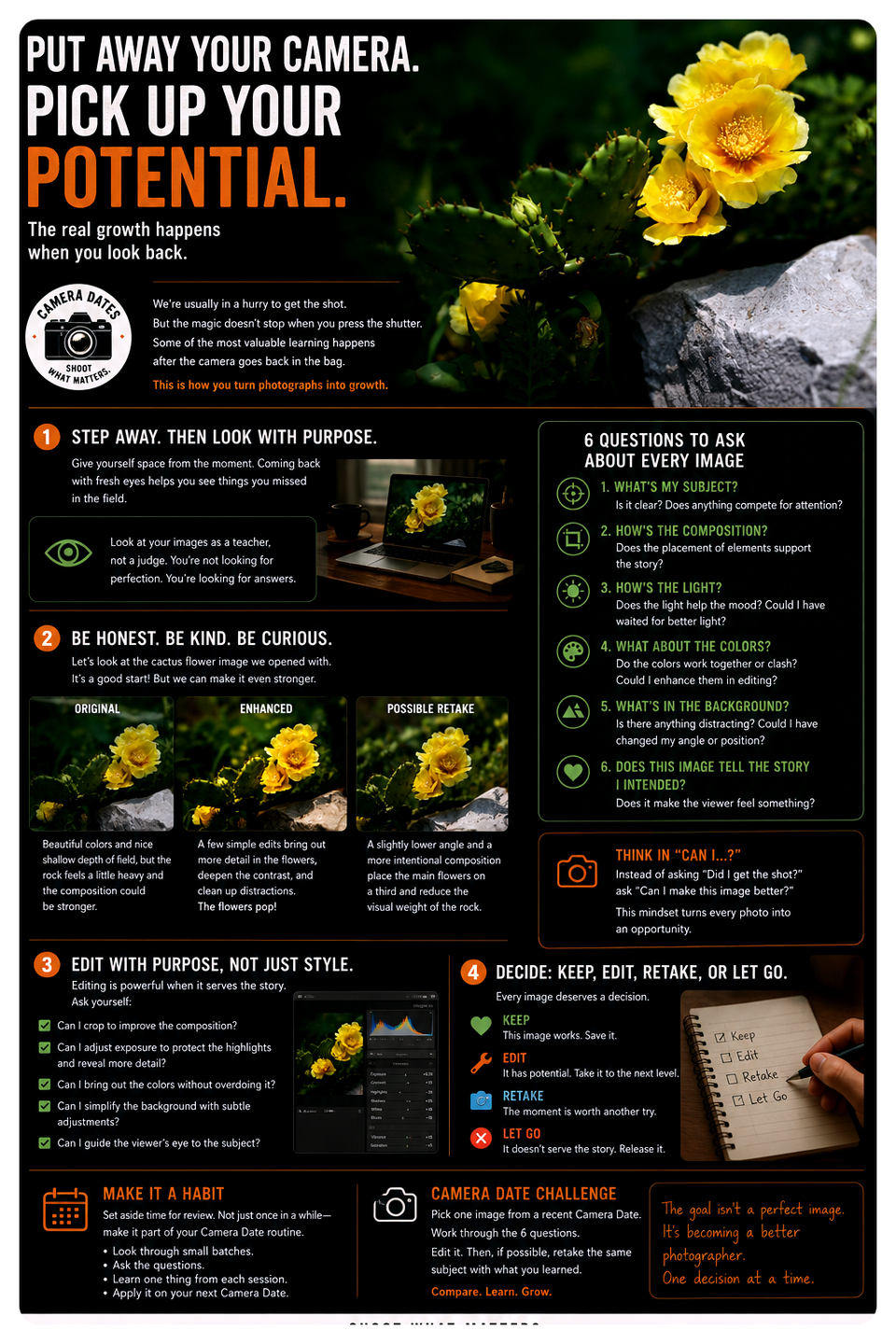
Ask Better Questions. Use the Cactus Flower.
Let me walk you through a real example. A couple of summers ago I came across this cactus in bloom and could not resist stopping to photograph it. If you have ever caught a cactus flower at the right moment you know exactly why. There is something almost absurd about something that prickly producing something that beautiful, and the yellow petals against the dark green backdrop stopped me in my tracks.
When I first came home with this image, I was pretty happy. The yellow flowers stand out beautifully against the darker background. The shallow depth of field does a nice job of separating the subject from what is behind it. The warm petals draw your eye immediately and hold it there. By almost any casual measure this is a good photograph and I felt good making it.
But then I sat down with it and started asking better questions. And that is where things got interesting.
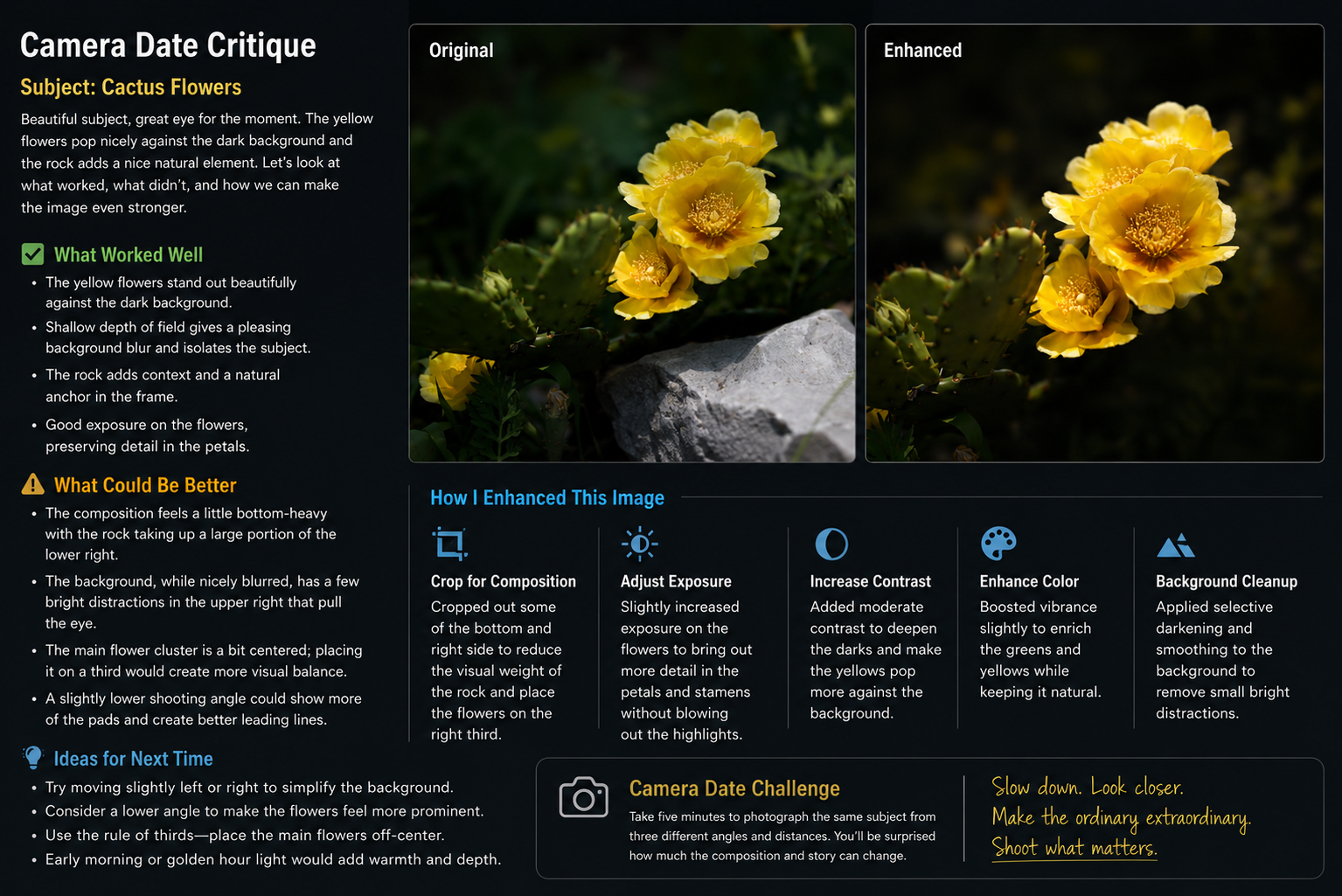
Does the rock in the lower right corner help the story, or does it pull the eye away from the flowers at a moment when the flowers should have the viewer's complete attention? Could one step to the left have simplified the composition and removed that visual weight entirely? Would a slightly lower shooting angle have made the flowers feel more prominent, more alive, more like the undisputed subject of the frame? Was there too much empty space pulling the composition off balance? Would waiting even five more minutes have given the light a softer, warmer quality that served those petals even better than what I got?
None of those questions mean the photograph failed. It did not fail. I still like it. But sitting with it honestly taught me something I carried into every cactus bloom I have photographed since. And that is exactly the point. The photograph gave me more than a memory. It gave me a lesson. But only because I was willing to ask the questions.
Edit With Purpose, Not With Hope
Sometimes after studying an image honestly you realize that what it needs is not a retake but a thoughtful edit. And editing done well is a genuinely powerful part of the photographic process, not a consolation prize for a shot that did not quite work.
A careful crop can dramatically strengthen a composition by removing a distracting element at the edge of the frame that you did not notice when you were shooting. A slight exposure adjustment can reveal detail hiding in the shadows or bring back highlight information that felt lost. Pulling back the highlights, opening up the shadows, adding a touch of contrast where the image feels flat, all of these can help your subject stand out and your story land more clearly.
But editing should always be purposeful. It should serve the story you were trying to tell, not invent a new one to replace the one that did not quite happen. If you find yourself spending twenty minutes trying to rescue an image in post, it is worth asking an honest question. Would the better investment be learning to see that improvement while you are still standing behind the camera?
Edit with purpose. Not with hope.
Would I Retake It?
This is my favorite question to ask at the end of a review session, and not because I want to replace every photograph I have ever made. I ask it because the answer teaches me how to prepare for the next shoot in a way that no tutorial or gear upgrade ever could.
If the flowers are still blooming, go back. If the old barn is still standing, go back. If the trail is ten minutes from your house, go back. The first visit taught you what to photograph. The second visit, armed with everything you learned the first time, teaches you how.
Some of the strongest photographs I have made came from a second attempt at a scene I had already shot once and studied carefully afterward. There is no rule that says your first visit to a location has to produce your best work from it.
Four Decisions Every Photograph Deserves
When I finish reviewing an image I try to land on one of four outcomes, and I have found that committing to one of these rather than leaving images in a kind of indefinite limbo keeps the whole process honest and moving forward.
Keep it (as is). The photograph is finished. It accomplished what you hoped it would and it belongs in your library as a completed piece of work.
Edit it. The photograph works but it has not reached its potential yet. Careful, purposeful editing will strengthen the story without changing the truth of it.
Retake it. The idea was sound but the execution was not quite there. You know exactly what you would do differently and the scene is worth returning to.
Let it go. Not every photograph deserves to live forever, and that is completely fine. Delete it, learn whatever it had to teach you, and move on without guilt.
Every photograph deserves one of those four outcomes. Not every photograph deserves a place in your portfolio. And the discipline of making that call cleanly, rather than leaving thousands of unreviewed images accumulating on a hard drive, is itself a skill worth building.
The Best Camera Date Happens at Home
When your Camera Date ends, do not rush toward the next one. Pour yourself a cup of coffee. Open your photographs. Turn off the television and give the images your actual attention, not the distracted, half present kind.
Spend thirty quiet minutes looking through your work with fresh eyes. Celebrate what worked, genuinely and specifically, because understanding why something succeeded is just as valuable as understanding why something did not. Study what fell short with curiosity rather than judgment. And before you close the computer, write down one thing, just one, that you will do differently on your next Camera Date. Not ten things. One.
Then take that one lesson out into the field with you next time and see what it does. That is how experience actually accumulates. Not by collecting thousands of photographs across hundreds of Camera Dates. By collecting tons of lessons, one honest review session at a time.
The camera is a wonderful tool. But your greatest growth as a photographer might not happen in the field at all. It might happen right here, at your desk, with a quiet cup of coffee and the willingness to ask one more question than you asked last time.
Camera Date Challenge
Tonight, put the camera away. Instead, open one recent Camera Date and review it with real intention. Choose five images and work through these six questions on each one. Pick up you favorite editor and have a little fun. The are all pretty forgiving.
What is my subject and is it immediately clear? How is the composition, does the placement of every element support the story? How is the light, did it help the mood or could I have waited for something better? What about the colors, do they work together or compete? What is in the background and is it helping or hurting? And finally, does this image actually tell the story I intended to tell?
Then make your decision. Keep it, edit it, retake it, or let it go.
Write down one lesson before you close the computer. Just one. Then carry it into your next Camera Date and see what happens.
You may discover that your greatest growth as a photographer does not happen in the field at all.
It happens right here.
Shoot What Matters | CameraDates.com