When One Exposure Isn't Enough
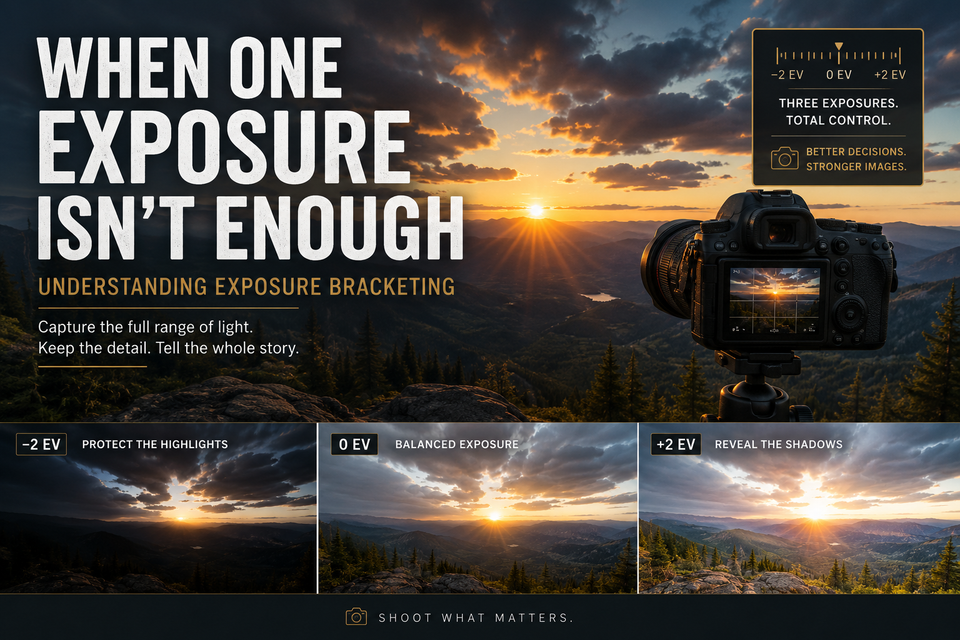
Understanding Exposure Bracketing
Without the Confusion
Every photographer eventually meets a scene that refuses to cooperate.
You're standing on the rim of the Grand Canyon just before sunrise. The sky is glowing orange and red, while the canyon below is still wrapped in deep shadow. You compose carefully, check your settings, and press the shutter.
The result is disappointing. Expose for the sky and the canyon becomes a silhouette. Expose for the canyon and the sunrise washes into a pale, lifeless glow.
You know what you saw. Your camera simply couldn't record it.
That's not a failure of your camera. It's a limitation of every camera ever made. Understanding that limitation, and knowing when exposure bracketing can overcome it, is one of those moments that separates operating a camera from understanding photography.
Your Eyes Are Better Than Your Camera
The human eye is extraordinary. Without you ever thinking about it, your eyes and brain constantly adjust to changing brightness. Stand inside a cabin and you can still see detail through the bright window. Walk outside, and within seconds your vision adapts again.
A camera sensor isn't nearly that flexible. It records only a limited range of brightness in a single exposure. Once highlights blow out to pure white, that detail is gone for good. Once shadows go completely black, there may be nothing left to recover.
Photographers call this dynamic range, and it's why so many landscapes, churches, city skylines, and sunsets never quite look the way you remember them. The camera isn't seeing incorrectly. It's simply seeing less than you can.
📷 Perspective: Your camera records light. Your eyes interpret light. Those are two very different jobs.
So What Is Bracketing?
Exposure bracketing is photographing the same composition several times while intentionally changing the exposure. A common bracket looks like this: minus two EV protects the highlights, zero EV is the camera's recommended exposure, and plus two EV opens up the shadows.
Instead of asking one photograph to record everything, you give yourself several versions of the same scene. Sometimes one exposure turns out to be perfect on its own. Other times, you'll blend a few of them later into a final image that's closer to what you actually witnessed.
Professional photographers don't bracket because they lack confidence. They bracket because they're working in conditions where one exposure simply can't capture the whole scene.
When Bracketing Makes Sense
One of the biggest misconceptions is that bracketing should always be on. It shouldn't. Most of the photographs you'll ever take don't need it. Portraits under soft light, wildlife, street photography: usually no.
But there are situations where it becomes genuinely valuable, like photographing a waterfall hidden beneath bright sunlight filtering through trees, the interior of an old church with brilliant stained glass windows, a sunrise over a dark mountain valley, a sunset reflected across a lake, or a city skyline at twilight.
These scenes often hold far more brightness range than one exposure can comfortably record. That's when bracketing stops being a trick and becomes a necessity.
When Bracketing Doesn't Help
This is something beginners rarely hear. Bracketing solves only one problem: exposure.
It won't improve poor composition. It won't remove distracting branches. It won't make flat light dramatic, steady a shaky tripod, or freeze a child running through your frame.
In fact, moving subjects are one of the biggest challenges with exposure blending. Leaves blowing in the wind, crashing waves, wildlife, or people walking through your composition can create ghosting when you merge exposures. That's why experienced photographers ask one question before turning on Auto Exposure Bracketing: is this scene actually suitable for it? Sometimes the answer is no.
Three Mistakes I See All the Time
The first is bracketing scenes that don't need it. This wastes storage space and slows your workflow without improving the final image.
The second is forgetting the tripod. Modern software has gotten remarkably good at aligning handheld brackets, but a stable camera almost always produces cleaner results.
The third is assuming bracketing replaces good photography. It doesn't. You still need strong composition, compelling light, and a reason the photograph is worth taking in the first place. Bracketing is another tool in the toolbox, not the toolbox itself.
📷 Perspective: Bracketing protects information. Composition creates meaning. Never confuse the two.
Should You Blend Every Bracket?
Not necessarily, and that surprises many photographers. Sometimes, after reviewing all three exposures, you'll find that one of them was already perfect. That's a success too.
Bracketing isn't about forcing yourself into HDR. It's about giving yourself options, and the best photographers know when to leave the toolbox closed.
📷 Take a Camera Date
Find a scene with both bright highlights and deep shadows. Set your camera on a tripod and shoot a three-image bracket. Before you edit anything, examine each exposure on its own.
Which one preserved the sky best? Which revealed the most shadow detail? Would you use just one exposure, or combine several, and why?
The why matters more than whether you blended the photographs.
📷 Shoot What Matters.