The Photograph Beneath the Photograph
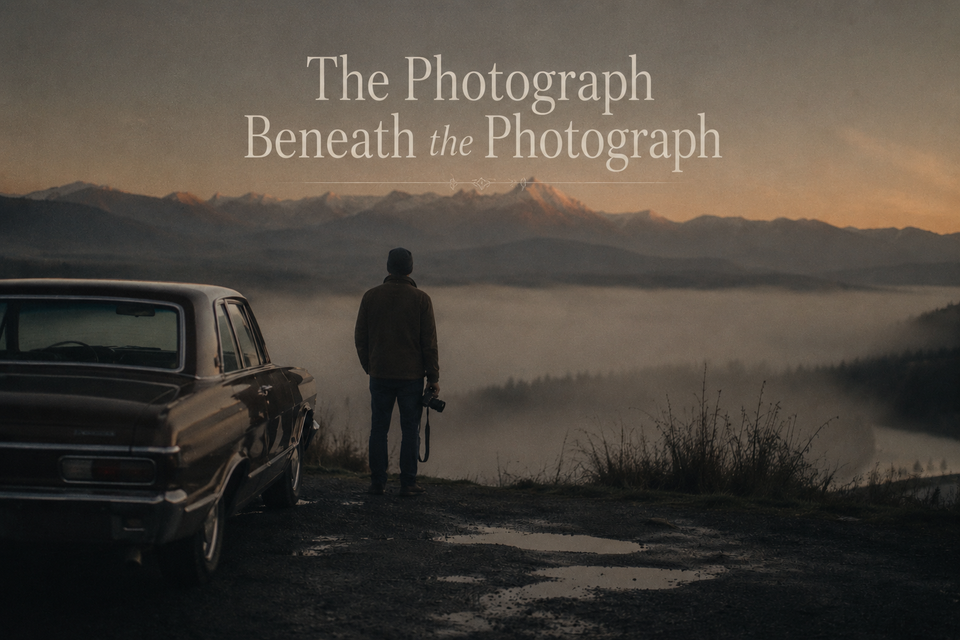
The first thing you learn about photography is how to point a camera at something. The last thing you learn is that the something or someone was never the point.
A young photographer stands at the edge of an overlook before sunrise, breath turning white in the cold air, camera hanging from his neck. Below him, mountains stretch into darkness like sleeping giants. He checks his settings three times before the light arrives. ISO. Aperture. Shutter speed. Everything technical, everything measurable. He is prepared for the photograph.
Then the sun breaks. Not dramatically. Not all at once. Just a thin line of gold quietly touching the tops of distant trees.
And suddenly it happens.
That strange feeling photographers spend their entire lives chasing. Not excitement exactly. Recognition. For one brief second, the world feels impossibly alive.
The mountains are beautiful, yes. But that is not what moves him. It is the loneliness of standing there while everyone else is asleep. It is the silence. It is the memory of being twelve years old in the backseat of his father’s truck watching dawn arrive through dusty windows on family road trips that no longer exist except in fragments.
He raises the camera.
Click.
Years later, someone will look at that image and say,
“Beautiful landscape.” But the photographer will know the truth. The photograph was never about the mountain. It was about longing.
This is the part of photography nobody explains when you first pick up a camera.
They teach you exposure triangles, focal lengths, and dynamic range. They teach you how to make an image sharp. How to properly expose highlights. How to compose using the rule of thirds.
All useful things.
But eventually every photographer arrives at the same unsettling realization: A technically perfect photograph can still feel completely empty. Because cameras record surfaces. Photographers record meaning. And those are not the same thing.
There is an old diner off a two-lane highway somewhere in the middle of nowhere. The kind with flickering neon in the window and cracked vinyl booths that have held a thousand exhausted people at two in the morning.
A photographer walks in during a rainstorm. Most people would see coffee cups. Waitresses. Chrome stools. Steam on windows. But photographers are cursed with noticing too much.
He notices the old man sitting alone near the glass, turning his wedding ring while staring out into the parking lot. Notices the tired waitress rubbing her lower back between tables when nobody is looking. Notices the pale green fluorescent light mixing with the warm glow from the kitchen. Notices how loneliness hangs in certain rooms like cigarette smoke even decades after smoking was banned.
Then he sees it. Not with his eyes exactly. With instinct. The photograph is not about the diner. It is about waiting.
So he frames the old man small against the wide empty window. Leaves space around him. Lets the reflections blur into the glass like ghosts. Click.
Now the photograph says something. Not loudly. Good photographs rarely do. But softly, almost under its breath: You have felt this too.
That is what separates photographs people glance at from photographs people carry with them. Recognition. Not of the subject itself, but of the emotion underneath it.
Anybody can photograph a beautiful woman standing in beautiful light. But not everybody can photograph the exact moment her expression drops between posed smiles and something honest briefly appears.
Anybody can photograph a city street. But not everybody notices the teenager standing under the laundromat sign pretending not to cry while buses roar past in the rain.
Anybody can photograph a child running through sprinklers. But not everybody understands they are actually photographing time itself. The unbearable fact that childhood is disappearing while it is happening.
Photography, at its deepest level, is not about documenting what things looked like. It is about documenting what life felt like.
Years from now, nobody will care what camera you used. Nobody will ask what your settings were. Nobody standing in a gallery will whisper, “Ah yes, exceptional histogram retention.”
What they will remember is how the image made them feel. Because photographs become meaningful the same way songs become meaningful. Not through information, but through emotional truth.
The photographs that survive are the ones containing something human inside them.
Happiness.
Tenderness.
Isolation.
Joy.
Grief.
Stillness.
A Memory.
The camera can capture a face in perfect detail and still miss the person completely. Or it can catch one fleeting glance, one imperfect frame, one accidental moment where something real slips through, and suddenly the photograph breathes. That is the difference.
A photograph is not successful because it shows us something beautiful. A photograph is successful because it shows us something true. Once you understand this, the entire world changes. You stop searching only for grand scenes and obvious subjects.
You start noticing the way late afternoon light falls across your kitchen table. The exhausted expression on your brother’s face after a long day. The silence inside grocery stores twenty minutes before closing. The way rain turns gas stations cinematic at night.
Ordinary places become charged with meaning. You realize photography has almost nothing to do with exotic locations and everything to do with attention. The world has always been offering photographs. Most people move too fast to see them.
A photographer walks through his house late at night, unable to sleep. The television hums softly in another room. The dishwasher clicks. Outside, distant tires hiss across wet pavement.
Then he sees his daughter asleep on the couch beneath a blanket, one arm hanging toward the floor, Christmas tree lights reflecting softly against the window behind her. And something inside him stops. Because suddenly he understands this moment will never exist again.
Not exactly like this. Not with her at this age. Not in this house. Not during this chapter of life. The moment is already vanishing while he is standing in it. He picks up the camera carefully so he does not wake her.
Click.
The photograph is not about a sleeping child. It is about the terrifying tenderness of loving something you cannot keep from changing. That is the photograph beneath the photograph. And once you begin seeing that layer, you will never photograph the world the same way again.
Shoot What Matters.