What Made You Pick Up the Camera? ‹› Issue XI
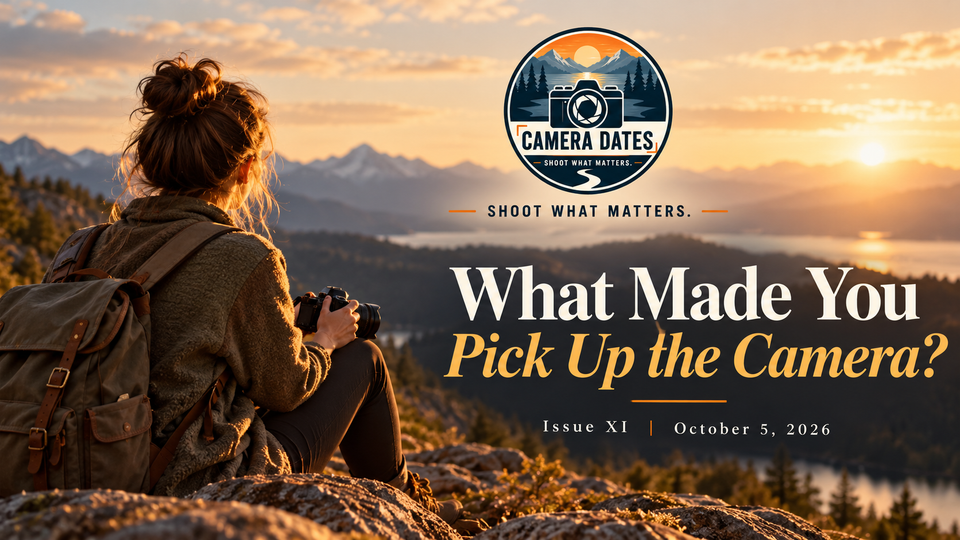
The reason I first reached for a camera was simple. The reasons I keep reaching for it have grown as I have.
From the Author
I started photographing my family. That's it. That is my answer. Then I started noticing how light interacted with various objects and backgrounds. Curiosity took over, and now I love seeing God's amazing creation in many different ways through my camera lens.
When I first thought about photography being part of my life here, I thought it might lead me to do family portraits and maybe fill in as a wedding photographer on occasion, so I created Paint By Light. That is how I started to see photography and what I felt like I was doing, so it seemed like a good fit. I liked the idea of making photographs that felt more deliberate than ordinary snapshots, and I was getting better with the camera. What I discovered fairly quickly, though, was that working directly with clients, booking jobs, coordinating schedules, and turning photography into that kind of business was not really my cup of tea.
The interesting part was that my interest in photography did not disappear when that path stopped appealing to me. It went somewhere else. That Paint By Light kept coming back to me, and I started building other skills.
I kept making photographs and started noticing more. A patch of light on a wall could stop me. A background that I once would have ignored suddenly bothered me. The relationship between two objects inside the frame became interesting. I started seeing photographs that had nothing to do with the family portraits that originally put the camera in my hands.
Eventually that pushed me toward education. I wanted to write a Photography Composition Mastery book, and the original idea for a Camera Date was to make it a practical exercise. I just started thinking about what a date was, a real date. At a basic level, it is about getting to know someone better because you're interested in them, right? Well, I wanted to get to know my camera better because I'm interested in doing so, and I wonder if others feel the same. Then I took the name and the idea of Camera Dates and ran with it into what I have today.
I am still in the humble beginnings of all of this. I am still learning too. But I am learning to see photographs through Visual Paths, Composition Levers, Shape Separation, Breathing Space, Edge Pressure, Subject Weight, Frame Competition, and other relationships that give me a language for what I am seeing. You will understand what I mean by all this if you follow along and join me on this journey.
So, what made you pick up your camera?
And maybe the more interesting question now is this: what makes you want to pick it up today?
A Reason to Make a Picture
Most people do not begin photography because they are fascinated by aperture blades or sensor size. They begin because something in front of them matters enough to photograph. For me, that was family.
I wanted pictures of the people I cared about. I wanted moments I could keep. At that stage, a successful photograph could be as simple as having everyone look toward the camera, getting the exposure reasonably right, and preserving something I didn't want to forget.
There is nothing wrong with that kind of photograph. In fact, some of the most important photographs any of us will ever make may be technically ordinary family pictures. A photograph can be slightly crooked, imperfectly exposed, badly lit, and still become priceless twenty years later because of who is standing in it.
The mistake would be assuming that becoming a better photographer means leaving those photographs behind.
I still photograph my family. If anything, I care about those photographs more now. The difference is that I am more aware of what else can be included in the story. I notice the expression that happens before everyone smiles for the camera. I notice the environment around them. I notice the light, the distance between people, a hand gesture, the way someone leans toward someone else, and the little pieces of context that tell me where we were and what the moment felt like. The photograph can still be about the people. It can simply tell me more about them.
That is one of the first ways photography grows. You begin by photographing what matters, and eventually you start asking what else inside the frame helps explain why it matters. It's my motto, and you'll see it everywhere: Shoot What Matters!
When Your Eye Starts Wandering
Something changes after you have spent enough time with a camera. You start noticing things even when you are not actively trying to make a photograph. Light coming through the kitchen window suddenly has shape. A shadow falls across an old chair and, for a second, the chair looks different from the chair you have walked past a thousand times. A road bends through a line of trees in a way that makes your eye want to follow it. Two buildings overlap awkwardly from one position, and without thinking, you move a few feet until they separate.
The camera begins teaching your eyes even when it is sitting at home.
I think this is one of the most interesting parts of learning photography. The subject that originally brought you to the camera does not necessarily disappear. Your awareness simply expands around it.
At first, I might have looked at a person and thought, " That is what I am photographing. Later I began to understand that the person was only one part of what I was photographing. The background mattered. The light mattered. The foreground mattered. The space around the person mattered. Timing mattered.
The subject was still important, but the photograph was becoming something larger than the subject. That idea has become a recurring part of Camera Dates because it changes the question you ask in the field. Instead of only asking, “What am I photographing?” you can begin asking, “What relationships are available here?” That question opens up an enormous amount of photography.
The Path You Thought You Would Take
I used to think photography might lead me toward portrait work. That seemed like a reasonable direction. I liked photographing people I knew, learning lighting, and seeing what happened when I made more deliberate choices.
Then I started imagining the reality of doing that for other people. Bookings. Scheduling. Clients. Expectations. Deliverables. Repeating the process because someone else needed photographs on a particular day at a particular time. That changed the equation for me.
Some photographers thrive in that world. They are good with people, good with business, good under pressure, and genuinely enjoy the relationship between client and photographer. That is a real skill, and it's definitely different from simply being able to take a good photograph. I realized I was more interested in the photograph itself.
I wanted to understand why one frame worked better than another. I wanted to know why moving a few feet could completely change the photograph. I wanted to understand why some backgrounds disappeared quietly while others seemed to shout over the subject. I wanted to know why some empty space felt peaceful, and some felt accidental. How can you take a photograph and, a week later, look at it thinking that it isn't at all how I remembered it?
In other words, I became more interested in the decisions behind the photograph than in building a portrait business. That was not the path I expected when I first picked up the camera. But it was still photography leading me somewhere.
Finding Words for What You See
One of the things I have been trying to do with Camera Dates lately is give names to visual relationships that photographers often notice without necessarily having words for them. The point is educational. I want to make those relationships easier to recognize, talk about, and work with in the field. That is where terms like Visual Path, Subject Weight, Shape Separation, Breathing Space, Edge Pressure, and Frame Competition begin to matter.
These are not new laws of photography. I am not trying to invent composition all over again. Photographers and artists have been dealing with these relationships forever. What interests me is giving them language that makes them easier to recognize while you're standing there with a camera in your hands.
For instance, if a subject keeps disappearing into the background, I can call that a Shape Separation problem. If something near the edge of the frame creates tension or feels awkwardly clipped, I can talk about Edge Pressure. If the viewer does not know what deserves attention because several elements are fighting for it, I can describe that as Frame Competition.
The names are useful because they make diagnosis easier. Once you can name the problem, you can start asking what to change.
That leads directly to what I have been calling Composition Levers. Composition Levers are the controllable choices you can change to alter the relationships inside a photograph. Position, camera height, distance, focal length, orientation, framing, timing, depth of field, shutter speed when motion matters, and exposure when it changes visual importance can all become levers.
The important part is not memorizing the list. The important part is learning not to change things randomly.
Visual Composition Concepts help you see what is happening. Composition Levers help you change it. That is the relationship I want people to become comfortable with.
See the problem. Diagnose it. Choose the lever that actually addresses it. Make another photograph. Compare the result. Keep what worked and change what did not. That process is far more useful to me than memorizing a collection of composition rules and hoping one of them fits whatever happens to be in front of the camera.
From Books to Camera Dates
This approach didn't originally begin as a website. As I was saying, I wanted to write small books about composition. The Photography Composition Mastery idea grew out of wanting to take one concept at a time, explain it seriously, and then give the reader something practical to do with it. A Camera Date was part of that.
The idea was simple: after reading about photography, go make photographs. That idea became much more important to me than I expected.
There is no shortage of photography information. You can spend all day watching videos about lenses, reading reviews, comparing cameras, studying composition, examining other photographers' work, and discussing photography without ever taking a photograph. Education can become another form of procrastination.
At some point, the lesson has to send you back to the camera.
That is why Camera Dates became its own thing for me. I liked the idea of an article on Monday that examines something in depth, followed by a Wednesday exercise that makes you go outside and actually find out whether you understand it.
Reading is not the product. Doing is.
That is also why the Camera Dates themselves are becoming more structured. I want the process to become familiar enough that you eventually don't need me standing beside you telling you what comes next. You can simply tell everyone you are going on a Camera Date and head out the door. Think of it as a photography walk-about, only with a little more purpose and a much better chance of being home in time for supper.
You can Listen. Explore. Nurture. Shoot. That is LENS.
You can make a Baseline. Diagnose what you see with the various visual composition concepts. And then, pull the appropriate Composition Lever. Compare the result. Refine it. Find a Keeper Candidate. Push once more. Decide when you actually have a Keeper. Eventually, that becomes your own internal conversation with the photograph.
That is when the framework starts disappearing into instinct.
Photography Changes What You Notice
I think this may be one of photography's greatest gifts. It makes ordinary things harder to ignore. You start appreciating everything God has created for us. Once you start paying attention to light, you see light everywhere. Once you start thinking about backgrounds, you can't stop noticing them. Once you become sensitive to Shape Separation, you start seeing awkward overlaps before you even raise the camera.
The world has not changed. Your attention has. That is why I do not think learning composition is simply about making prettier photographs. It is about becoming more observant.
You begin noticing how things relate to one another. You start recognizing that a photograph can change dramatically without changing the subject at all. Move three feet. Wait thirty seconds. Lower the camera. Let the person walk into the light. Allow the background to change. Give something more room. The photograph was there, but you had to notice what was available.
That is one reason I still enjoy photography after all this time. Another photograph is always hiding inside something familiar. Sometimes I find it. Sometimes I do not. But I will never stop looking.
The Reason Can Change
What made you begin does not have to be what keeps you going.
Maybe you started because you had young children. Maybe you bought a camera before a vacation, wanted better pictures of your dog or garden, or simply found cameras fascinating. Whatever the reason, it does not have to become your permanent photographic identity.
Photography is allowed to wander.
You do not have to abandon one interest to make room for another, either. Photography does not require you to choose a permanent lane and stay in it. You can photograph family and landscapes, architecture and wildlife, quiet details around the house and whatever catches your eye on a trip. Your interests can overlap, grow, circle back, and change as your life does. You don't need a label for it all to count.
You may have begun with family, then discover that as life changes, your attention shifts toward landscapes, architecture, street photography, wildlife, or something completely unexpected. You may spend years photographing one subject and then suddenly find yourself fascinated by ordinary objects around the house because the light happens to fall across them in a way you cannot ignore.
The path does not have to be straight, and I think that is part of what keeps photography interesting. The important thing is to keep paying attention to what catches your eye now, not only to what first put a camera in your hands.
Let photography surprise you once in a while. Sometimes the next thing that pulls at your attention doesn't replace what you already love. It is simply adding another reason to pick up the camera.
What Catches Your Eye Now?
Ask yourself this useful question the next time you are out with a camera. What keeps making me look twice?
Do not worry yet about whether it is a good subject. Do not ask whether anyone else would photograph it. Do not immediately decide which lens it requires. Just notice what keeps getting your attention.
Maybe it is the way late light hits the side of a building. Maybe it is people interacting. Maybe it is repeating shapes. Maybe it is old machinery, quiet roads, reflections, trees, weather, animals, color, architecture, or the strange little moments that happen between the obvious ones. Follow that curiosity for a while.
Photography becomes more personal when you stop asking only what photographers are supposed to photograph and begin paying attention to what you cannot seem to stop noticing. That does not mean every photograph will be good. It means the reason for making it belongs to you. Once you have a reason to take the photograph, you can start working on the photograph itself.
What You Just Learned
Most of us begin photography because something matters enough to preserve. Over time, the camera can teach us to notice much more than the original subject. Light becomes important. Backgrounds become important. Timing, spacing, relationships, and visual structure begin entering the conversation.
That is where vocabulary can help. Visual Composition Concepts name what is happening inside the frame and help you understand it. Composition Levers give you choices for changing it. The goal is not to bury photography under terminology. The goal is to make deliberate decisions easier until the thinking gradually becomes instinct.
The reason you picked up the camera may have changed since the beginning.
That is okay. The more useful question may be the one you can answer today:
What keeps catching your eye?
Pay attention to that.
It may point to the photographs you should make next.
Next Wednesday's Camera Date will start there.
Shoot What Matters.
Jonathan Charles
CameraDates.com