The Wait ‹› Issue IX
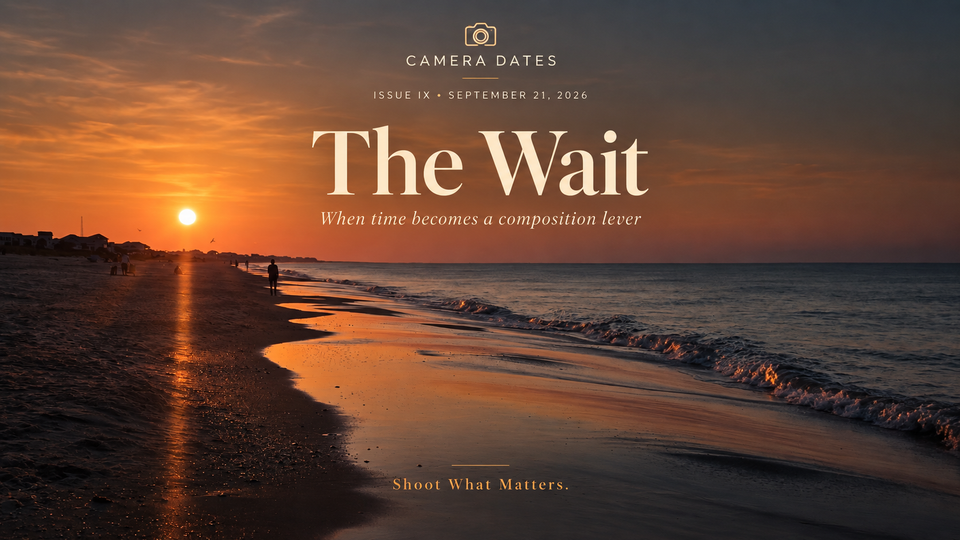
From the Editor: Welcome to Issue IX. September 21, 2026
A lot of photography education teaches us what to do. Change the aperture. Move your feet. Simplify the background. Watch the edges. Find better light. Get closer. Change the focal length. All of those things matter, and throughout Camera Dates, I have spent a lot of time covering the deliberate choices photographers can make to change what is happening inside the frame. This week I want to talk about a photographic decision that can look suspiciously like doing nothing at all.
Waiting.
There are moments when the composition is nearly there. The camera position is right. The background works. The light is close. You know what the photograph could become, but something has not happened yet. A person has not entered the right part of the frame. A cloud has not moved. The expression has not changed. The wind has not settled. The shadow has not reached the place you need it to reach. At that point, photographers often do something completely understandable. We leave. An uncomfortable feeling comes with standing in one place while nothing seems to be happening. Somewhere else there might be a better photograph. Maybe the light is better around the corner. Maybe another subject is waiting. Maybe I should keep moving instead of standing here waiting for a picture that has not arrived.
Sometimes moving is exactly right. But sometimes the most important Composition Lever available to you is time. Instead of changing the photograph, you allow the world inside it to change. That is The Wait.

Featured Article: The Wait
Imagine finding a street corner late in the afternoon. The light is directional and warm. An old wall catches it beautifully. The background is unusually clean, and from one particular position everything seems to fall into place. There is only one problem. Nothing is happening. The frame needs a person, and you can already imagine exactly where they need to be. Somewhere near the edge of the light, far enough from the wall to separate clearly, perhaps moving across the frame rather than toward you. If someone walked through that exact spot, the scale would suddenly make sense, and the empty architecture would become a photograph about a person moving through it.
So you stand there. A minute passes. Then another. People walk everywhere except where you need them. The light shifts slightly. You start looking over your shoulder, wondering what is happening around the corner. Eventually the scene that looked so promising starts feeling foolish, mostly because you have been staring at it too long. So you leave. Five minutes later, someone walks through exactly where you imagined them. That is one of photography's cruel little lessons. Sometimes you were not wrong about the photograph. You were simply early.
The Decisive Moment Is Only Part of Timing
Photography has a long relationship with the idea of the decisive moment. The phrase is usually associated with Henri Cartier-Bresson and has become shorthand for that fraction of a second when gesture, geometry, expression, movement, and meaning suddenly align. There is genuine truth in that idea. Some photographs exist for almost no time at all. A bird spreads its wings. A runner reaches the finish. A child looks up. Two strangers cross paths at exactly the right angle. The photographer has to recognize the possibility and respond quickly enough to capture it.
But there is a real danger in thinking that timing in photography is therefore mostly about reflexes. Often the decisive moment is preceded by a very indecisive-looking period in which the photographer simply waits. The wildlife photographer may have been watching that bird for forty minutes before the wings opened. The street photographer may have built the composition first and then waited for the right person to enter it. The landscape photographer may have returned to the same location three mornings in a row before the fog and light finally cooperated. The portrait photographer may have taken twenty perfectly sharp, technically correct photographs before the subject finally relaxed enough for something honest to appear on their face. The shutter may be pressed in a fraction of a second. The photograph may have taken much longer to make. That distinction matters more than most photographers realize.
Timing Is a Composition Lever
Throughout Camera Dates, I've used the term Composition Lever to describe something you can deliberately change to alter the relationships inside the frame. Position is a lever. Distance is a lever. Camera height, focal length, orientation, depth of field, and framing are all levers. Timing belongs on that list, and it deserves to be treated with the same intentionality as any other compositional decision. The difference is that timing often changes the photograph without requiring you to go anywhere at all.
Suppose you have already found a strong composition, but two people are overlapping badly in the background. You could move sideways to improve Shape Separation between them. That is one solution. Or you could hold your position and wait three seconds for them to separate on their own. A bright car sitting directly behind your subject creates frame competition, pulling the viewer's eye away from what matters. You could reframe to exclude it. Or you could wait for the car to pass. A landscape feels flat because the mountain is completely covered in shadow. You could leave and search for something else to photograph. Or you could watch the gap developing in the clouds and wait for the light to reach the ridge you know is there. A portrait feels stiff and guarded. You could keep giving the person new instructions every few seconds. Or you could stop talking entirely and wait until they forget for a moment that they are being photographed. Timing changes relationships inside the frame. That makes it composition.
Waiting Is Not Doing Nothing
This is the part that takes real practice to internalize, because good waiting is genuinely active. You are not standing around hoping the universe eventually rewards your patience. You observe the scene closely enough to recognize what is slowly changing and anticipate what might develop next. There is a meaningful difference between waiting and hesitation, and understanding that difference changes how you work in the field.
Hesitation happens when you don't know whether to take the photograph. You see something, second-guess yourself, delay too long, and often miss it entirely. Waiting happens when you know exactly why you aren't taking the photograph yet. That difference may be invisible to anyone watching you stand there, but inside the photographer, it's an entirely different state of mind. Hesitation is indecision. Waiting is intention. If you are waiting for a person to enter a patch of afternoon sunlight, you know what you want. If you are waiting for two people to separate enough to create clean visual shapes, you know what you want. If you are waiting for someone's expression to soften into something real, you know what you want. The camera is ready. The exposure is already set. The composition already exists. The photograph simply has not happened yet.
Learn to Predict, Not Just React
Waiting becomes dramatically more powerful once you anticipate rather than merely observe, and this is where patient photographers consistently outwork faster ones. Watch how people move through the scene. Where are they coming from, and where do they naturally cross? Does a doorway keep producing interesting subjects at regular intervals? Is there a traffic light creating a predictable rhythm in how pedestrians move through the space?
Watch the clouds and understand their direction. Is the gap in the overcast getting larger or closing? If sunlight is slowly moving across a landscape, trace where it will fall next and be positioned there before it arrives. Watch how shadows behave over time. A shadow is not fixed just because the building creating it is fixed. Across enough time, its edge moves across a wall, a floor, a face. A location that looks completely wrong right now may be exactly right twenty minutes later. Watch the behavior of your subject. A bird leaning forward repeatedly may be preparing to launch. A child glancing repeatedly toward someone outside the frame may be about to run toward them. A person who is visibly uncomfortable in front of your camera may gradually settle if you simply give them enough quiet time. The better you become at reading what is already happening, the less waiting feels like gambling on an outcome you cannot control. You are making an educated prediction about what the scene may become, and that is a skill that compounds with every Camera Date you complete.
What Are You Actually Waiting For?
This question is enormously useful because vague waiting becomes frustrating very quickly, and frustration leads to abandoning compositions that were actually close to working. Don't just tell yourself you will wait and see what happens. Look at the scene and decide what change would strengthen the photograph. Maybe you are waiting for a cloud to move away from the sun, a person to enter a particular part of the frame, a child to look in a certain direction, or the wind to separate two overlapping branches.
The goal is to be specific. You have already read the scene and made an educated guess about what may happen next. Now name the particular change that would make the photograph stronger so you will recognize it when it arrives.
Maybe you are waiting for light. A cloud needs to soften the direct sun falling harshly across your subject's face. The afternoon light needs to reach a particular window. A bright patch needs to move across the floor into a useful position. The shadow needs to leave someone's face so the detail underneath becomes visible. Maybe you are waiting for people. Someone needs to walk into an empty part of the frame where the composition currently has no human scale. A crowd needs to clear just enough to isolate your subject. Two people need to move apart so the important shapes in the frame can breathe. Maybe you are waiting for movement or stillness. The wind needs to stop so the reflection settles. The water needs to quiet. The animal needs to turn its head. The gesture needs to begin or finish. The more precisely you can describe what you are waiting for, the more productive the waiting becomes. You are not waiting for something better in a vague general sense. You are waiting for one specific relationship inside the photograph to change, and that is an entirely different posture.
Protect What Is Already Working
This connects directly to something I want Camera Dates readers to become increasingly comfortable with across every field session: protect what works, and fix only what does not. Photography has a strange habit of encouraging us to abandon perfectly good decisions simply because one part of the photograph hasn't cooperated yet. You find the position. The background is right. The light is good. The Visual Path works. The Subject Weight feels correct. Then one thing is still wrong, and instead of fixing that one thing, you walk away entirely and start a new photograph somewhere else.
Sometimes the better decision is to protect everything you already solved and give the last piece time to arrive. If the composition is strong but the background contains one person standing in exactly the wrong place, wait. If the light is right but the subject hasn't entered yet, wait. If the portrait is working but the expression is still guarded, wait. An incomplete photograph does not mean the composition is wrong. Sometimes ninety percent of the photograph is already there, and your job is simply to give the last ten percent a reasonable chance to arrive.
The Moment Before and the Moment After
Another reason to wait is that the photograph may not be finished yet. The first good moment is not always the best, and photographers who lower the camera the instant something occurs often miss what follows. Suppose someone finally enters the patch of light you have been watching. You make the photograph. Good. Do not immediately lower the camera or move your attention elsewhere. They may turn. Another person may enter the frame from a completely different direction. Their shadow may become more interesting than their body. Something may happen at the edge of the frame that changes the entire meaning of the composition.
This is especially true when photographing people, because people continue. Expressions continue after the obvious one passes. Gestures continue beyond the peak moment. Relationships between people keep developing in ways you can't always predict. The smile you anticipated may be perfectly pleasant, but the half second after the smile often reveals something more natural and more honest. The obvious embrace may be less interesting than the hands separating gently afterward. Timing in photography is not simply knowing when to press the shutter. Sometimes it is knowing when not to stop paying attention to what is still unfolding in front of you. Stay for the echo of the moment. It may contain the better photograph.
Patience Can Reveal a Different Photograph Entirely
Waiting doesn't always give you the photograph you predicted, and the best photographers stay genuinely open to that possibility. Sometimes waiting gives you a completely different photograph from the one you were expecting, and that photograph may be stronger than anything you originally imagined. You may wait for a person to cross the frame and instead notice that the moving shadow has quietly become the subject. You may wait for fog to clear and realize that the fog itself is what made the scene worth photographing in the first place. You may wait for everyone to leave the background and suddenly understand that the crowd was giving the image exactly the human energy it needed.
That is why productive waiting requires active attention rather than stubborn commitment to a single outcome. The goal is not to stand there demanding that reality eventually produce the picture you imagined. The goal is to remain with the scene long enough to see what possibilities actually develop. You arrive with an idea, but you stay available to a better one. That is a very different thing from simply standing still and hoping.
When Waiting Is the Wrong Lever
Patience deserves honest treatment, which means acknowledging that sometimes waiting is simply the wrong decision. The light is moving in a direction that will only make things worse. The crowd is growing instead of clearing. The subject is becoming noticeably more uncomfortable with every passing minute. The weather is deteriorating. The relationship you hoped would develop between elements in the scene is simply not going to happen under these conditions.
Sometimes the right Composition Lever is your feet, and recognizing that is as important as knowing when waiting will pay off. The intent is not to become the photographer who stubbornly defends a mediocre composition for an hour because you have decided that patience is always virtuous, but to accurately diagnose what is preventing the photograph from becoming stronger and decide honestly whether time can reasonably change it. Ask yourself one clear question: can the thing that is bothering me actually change if I stay here long enough? If the answer is yes, waiting may be exactly the right lever. If the answer is no, change something you actually control. Diagnose first. Pull the lever second. That principle applies here the same way it applies everywhere else in deliberate photography.
The Cost of Leaving Too Soon
One of the hardest things about abandoning a scene is that you almost never discover what happened immediately after you walked away. Maybe nothing happened, and you made exactly the right decision. But photographers who develop a constant habit of hunting for the next thing often end up with a collection of photographs that are almost there. Good places. Good subjects. Decent light. Reasonable compositions. Everything except the moment that would have made them memorable.
Digital photography makes impatience easier than ever, because you can keep producing frames and feel genuinely productive simply because the shutter keeps clicking and the file count keeps rising. Waiting feels less productive by comparison. Nothing appears to be happening. The memory card is not filling up. But photography has never been improved by the number of files stored on a card. Sometimes ten minutes spent making one photograph is considerably more productive than ten minutes spent making fifty. The abundance of possible subjects that exists in almost any location can create its own kind of restlessness, and that restlessness is worth recognizing and resisting when you find a composition that is genuinely close to working.
Waiting Changes the Photographer
Waiting offers a benefit that has very little to do with the specific photograph you eventually make, and it may be the most lasting one. Waiting changes how you see. Stand in one place long enough, and you begin noticing rhythms that were completely invisible when you first arrived. You see how people actually use the space, not how you assumed they would. You notice where the light consistently catches faces as it moves. You discover that every few minutes the traffic clears and the street becomes briefly quiet. You notice reflections shifting in windows across the street. You begin seeing small, quiet gestures because you are no longer scanning rapidly for large and obvious ones.
Slowing down gives observation the time it needs to deepen, and that is close to the heart of what Camera Dates has always been about. I do not want photography to become an endless hunt for things to point a camera at. I want the camera to become a reason to pay closer attention to the world that is already there. Sometimes the photograph is the reward for that attention. Sometimes the attention itself is the reward, and the photograph is simply the record.
Timing and the Keeper
The Keeper is not simply the most technically correct frame from a session. It is the photograph where the important relationships finally align with what you were trying to make, and sometimes that alignment requires the photographer to outlast their own impatience. You find your position. You wait. The light improves. You wait. Someone enters the frame but overlaps another person. You wait. They separate. You make the photograph. Then something else happens, and you make another.
Later, looking at those frames together, you realize how little separated the competent photograph from the Keeper. Perhaps half a second of real time. Maybe one foot of movement on the subject's part. A glance. A hand. A shadow that finally crossed the right threshold. A cloud that moved at exactly the right moment. Tiny timing changes can create enormous differences in what a photograph communicates. The photographer who genuinely understands that does not always need to find another subject or a different location. Sometimes they simply need to stay where they are a little longer.
Stay Long Enough to See
Photography rewards curiosity, but curiosity does not always mean moving toward something new. Sometimes it means staying with what you have already found and giving it the attention it's asking for. What happens if you give this scene another five minutes? Where is that light going? What will your subject do when you stop directing them and simply let them be? What happens in the moment immediately after the one you have been waiting for?
You cannot know every answer in advance. That is precisely why you stay. The next time you find a composition that is almost there, resist the automatic urge to abandon it for something that looks more promising from a distance. Look carefully at what is actually missing. Decide whether time could reasonably provide it. If it can, give the photograph a chance to arrive. Your camera can freeze a fraction of a second, but sometimes earning that fraction requires ten minutes of doing almost nothing except paying close, honest, unhurried attention. There is nothing passive about that.
📷 Shoot What Matters.
Jonathan Charles
CameraDates.com