Camera Date: The Ten Minute Wait
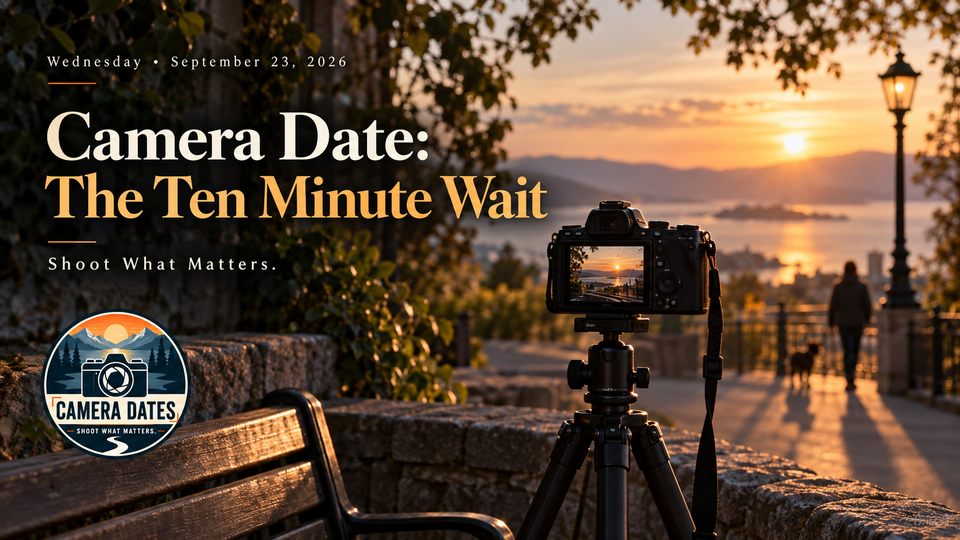
Issue IX Camera Date · Wednesday, September 23, 2026
The Assignment
For this Camera Date, you'll take one strong photograph fairly quickly, then give the same scene something most photographers never offer: time.
That first photograph becomes your Baseline. It should be the capable, deliberate frame you would normally make after arriving somewhere promising, finding a composition that works, and deciding you have probably done what you can with it. Today, instead of immediately moving on, you are going to remain with that scene for at least ten full minutes and discover what changes when you stay.
You are free to photograph throughout the wait. If someone walks into the light at minute three, frame them. If the background clears at minute six, respond. If the clouds open for ten seconds and completely transform the scene, don't stand there watching because the timer hasn't expired. The ten minutes are not a waiting period before you can photograph again. They are your commitment to stay engaged with one scene long enough to find out what time can do to it.
This Camera Date treats timing as a Composition Lever, with the same deliberate seriousness you already bring to position, distance, camera height, focal length, and framing. Sometimes a photograph becomes stronger because you change something. Sometimes it becomes stronger because you hold what is already working and allow the world inside the frame to change for you.
At the end, compare the Baseline with the strongest frame you made during the wait, identify exactly what changed, and ask yourself honestly whether you would have seen that possibility if you had left after the first photograph.
Choose a Location With Genuine Possibility
Before you commit to a scene, stand inside it for about thirty seconds without photographing anything. Watch what is actually happening. Do people enter and leave in recognizable patterns? Are clouds moving in a direction that could change the light? Are shadows creeping toward or away from useful parts of the frame? Does traffic clear periodically? Are reflections shifting? Can you already imagine one or two realistic changes that might strengthen the photograph?
If nothing seems capable of changing in the next ten minutes, choose a different location. You are not looking for guaranteed success. You are looking for a scene with enough genuine possibility that time could influence what happens inside the frame.
A street corner with regular foot traffic is a natural choice, but a park path, cafe window, public square, doorway, bridge, porch, overlook, or landscape with moving clouds works just as well. What matters isn't the specific location, but the presence of something that can change the relationships inside the frame while you stay roughly in place. Moving light, shifting shadows, passing people, changing weather, reflections, animals, gestures, vehicles, expressions. Any of these can become what timing ultimately changes.
Avoid committing to a completely static scene unless the light itself is clearly moving. A beautiful landscape under a cloudless midday sky may look essentially identical at minute one and minute ten. That may be a wonderful subject another day, but it gives this exercise nothing to work with.
Photograph One: The Baseline
Make your first photograph fairly quickly after you commit to the scene, but not carelessly. The Baseline is not meant to be a weak frame that the later photograph easily defeats. It should be the honest, capable image you would have been genuinely satisfied with if you were shooting without an assignment and planned to move on afterward.
Find your position. Set the exposure deliberately. Check the background. Scan every edge and corner. Consider Subject Weight, Shape Separation, Visual Path, and Frame Competition. Build the strongest photograph you reasonably can without turning the Baseline itself into a ten-minute exercise.
Then stop and look at it honestly. Not to admire it. To diagnose it.
Ask yourself what single change would make this photograph meaningfully stronger without requiring you to abandon the scene entirely. Maybe a person needs to enter the empty foreground and give the composition human scale. Perhaps someone already in the frame needs to move several feet and separate from another figure. A bright vehicle behind the subject may need to leave before Frame Competition settles. Sunlight may need to reach one particular area of the scene. Wind may need to quiet enough for a reflection to become usable. An animal may need to turn its head.
Whatever the change is, name it before the timer starts.
This step matters more than it might seem. Vague waiting, standing around hoping the photograph improves in some unspecified way, becomes frustrating and unproductive very quickly. Purposeful waiting, knowing exactly what relationship you are watching for and staying alert enough to recognize it when it arrives, is an entirely different discipline. Name the specific change you are looking for. That clarity will sharpen your attention and make you far more likely to respond when the moment actually comes.
Start the Ten Minutes
Set a timer for ten full minutes and commit yourself fully to the scene.
You may refine your framing slightly as you observe and learn more about what is happening. You may adjust exposure if the light changes. You may shift your position by a step or two if a small correction strengthens what you already found. What you are not doing is abandoning the location because nothing dramatic has happened quickly enough and starting to hunt for a different photograph somewhere else.
Stay off your phone and keep your finger on the trigger. Don't spend the time obsessively reviewing the Baseline on the camera screen. Keep your attention on what is unfolding in front of you, because what you are waiting for will not announce itself in advance.
Use the ten minutes actively. Watch where people naturally enter and leave the frame and notice whether their movement follows a rhythm you could begin to anticipate. Pay attention to where the light is traveling and whether shadows are moving toward useful positions or away from them. Study the edges of the frame for anything that might enter or exit with time. Watch reflections, gestures, expressions, interactions between people, animals changing position, clouds opening, wind arriving, or any other element the world is producing entirely on its own.
Work toward anticipating rather than simply reacting. If people consistently emerge from the same doorway, watch that doorway. If traffic clears at regular intervals, learn the rhythm and be ready before the next gap opens. If a break in the clouds is approaching the sun, have the camera up before the light arrives. The better you become at reading what is already happening, the less waiting feels like hoping and the more it feels like genuine preparation.
You are not waiting for photography to happen to you. You are studying what the scene might become and making sure you are ready when it does.
Photograph What Arrives
When what you were waiting for happens, photograph it immediately. Do not wait for the timer to expire. Timing does not care about your assignment, and the moment will not hold its position while you finish the exercise correctly. If the person enters the exact patch of light you imagined at minute two, frame it. If the background becomes clean at minute five, photograph it before something else enters. If the scene offers you a completely different possibility from the one you predicted, respond to that instead.
This distinction matters enormously. Waiting should never become stubbornness. You may begin hoping a crowd will thin, only to realize the crowd itself is producing the most compelling relationships in the frame. You may wait for direct sunlight only to discover that a moving shadow makes the scene far more interesting than the light ever would have. The world is not obligated to produce the photograph you imagined. It will produce what it produces. Your job is to stay present enough to recognize when what it produces is worth making.
Begin with an intention. Stay available to a better one.
Photograph meaningful changes selectively and with intention. Resist the temptation to hold the shutter down every time something moves and hope that one frame out of a hundred accidentally becomes the Keeper. Each time you press the shutter, know what changed and why you responded. That awareness will matter when you compare the photographs afterward and try to explain precisely what timing contributed.
Stay for the Echo
When you believe you have made the photograph, do not immediately lower the camera and move on. Give the scene a few more seconds. The first strong moment in a scene is rarely the best, and the photographers who consistently find the strongest frames are often the ones who outlast their own satisfaction by just enough time. Someone who enters exactly where you want them may turn in a way that changes the entire photograph. Another figure may arrive from a direction you were not watching. An expression may soften after the obvious moment passes into something quieter and more honest. A gesture may continue beyond its apparent peak and become more revealing in its resolution than it ever was at its height.
This is especially true when people are involved because people do not move in isolated photographic moments. Expressions flow into other expressions. Gestures continue past what seemed obvious. Relationships develop in real time. The smile may be pleasant, but the half second after the smile often feels more genuine. The embrace may seem like the clear photograph, but the moment the hands separate may say something the embrace never managed to.
Photography has the moment you anticipated. Sometimes it also echoes immediately afterward. Stay attentive long enough to see both before you decide the session is finished.
When the Timer Ends
When ten minutes have passed, do not automatically pack up and leave. The timer marks the end of your required commitment, not the expiration of the photograph. If the scene is still moving in a useful direction and you are genuinely engaged, stay longer.
Before you leave, think honestly about what actually happened during the wait. Did the change you identified at the beginning ever occur? Did something better arrive instead? Did the scene improve, deteriorate, or simply become different from what you expected? At what point did you most want to give up and move on to something else?
That last question is worth carrying with you. If you felt restless at minute four but made your strongest photograph at minute eight, you have just experienced the precise gap this Camera Date exists to reveal. Without the assignment, there is a reasonable chance you would never have known the stronger photograph was coming because you would already have been somewhere else when it arrived.
If nothing useful happened during the full ten minutes, that is still valuable information. Waiting is not always the correct Composition Lever, and recognizing when time has stopped serving the photograph is as important as knowing when to keep waiting. The light may have been moving in the wrong direction. The crowd may have grown worse rather than better. The behavior you anticipated may simply never have developed. That is not failure. That is an accurate read of a scene, and accurate reads are worth developing.
If one last frame presents itself clearly before you leave, make it. Then go. There is a version of this exercise where you never actually leave because something better always seems like it might be coming, and that version is just called standing outside indefinitely. LOL
Seriously, head home, compare your frames honestly, and if you found something worth sharing, bring it to the Camera Dates community. We want to see your Baseline, your Keeper, and the ten minutes in between. What made it for you?
Compare the Baseline to the Patient Frame
OK, now when you get home, open the Baseline beside the strongest photograph you made during the wait and compare them with the same deliberate attention you brought to the scene itself.
Do not assume the later photograph automatically wins because you waited for it. Some Baselines really are the strongest available frame under the conditions that existed. If that is what you find, accept it without disappointment. This camera date is not designed to prove that patience always improves a photograph. It is designed to show you what time can change when the scene has genuine possibility.
Look at what actually changed inside the frame. Did Subject Weight improve because someone entered the scene and gave the composition human scale or meaning it lacked? Did Shape Separation become cleaner because two overlapping figures finally moved apart? Did Frame Competition drop when a bright distraction left the background without you having to reframe at all? Did a shadow strengthen the Visual Path and give the viewer a clearer route through the composition? Did the light reveal something the Baseline barely suggested?
Then ask the question at the center of the entire exercise: would you have seen any of these later possibilities if you had left after making the Baseline?
That is what the ten minutes actually bought you.
Diagnose the Difference
Go beyond deciding which photograph you prefer and identify specifically why the stronger frame works. Maybe waiting allowed two people to separate, and Shape Separation improved as a result. Perhaps a bright distraction cleared the background and Frame Competition collapsed entirely. A gesture may have arrived that increased Subject Weight without any other change in the composition. The light may have shifted in a way that created a stronger Visual Path through the scene. Maybe the frame didn't simplify at all but instead created a relationship between elements that gave the photograph meaning the Baseline never had.
Find the single biggest difference between the two frames and describe it as precisely as you can.
This is where timing becomes a genuine skill rather than a vague virtue. You are no longer simply saying the second photograph is better because you waited. You are saying the second photograph is stronger because waiting allowed this specific visual relationship to change in this specific way. That level of diagnosis is what makes patience transferable. You now know what to look for the next time, how long it might take to arrive, and how to recognize it clearly enough to respond when it does.
Find the Keeper
Now we are finally ready to choose the strongest photograph from the session and look at it one final time before you call it finished.
What is the biggest remaining weakness? Could better timing have addressed it? Did you press the shutter a half second too early or too late? Was the background nearly clean when you fired but not quite there? Did the gesture almost complete itself before you responded? Did the light peak a few seconds after your frame rather than during it? Did you capture the obvious moment and then lower the camera before the echo arrived?
Use these questions to learn, not to criticize. The purpose of this review is to make the next decision more deliberate. If the location is easy to revisit and the photograph still feels unresolved, return. The first visit taught you how the scene behaves. You may now know where people consistently enter the frame, when the light becomes most useful, which background distractions tend to clear on their own, and what moment you were a fraction of a second from making. That knowledge makes the second visit considerably more intentional than the first.
Protect what is already working. Address what is not. When nothing meaningful remains to change, you have your Keeper.
What You Proved to Yourself
You began with the photograph that was immediately available. Then you stayed.
During those ten minutes, your aperture may not have changed. Your focal length may not have changed. Your position may have barely moved. Yet the photograph itself could change dramatically because the relationships inside the frame kept evolving while you remained present enough to notice and respond to them.
You learned that timing is not simply having fast enough reflexes when something suddenly happens. Timing can begin long before the shutter fires. It can mean recognizing that a photograph is almost there, diagnosing what would make it stronger, and staying engaged with the scene long enough to see whether that possibility actually arrives.
You may also have learned something specific about your own habits. Perhaps ten minutes felt surprisingly long and revealed how quickly impatience usually arrives. Perhaps patterns became visible after five minutes that were completely invisible in the first thirty seconds. Perhaps the specific change you thought you were waiting for never came, but something better appeared because you stayed available to the scene long enough to see it.
That's a successful outcome.
Photography asks you to notice. Waiting gives observation time to deepen. The next time you find a composition that is almost there, resist the automatic assumption that something better must be waiting somewhere else. Diagnose what is missing first. You may need to move. You may need a different position, a cleaner background, a change in focal length, or a different exposure. Or you may already be standing in front of the photograph.
It just has not happened yet. Give it a little time.
Shoot What Matters.
Jonathan Charles
CameraDates.com