The Camera You Have Is Not the Problem ‹› Issue I
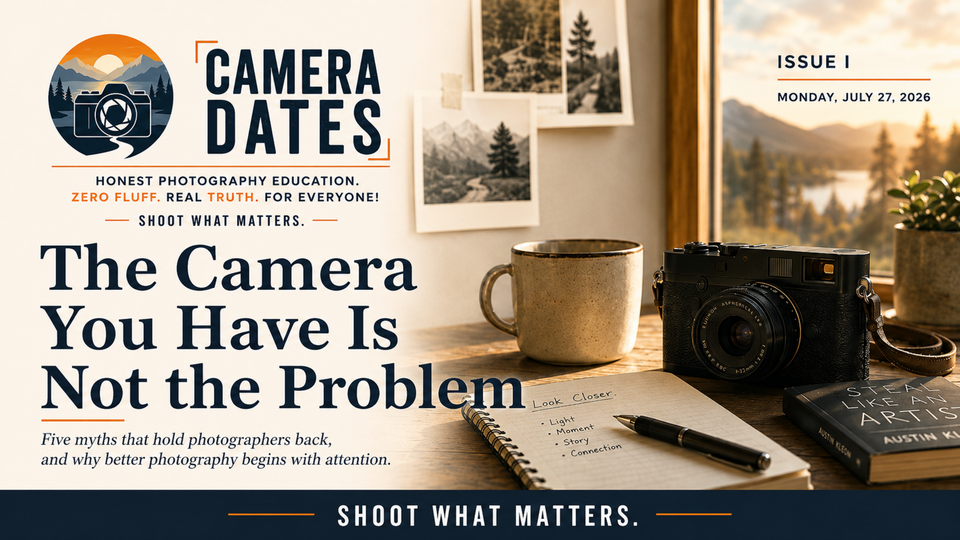
From the Editor: July 27, 2026
For a long time, I have wanted photography education to feel more honest. Information about cameras, lenses, settings, and software is everywhere. Most photographers can find an answer to almost any technical question within minutes. What is harder to find is guidance that helps us slow down, pay attention, and understand why one photograph feels meaningful while another does not. That is why I created Camera Dates.
Camera Dates is built on a few simple ideas. Photography education should be honest, practical, welcoming, and useful in the real world. Becoming a better photographer takes more than new equipment or memorized settings. It means learning how light behaves, understanding composition, recognizing meaningful moments, and developing the confidence to create with purpose. Sometimes that growth happens on a distant trip or during a carefully planned shoot. Just as often, it begins close to home, when we finally slow down long enough to notice what was always there.
This is a place to learn the technical side of photography without losing the creative side. A place for detailed articles, practical assignments, honest conversations, and the kind of encouragement that keeps photographers picking their cameras back up. The goal is not to get everyone shooting the same way. It is to help each photographer understand what they are doing, why they are doing it, and how to express more of themselves through the images they make.
I want Camera Dates to feel like the free photography magazine I always wished existed. Thoughtful articles, practical lessons, and assignments that get you using your camera and not just reading about it. Honest information that can sometimes feel hidden from beginning photographers. Some weeks we will talk about composition. Other weeks, light, timing, storytelling, patience, mistakes, or the small, strange things that make us stop and raise a camera to our eye.
You do not have to be a professional to belong here. If you are, you are certainly welcome, and you might learn a thing or two along the way. You do not need expensive gear, a large audience, or years of experience. You only need curiosity and the willingness to keep looking.
My hope is that every issue gives you one useful idea to carry with you. Something that changes how you notice a background, recognize good light, frame an ordinary subject, or understand what you were really trying to say when you pressed the shutter. That is where better photography begins. Not with more gear, but with learning to see.
Welcome to Camera Dates.
Jonathan Charles
Featured Article: The Camera You Have Is Not the Problem
Somewhere on the internet right now, a photographer with forty thousand followers is explaining why you need a full frame camera, three prime lenses, and a five thousand dollar setup before you are allowed to call yourself serious. Ignore him. He is wrong, and there is a decent chance the video is sponsored by someone selling exactly that setup, so consider the source.
Here is the actual truth nobody sells merchandise about. A professional is not a camera setting. It is a way of paying attention, and you already own the only piece of equipment that matters. That would be your eyes and your mind, which came free with your face.
I should say up front that I am not a professional by the narrow definition people usually mean. I do not make my living from clients, and I do not have a studio with a skylight. What I do have is a great many hours behind a viewfinder, years spent studying photography, and a stubborn refusal to believe that expertise must be gatekept behind a receipt. If that disqualifies me from the title, I can live with that. The photographs still matter, and the lessons still work.
I am bringing this up because I lived on the other side of that gatekeeping for a while. Many years ago, not long after I first fell in love with photography, I was made to feel, more than once, that I was not a real photographer. It was rarely said directly. Most of the time, it showed up in Facebook groups, on Twitter, and even in classes I had paid good money to attend. The message was always the same. I did not own the right equipment, I was not making money from photography, and therefore I had not earned the right to take myself seriously and call myself a photographer. And it was not because my photos were bad. It was about whether I owned the equipment they respected and whether someone was paying me to use it.
One person actually laughed at me for shooting with a phone, as though the phone were standing in the way of the photograph instead of simply being the tool I had with me. I wish I could say it did not bother me, but it did. It held me back longer than I want to admit because I allowed people who had appointed themselves gatekeepers to convince me that the door was locked.
It was not locked. It was never locked.
Now that I know that, I have no interest in closing the door behind me the way it was closed in front of me. Everything I have learned and all I will learn, I intend to hand over freely because none of this was ever a trade secret. It was simply treated like one by people who benefited financially from you and me believing it.
So let us talk about the things beginners get wrong most often, and why almost none of them are really about the camera in their hands.
Myth One: Good Photos Require Expensive Gear
You have probably heard this one already, possibly in a comment section, or possibly from a guy at a wedding who corners people to talk about his sensor size. The claim is always some version of the same idea: your photographs would be better if your equipment were better.
Here is the problem with that theory. Shallow depth of field will not save a boring photograph. Neither will a wide aperture, a perfectly exposed histogram, or a lens that costs more than your car. Technical competence matters, but it is only the beginning. It can help you produce a photograph that is sharp, properly exposed, and technically clean. It cannot guarantee a photograph anyone will remember.
What separates a forgettable photograph from a meaningful one often has far less to do with the equipment list and far more to do with where the photographer decided to stand, what was included in the frame, and what was deliberately left outside it. Composition is free. Attention is free. Waiting ninety seconds for the light to become more interesting instead of pressing the shutter immediately is also free, and that small act of patience may improve the photograph more than a seventeen hundred dollar lens upgrade.
For proof, look at almost any photograph you consider genuinely great and find out what it was made with. Many were created using equipment that would now be considered old, limited, or entry level. Some were made before autofocus, image stabilization, electronic viewfinders, and cameras capable of taking twenty frames per second. The equipment played its part, but it did not recognize the moment, choose the composition, or decide when to press the shutter.
The camera did not make the photograph.
The photographer did.
Myth Two: You Need Permission to Start
This one is sneakier because it rarely shows up as a direct thought. It shows up as hesitation. As waiting until you know more before you post anything. As deciding you are not ready to call yourself a photographer yet, as if there is a licensing board somewhere handing out the title.
There is not. Nobody is grading your entry exam. The first qualification that matters in photography is repetition, and repetition does not require permission from anyone.
Working photographers shoot constantly, including a huge number of frames that never see daylight. That ratio of good to forgettable never fully disappears, even for people who do this professionally. It just gets more forgiving over time, because pattern recognition improves with volume. You start noticing good light faster. You start predicting the moment before it happens instead of reacting a half second late. None of that comes from reading about photography. It comes from doing it badly a few hundred times first.
So if you are waiting for some invisible moment where you feel qualified enough to start taking this seriously, I have some good news. That moment does not exist, and you can skip waiting for it entirely.
None of this means education does not matter. Good instruction can save you years of frustration. A thoughtful teacher can help you understand light, composition, exposure, timing, and all the other pieces that make photography work. The problem is that too much photography education stops just short of the part people actually need.
You are shown the settings. You are told which lens was used. You are given a list of rules, a few before and after photographs, and perhaps a link to buy the equipment. What you are not always given is the connection between all those things. Too few people dig deeply into how to recognize the moment, why one choice matters more than another, or how to take what you learned and use it when the light is different, the subject will not cooperate, and the scene looks nothing like the demonstration.
It reminds me of being handed a recipe with one ingredient missing. Everything looks complete. The instructions seem clear. You follow every step exactly, but the result never tastes quite right. Then you assume the problem must be you.
That missing ingredient is why I created Camera Dates.
I do not want to give you just enough information to keep you watching another video, signing up for another class, or wondering whether the next camera will finally make everything click. I want to help you understand the part that connects the lesson to the photograph. The part that helps you see what is happening in front of you, make a decision, and know why you made it.
Camera Dates was created to fill in the gaps. To explain the things that often get skipped. To tell the whole truth, including the mistakes, the uncertainty, the failed frames, and the fact that even experienced photographers do not always know what they are doing until they work through it. I want to take the knowledge that can feel guarded, complicated, or incomplete and make it practical enough that you can carry it outside and use it.
That is my mission here. Not to impress you with what I know, but to help you discover what you can do. I don’t know it all and never will, but I promise what I do learn I will always share with you freely.
One of the cruelest habits beginners develop is treating every bad photograph as evidence that they do not belong. Experienced photographers usually see a failed frame for what it is: information. It tells them something about timing, light, composition, or technique. Then they adjust and try again. So stop waiting for the day when someone officially decides you are ready. There is no ceremony, no certificate, and no photography police coming to inspect your camera bag.
Show up. Pay attention. Make photographs.
Do that, and guess what?
You are a photographer.
Myth Three: Mistakes Mean You Are Bad at This
This one is related to the last myth, but it deserves its own space because it hits differently. This is not about being afraid to begin. It is about the voice that shows up after you already have.
It is the voice that looks at a blown out sky, a missed focus point, or a crooked horizon and decides that the photograph says something permanent about your ability. Instead of seeing one bad frame, you see proof that you are not talented enough, not experienced enough, or perhaps not meant for photography at all.
That conclusion feels personal, but it is almost always wrong.
Every photographer you admire has made technically ruined photographs. They have overexposed skies, misfocused portraits, clipped highlights, awkward compositions, and entire memory cards filled with ideas that seemed brilliant in the moment and looked like absolutely nothing once they reached the computer. They have missed important moments because they chose the wrong setting, stood in the wrong place, or reacted a second too late.
The difference is not that experienced photographers stop making mistakes. The difference is that they stop treating every mistake like a verdict.
A failed photograph is information. It tells you that the shutter speed was too slow, the background was too busy, the light was flatter than you realized, or the moment had already passed. Sometimes it tells you that the idea itself was not very good. That can sting, but it is still useful. You cannot correct what you refuse to examine.
The photographers who improve fastest are not the ones who avoid mistakes. They are the ones who look at a bad frame and ask a better question. Not, “Why am I terrible at this?” but, “What happened here, and what can I change next time?”
That question changes everything.
It turns embarrassment into curiosity. It turns frustration into instruction. It gives you something useful to carry into the next photograph instead of simply carrying the disappointment.
This is another place where Camera Dates matters. I do not want to show you only the polished photograph and pretend it appeared fully formed. I want to talk about the frames that failed, the choices that did not work, and the adjustments that finally brought the photograph together. Seeing the final result can inspire you. Understanding the mistakes behind it can actually teach you.
A bad photograph does not mean you are bad at photography.
It means you made a photograph, looked closely at it, and found something you can improve.
That is not failure. That is the work.
Myth Four: The Goal Is a Perfect Photo
Here is the myth that quietly ruins more promising photographers than almost anything else. Somewhere along the way, many people absorb the idea that the goal of photography is technical perfection. Sharp focus. Correct exposure. Clean shadows. A histogram that would make a spreadsheet jealous.
Those things matter. Learning exposure matters. Focus matters. Knowing how to control your camera matters. Technical skill gives you more choices and helps you make the photograph you intended instead of accepting whatever the camera happened to produce.
But technical correctness is a floor, not a ceiling.
A photograph can be perfectly exposed, perfectly sharp, beautifully edited, and completely forgettable. It can check every technical box and still have nothing to say. That is because viewers do not connect with settings. They connect with moments, expressions, relationships, light, tension, humor, beauty, and truth.
Some of the most memorable photographs ever made are not technically perfect. Some are grainy. Some are slightly soft. Some contain blown highlights, deep shadows, motion blur, or compositions that would probably be criticized in an online photography group. What makes them work is that they caught something real. A human expression that lasted half a second. A gesture between two people. A piece of light that arrived once and disappeared. A moment that could not be repeated more neatly for the camera.
Nobody remembers a photograph because its histogram was centered. They remember it because it made them feel something, notice something, or recognize an experience they had felt before but had never seen expressed so clearly.
Perfection can also become a convenient hiding place. You can spend twenty minutes adjusting settings, checking corners, and studying the back screen while the actual moment is slipping away in front of you. Sometimes the better choice is to accept a little noise, a slightly imperfect exposure, or a frame that is not clinically sharp and make the photograph before it disappears.
This does not mean carelessness should become a style. A missed focus point is not automatically artistic, and a poor exposure does not become meaningful simply because the moment mattered. The goal is to gain enough technical control that you can respond quickly, then understand when the life of the photograph matters more than flawless execution.
If you spend your early years chasing only technical perfection, you may produce technically correct photographs that say very little. If you spend them learning to recognize moments that feel honest and meaningful, you will occasionally make a photograph that is not perfect and still turns out to be the best thing you have ever created.
Given the choice, that trade is worth making every time.
Myth Five: You Need to Find Your Style Right Away
If you are thinking about photography as a career, this one probably feels urgent in a way it does not for casual shooters. You have likely already been told, often by someone with good intentions, that you need a signature look. A consistent edit. A recognizable approach. Something distinct enough that people scrolling past could see a photograph and know it was yours before they ever read the name beneath it.
That advice is not entirely wrong. It is just usually given too early.
Style is not something most photographers choose in advance and then successfully apply to everything they make. It is something that gets discovered after a large enough body of work exists for the patterns to become visible. You begin to notice that you are repeatedly drawn to certain kinds of light, certain distances from your subject, certain colors, certain moods, and certain moments. Those repetitions slowly become a visual language.
You do not decide your style before you have made thousands of photographs any more than a writer decides on a voice before writing enough words to hear what that voice actually sounds like. Style arrives quietly. It begins to show up somewhere around the point when you stop consciously imitating the photographers you admire and start responding to scenes in the way that feels natural to you.
That does not mean imitation is bad. Studying the work of other photographers is one of the ways we learn. You may borrow a composition, try someone else’s editing approach, or spend a season photographing in a style that is not fully your own. That is part of the process. The mistake is not imitation. The mistake is confusing an early experiment with a finished identity.
Chasing a style too soon can also make you afraid to explore. You begin rejecting subjects because they do not fit your feed. You stop experimenting with color because your portfolio is mostly black and white. You ignore a photograph that excites you because it does not match the look you decided you were supposed to have.
That is backwards.
Your style should grow out of the work. The work should not be squeezed into a style before it has had a chance to become anything.
Give yourself permission to photograph widely. Try landscapes, portraits, street scenes, wildlife, family moments, still life, architecture, and whatever else catches your attention. Edit some photographs gently and others more boldly. Pay attention to what feels forced and what feels like you.
Eventually, the patterns will become impossible to miss.
You will notice what you keep returning to. That is your style beginning to introduce itself.
So What Now?
None of this means gear is useless or that learning your settings does not matter. You should know your camera. You should understand exposure, focus, light, and the tools in your hands. But the camera is still only a tool. It is not the talent, the vision, the courage, or the work.
Nobody becomes a photographer because somebody important finally gives them permission. They become one because they keep showing up. They keep making pictures when the results are disappointing. They keep studying what failed. They keep learning, adjusting, and going back out again.
There will always be someone ready to tell you that you are not good enough yet. Your camera is too cheap. Your portfolio is too small. Your editing is too simple. Your work is not polished enough. You have not earned the title.
Let them talk.
You do not need their approval. You need practice. You need attention. You need the nerve to make bad photographs long enough to start making better ones.
The camera you have is not the problem.
You already have what matters most. You have a camera. You have your eyes. You have your mind. You have subjects all around you, backgrounds waiting to be noticed, light changing by the minute, and a world full of photographs nobody else will see exactly the way you do.
The only real question is whether you are willing to use all of it.
So stop waiting. Stop asking permission. Stop treating other people's opinions like locked doors. Pick up the camera. Your first Camera Date assignment for this issue drops Wednesday morning. See you then. Go make the photograph.
📷 Shoot What Matters
Jonathan Charles
CameraDates.com