Aperture Priority Is Not Cheating
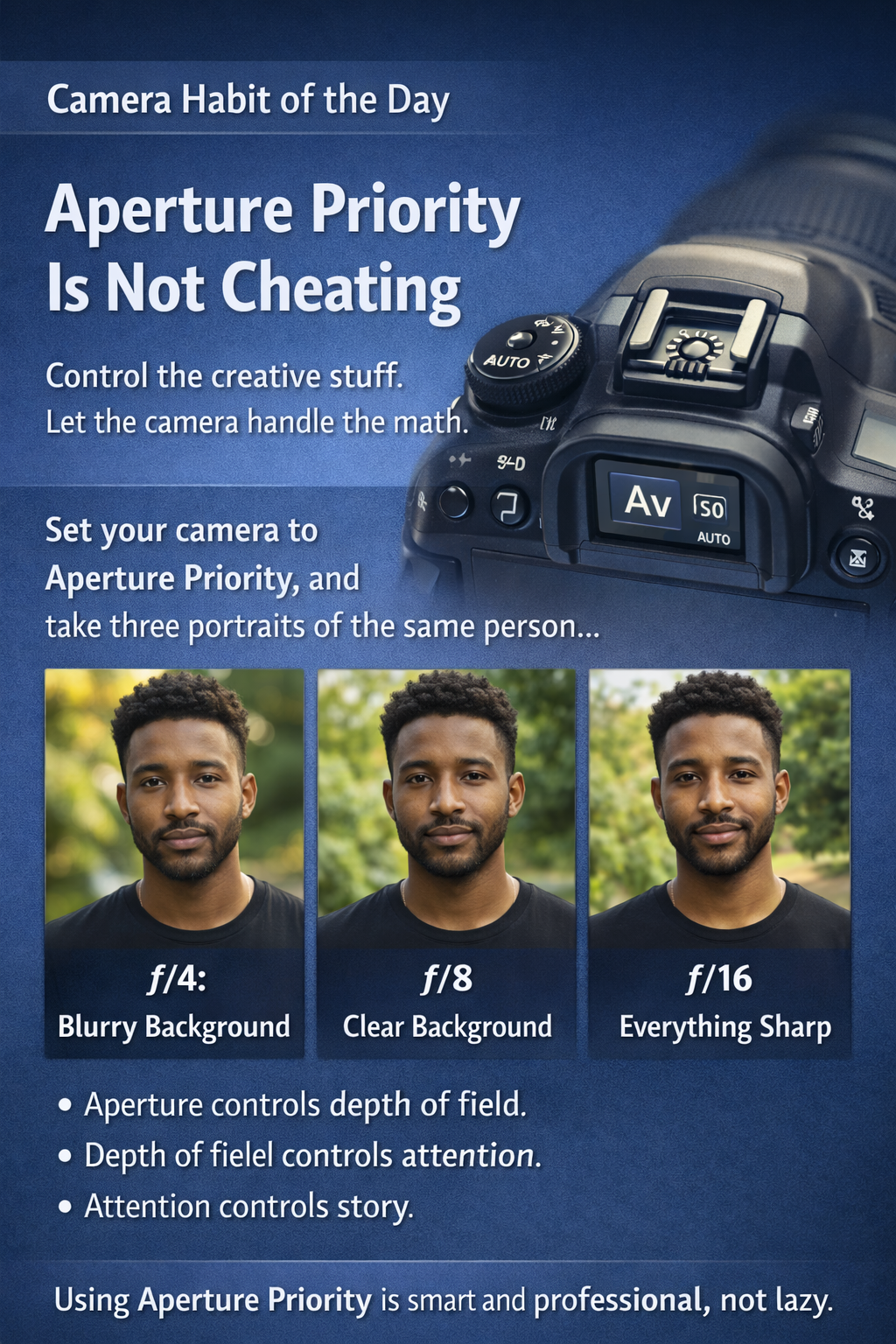
Somewhere along the way, many photographers were taught that “real” photography means shooting in full manual mode all the time. The implication is that if the camera helps you decide exposure, you somehow surrendered creative control. That idea has caused unnecessary frustration.
Manual mode is useful. Sometimes it is absolutely the right choice. But it is not a badge of honor, and using Aperture Priority does not make you less serious, less skilled, or less intentional. In many situations, Aperture Priority is simply the smarter tool.
What Aperture Priority Actually Does
In Aperture Priority mode, you choose the aperture and the camera chooses the shutter speed needed for the exposure. If you also use Auto ISO, the camera can adjust ISO within the limits you set while you focus on the decision that matters most for the photograph.
That means you are not handing over creativity. You are deciding which part of the exposure deserves your attention. If depth of field is the creative priority, Aperture Priority makes perfect sense.
You decide whether the background should disappear into softness or remain part of the story. You decide whether you want one eye sharp and everything else falling away, or the entire environment to remain recognizable. The camera handles the arithmetic required to maintain a usable exposure while the light changes. That is not laziness. That is efficiency.
Why This Matters in Real Photography
Photography rarely happens under perfectly controlled conditions. Light changes. Clouds move. A subject steps from sunlight into shade. Expressions come and go. Wildlife does not wait while you rotate three control dials. Street scenes change before you have time to think about them. If Aperture Priority lets you stay focused on the photograph instead of constantly correcting shutter speed, that is a strength.
Knowing your camera isn't about proving you can manually control every setting. The point is to understand the settings well enough to know when the camera can help you and when you need to take over. That distinction matters. A photographer who understands exposure but chooses Aperture Priority intentionally is still making an exposure decision. They have simply decided which variable should lead.
Aperture Is Really About Attention
Aperture is often introduced as the setting that blurs backgrounds. That is true, but it barely scratches the surface.
Aperture controls depth of field, and depth of field influences where the viewer’s attention goes. A wide aperture can isolate a subject and simplify everything around it. A smaller aperture can preserve context and make the surroundings part of the story.
Think about a portrait. At f/2.8 or f/4, the person may stand clearly apart from the background, and the viewer’s attention goes immediately to the face. At f/8, the background becomes more recognizable, and the location begins contributing information. At f/16, much more of the scene can remain sharp, making the image feel less like a portrait and more like an environmental record.
None of those choices is automatically better. They are different ways of telling the story. That is what aperture is really doing.
Distance Changes the Story Too
Here is another reason aperture can be misunderstood. Depth of field is not determined by aperture alone. Your distance from the subject matters. The subject’s distance from the background matters. Focal length matters too.
Take a portrait at f/4 from several feet away and look at the background. Then step much closer without changing the aperture and photograph again. You will often see a dramatic difference in how quickly the background falls out of focus.
That means learning aperture is not just about memorizing f-numbers. It is about learning how aperture works with distance and composition. This is where the camera stops feeling like a collection of settings and starts becoming a creative tool.
Try This as a Camera Date
Set your camera to Aperture Priority. If your camera allows it, turn on Auto ISO and set a reasonable upper limit for the camera and lighting you are working with.
Now choose one subject. A person works well, but it could just as easily be a flower, coffee mug, tool, dog, fence post, or anything else with a background.
Start by choosing a shooting distance and stay in that exact spot for the first three photographs. This matters. If you move closer or farther away while changing aperture, you change more than one thing at a time, and it becomes harder to see what the aperture itself is doing.
Make one photograph with a fairly wide aperture, perhaps f/2.8 or f/4 if your lens allows it. Then take another at f/8, and another at f/16. Keep your focal length, subject distance, and framing as consistent as you reasonably can. Do not rush through them. Look at what changes.
Pay attention to the subject first, but also look carefully at the background. Does it disappear? Does it become distracting? Does it start adding useful context? Does the photograph feel intimate, clean, busy, descriptive, or documentary?
Now choose one aperture and stick with it. This time, change only your distance from the subject. Make one photograph from fairly close, then another from several feet farther away while keeping the same aperture. If possible, compare a close working distance, perhaps around 2 feet, with a farther position around 6–8 feet.
Notice what happens to depth of field and background separation even though the f-number did not change.
Now you are no longer just learning what an aperture setting does. You are learning that aperture and subject distance work together to control how much of the scene feels sharp and how strongly the subject separates from its surroundings.
Watch the Shutter Speed
Aperture Priority users need to watch one thing. The camera may choose the shutter speed, but you are still responsible for noticing whether it's appropriate.
If you choose a small aperture in dim light, the camera may choose a shutter speed that is too slow to handhold or freeze your subject. That is where ISO comes into the conversation. Raise ISO, use Auto ISO, open the aperture, stabilize the camera, or accept some motion blur.
The important thing is that you understand what the camera is doing and why. Aperture Priority works best when you are cooperating with the camera rather than ignoring it.
Manual Mode Is a Tool Too
None of this is an argument against Manual mode. Manual mode is excellent when you need consistency or when the light is stable, and you don't want the camera changing exposure from frame to frame. Studio work, flash photography, panoramas, certain landscape situations, and controlled scenes are all examples where Manual mode can be incredibly useful.
But there is no prize for using it when another mode would let you work faster and more effectively. The goal is not to shoot Manual. The goal is to make the photograph you intended to make.
Sometimes that means Manual. Sometimes it means Aperture Priority. Sometimes it means Shutter Priority. Sometimes it means letting Auto ISO quietly do its job while you concentrate on composition and timing.
Knowing when to use each one is a much better measure of photographic understanding than stubbornly using one mode for everything.
Stop Fighting the Camera
Your camera is not trying to steal creative control from you. It is a tool that can handle certain technical decisions extremely quickly. When you understand those decisions, you can decide which ones deserve your attention and which ones the camera can manage for you.
Aperture Priority lets you say, “This is how much depth of field I want. You handle the exposure while I make the photograph.” That is not cheating. That is knowing what matters.
So if you have been avoiding Aperture Priority because somebody convinced you that serious photographers only shoot Manual, try letting that idea go. Choose the aperture, watch the shutter speed, pay attention to the background, move closer, move farther away, and see what changes.
Control the creative decision. Let the camera help with the math. Then get back to the photograph.
Shoot What Matters.
Jonathan Charles
CameraDates.com