Before You Buy Anything Else
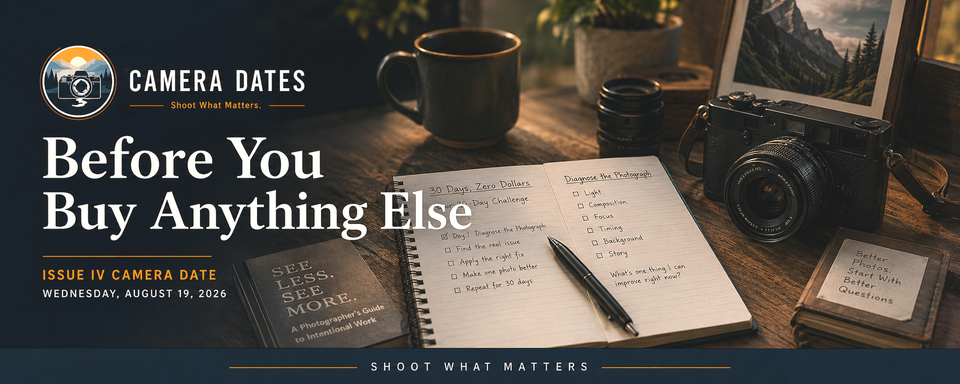
Issue IV · Wednesday, August 19, 2026
This Camera Date Is About Learning to Trust Yourself
This Camera Date does not center on a particular lens, location, subject, or camera setting. This Camera Date centers on something more important: learning how to recognize what a photograph actually needs before you change things, buy things, or blame the equipment in your hands.
That is a skill worth developing because weak photographs can create a strange kind of panic. Something does not look right, so we reach for solutions before we have identified the problem. We change the aperture, move the camera, switch lenses, raise the ISO, alter the composition, open an editing program, and start fixing whatever looks easiest to fix. Sometimes the photograph improves. Sometimes it gets worse. Either way, we may have no idea which decision actually mattered.
Today is going to be different.
You are going to make a photograph, stop, Study it carefully and identify the single biggest thing keeping it from being stronger. Then you will make the smallest meaningful change that directly addresses that problem. Afterward, you will compare the two frames and decide whether your diagnosis was correct.
Let me say that again, You are going to make a photograph, stop, Study it carefully and identify the single biggest thing keeping it from being stronger. Then you will make the smallest meaningful change that directly addresses that problem. Afterward, you will compare the two frames and decide whether your diagnosis was correct.
That process is where photographic confidence grows. Confidence does not mean every photograph works. It means that when one does not work, you do not immediately feel lost. You have learned how to look at the result, identify what is happening, and choose a reasonable next move. By the end of this Camera Date, I want you to feel less dependent on luck and more capable of solving the photograph in front of you.
Choose a Subject That Gives You Time to Think
You will probably notice some familiar subjects showing up again here. A coffee mug, an old camera, a flower, a tool, a chair, a pair of boots, a parked vehicle, or some other simple object that is easy to control can work extremely well. There is a reason Camera Dates keeps returning to subjects like these. They are useful teachers. They stay put, they give you time to study the frame, and they allow you to make deliberate changes without the subject disappearing halfway through the lesson.
That does not mean you have to photograph the same kinds of objects forever. Use whatever interests you. A willing person can work beautifully. So can a bicycle, a porch, a garden ornament, a tree, a piece of machinery, or something meaningful in your home. What matters is that the subject gives you enough control to make another photograph after you have studied the first one.
This is not a Camera Date about chasing a fleeting moment. It is about slowing down enough to understand why one frame works better than another. Give yourself at least an hour if possible. The longer you stay with the subject, the more useful this becomes.
Start With the Photograph You Would Normally Make
Do not begin by trying to create the best photograph of your life. Walk up to the subject and make the photograph you would normally make. Use your usual instincts. Compose it naturally, focus where you normally would, and press the shutter. Then stop.
Do not immediately make another frame. Do not start changing settings because you assume something must be wrong. Look at the photograph first and ask one useful question.
What is the single biggest thing keeping this photograph from being stronger?
You may notice several things. That is fine. Do not attempt to fix them all. Find the one that matters most.
Perhaps the background is distracting. Maybe the subject feels too small in the frame. Maybe the light is flat. Perhaps the sharpest detail is not the most important detail. Maybe the photograph feels too bright or too dark. Maybe the camera position is simply ordinary, and the entire frame lacks energy. When you look at it what one thing really catches your attention the most?
Pick one problem. That is your diagnosis. Do not worry about being right immediately. You are learning how to see problems clearly enough to test them. If your first diagnosis turns out to be wrong, that is not a failure. It is information.
Fix the Problem, Not the Entire Photograph
Once you have identified the biggest weakness, change only what directly relates to that weakness.
If the background is the problem, begin with your position. Move left or right. Get lower. Get higher. Step closer. Back away. Look for an angle that removes the bright object, cleans up the edge, separates the subject, or places something more useful behind it. You already learned in Issue II how powerful the background can be, so use that knowledge here without turning this into another background lesson.
If the light is the problem, work with the light itself. Turn the subject if possible. Change your own position around a fixed subject. Move into shade. Wait for a cloud. Use a window. Turn off an ugly overhead light. Bounce a little light back with a whiteboard or light-colored surface. Ask yourself whether the problem really needs exposure compensation or whether the light itself needs to change.
If the camera position is the problem, move it . Most photographs begin at standing eye level because that is where we are, not because it is the strongest perspective. Lower the camera and see what happens. Raise it. Move closer and let the subject dominate. Back away and allow the surroundings to become part of the story. Your subject may not change at all, yet the photograph can change dramatically because your relationship to it has changed.
If focus is the problem, place focus deliberately. Do not simply accept whatever the autofocus system selects. Ask which detail actually matters and put sharpness there. If motion is the problem, reconsider the shutter speed. If depth of field is the problem, adjust the aperture or change the physical relationship between the subject and the background. If brightness is the problem, use exposure compensation or manual exposure to make the frame look the way you intend.
Then make another photograph. Compare it with the first one. Did it improve?
If it did, stop for a moment and recognize what just happened. You did not randomly stumble into a better frame. You saw a problem, chose a solution, and tested it. That is a repeatable skill.
If it did not improve, you have still learned something. Perhaps the problem was not what you thought it was. Maybe the change was too small. Maybe fixing one weakness revealed another one that matters more. Look again and make another diagnosis.
This is the loop you are practicing: see the problem, decide, test it, compare the result, and adjust again if necessary.
Protect What Is Already Working
As the photograph improves, the exercise changes slightly. Early in the session, you are looking for obvious weaknesses. Later, you need to become just as good at recognizing what is already working.
If the background is clean, protect it. If the light looks good, leave it alone. If the camera position suddenly gives the subject real presence, do not abandon it just because you feel like experimenting. If the exposure looks exactly the way you want, stop touching it.
One of the easiest ways to ruin a nearly successful photograph is to keep adjusting things that you have already fixed. This is what experienced photographers get better at. They are not only good at changing things. They are good at knowing what not to change.
Perhaps the composition is strong, the background works, and the light is beautiful, but the expression is weak. Then wait for the expression. Do not redesign the entire scene. Maybe everything works except one bright object entering the edge of the frame. Fix the edge. Perhaps the photograph feels right except the focus point is sitting on the wrong detail. Move the focus point and leave everything else alone. Protect what works. Fix what does not. That principle alone can make your photography feel calmer and more deliberate.
Learn Which Problems Belong at Capture
While continuing your work, begin to differentiate problems requiring immediate attention before the subject from those that can reasonably be postponed until the editing phase. Camera position is usually a capture decision. So is timing. Focus placement, subject placement, light direction, major background relationships, and the exact moment are all things that are best handled while you still have access to the scene.
If a telephone pole appears to be growing out of someone’s head, move if you can. If the face is buried in ugly light, change the relationship to the light before relying on software. If the subject is pressed against the background and everything feels visually tangled together, create separation while you are there.
I always want to make the image as strong as reasonably possible in the camera. I want the light, composition, focus, subject, timing, and background already doing most of the work before I ever sit down at the computer. That does not mean the photograph must come out of the camera completely finished. It means I want to give myself excellent material to finish.
Learn Which Problems Belong in Editing
Editing is still part of the process, and sometimes it is exactly where the remaining work belongs.
White balance may need refinement. Highlights may need to be pulled back slightly. Shadows may need some opening. A small crop may improve the relationship between elements. Noise reduction may help a high ISO frame. Color and contrast may need adjustment so that the finished photograph feels closer to what you saw or intended. Those are reasonable finishing decisions. The important distinction is whether you are finishing a strong photograph or asking software to rebuild decisions you never made.
There is a big difference between the two.
Good editing can take a strong capture and bring it fully to life. It can refine tone, color, contrast, detail, and mood. But the better your starting point, the more freedom you have later. When the composition is already strong, the focus is where it belongs, the background works, and the light supports the subject, editing becomes creative rather than desperate.
Whatever software you use, that is the position I want you to be in.
Now Ask Whether the Tool Is Actually the Problem
At some point, you may encounter a limitation that truly feels like equipment. Do not dismiss that. Test it.
Suppose you cannot get close enough to a distant subject without disturbing it. You have moved as close as practical, used the longest focal length you own, and still cannot create the composition you want. That may be a legitimate reach problem.
Suppose you are photographing in very low light and need a shutter speed fast enough to stop movement. You have opened the lens as far as practical, raised ISO to the highest level you find acceptable, and you still cannot maintain the shutter speed you need. A faster lens or a camera with stronger high ISO performance may genuinely expand what you can do.
Maybe autofocus repeatedly fails on the subjects you photograph most, even after you understand the correct modes, focus areas, and technique. That could eventually become a real equipment limitation, too. This is where gear becomes useful rather than aspirational.
The goal is not to prove that equipment never matters. The goal is to give your current equipment a fair trial before declaring it guilty. If you can identify the problem clearly, understand why it is happening, try sensible ways around it, and still reach the same limitation, then you have learned something valuable. Now a future purchase has a job.
Make the Final Photograph
By this point, you should have a sequence of photographs that shows your thinking.
Now make the strongest final image you can.
Use whatever settings are appropriate. Move the camera. Change focal length. Adjust aperture or shutter speed. Add light if needed. Recompose. Use whatever equipment you already brought with you. But before making a meaningful change, ask yourself why you are making it.
What problem are you solving? If you can answer that clearly, make the adjustment. If you cannot, stop touching things and look again. Your final photograph may be dramatically better than the first one, or the improvement may be subtle. Either outcome is fine. What matters is that you can explain what changed and why it mattered. That is the real success of this Camera Date.
You are no longer hoping the photograph gets better. You are learning how to make it better.
This Camera Date Continues for Thirty Days
You can finish today’s photography session here, but I want this lesson to follow you for the next month. For thirty days, try to buy nothing related to photography.
No camera. No lens. No new editing software. No preset pack. No course. No filter. No bag. No accessory that suddenly seems essential after you have watched four reviews late at night. This is not punishment, and it is not an argument against buying photography equipment. It is simply an experiment designed to remove purchasing as your immediate solution. For thirty days, give yourself the chance to discover how much you can solve with what you already own. Get out in the field and run through this Camera Date over and over and pick at what you think limits your photographs the most.
When you run into a limitation, resist the urge to start shopping. Diagnose it first. Try another approach. Learn something. Push the equipment you already have. See whether the problem remains after you understand it better. Remember, the goal is not to prove that you need nothing. The goal is to find out what you really need.
Keep a List Called “Things I Thought I Needed”
Every time you catch yourself thinking, “I really need...” write it down. Beside it, write the problem that made you want it. Perhaps you think you need a faster lens because your backgrounds are not soft enough. Write that down, then experiment with subject distance, background distance, focal length, and camera position before spending anything. You may discover that you still want the lens, but you may also discover that the photograph changed dramatically once you moved the subject farther from the background.
Maybe you think you need a new camera because moving subjects are not sharp. Spend a session studying shutter speed, and another on autofocus mode, and focus area, and technique first. If the problem disappears, you just saved money and learned something. If it remains after you understand what you are doing, that tells you something too.
Perhaps you think you need new editing software. Before buying it, spend enough time with the software already on your computer to determine whether the feature is genuinely missing or simply something you have never learned to use. Go to the camera dates community site and ask away here. Do not treat this list as a list of things you are forbidden to own. Treat it as evidence. And run and rerun this Camera Date until it is second nature to you.
Give Every Limitation a Fair Trial
During those thirty days, whenever something frustrates you, try to solve it with the tools and knowledge you already have. Change the light. Change the time of day. Move your camera’s position. Try another lens you already own. Read the camera manual. Learn the autofocus feature that you have ignored. Use a tripod that has been sitting in the closet. Change the relationship between the subject and the background. Spend an hour learning one part of your existing editing software instead of immediately looking for another program.
Most importantly, repeat the photograph. A single failure tells you very little. Repeated failure after deliberate practice tells you much more. Some limitations will disappear once you understand them. Others will remain. Those remaining limitations are the interesting ones.
If the same problem appears repeatedly, you understand what causes it, you have tried sensible ways around it, and it still prevents you from making photographs you genuinely want to make, you may finally have identified a real reason to buy something new. That is a confident purchase. Not an insecure one.
At the End of Thirty Days
When the month is finished, sit down with your list. Some items will probably make you laugh. Good. Cross them off. Some will have turned into lessons. Maybe the lens you thought you needed became a lesson about distance. Maybe the new camera became a lesson about shutter speed. Maybe the software subscription became a lesson in learning the tools you already owned.
Keep those lessons. They are worth more than the thing you almost bought. A few items may still remain.
For each one, finish two sentences:
The problem I keep encountering is... This purchase would solve it by... Be specific. “I need better pictures” is not a diagnosis. “I regularly photograph indoor sports and cannot maintain the shutter speed I need without pushing my current equipment beyond the image quality I will accept” is a diagnosis. “I need more professional portraits” is vague. “I cannot create the working distance and perspective I repeatedly want in the spaces where I photograph, and a longer focal length would solve that specific limitation” is much more useful.
If you can clearly explain the problem and the solution, you are no longer shopping because you feel behind. You are choosing a tool because you understand what it will do.
What I Want You to Take From This
I do not want you to finish this Camera Date believing that buying photography equipment is wrong. That would completely miss the point. I want you to leave feeling more confident about what you already own and understanding that a weak photograph does not automatically mean something is missing from your camera bag.
When a photograph does not work, you have options. You can change your position, wait for the light, alter the light, rethink focus, change shutter speed or aperture, simplify the frame, adjust the composition, or simply slow down long enough to figure out what the photograph is asking for. Composition mastery is a lifelong journey where someone can take a cheap fifty dollar point-and-click camera and make a magazine quality amazing image that everyone will WOW over for months when you learn to master composition. The important part is learning to stop, look, diagnose, and make the next decision with purpose.
Confidence does not come from knowing that every photograph will work. It comes from knowing that when one does not; you have enough understanding to figure out why.
Give yourself thirty days to prove how much you can do with the camera, lenses, software, and knowledge you already have. Push them hard enough to discover their real limits rather than the limits you assumed they had.
Then, if you truly need the next thing, you will know why. And when you finally bring that new tool home, you will be much more prepared to learn it too.