The Moment You Stop Trying to Make the Photo (and make it)
There is a point in almost every serious attempt at composition when effort reaches its peak. You have walked around the subject, tried the obvious angle, moved left and right, changed height, changed focal length, checked the background, and made enough frames to know that none of them quite work. That moment can feel like failure, but often it is the point where the easy compositions have been exhausted and you are being forced to see the scene more carefully.
Composition Starts With More Than a Subject
When photographers first arrive at a scene, they notice subjects before they notice structure. A person, tree, building, mountain, or patch of light catches the eye, and the camera immediately follows. That is natural, but finding a subject is not the same thing as finding a composition.
Composition begins when you decide what deserves to remain in the frame and how everything around the subject affects it. The background matters. The edges matter. Empty space matters. The distance between shapes matters. A bright object near the edge can compete with the subject, while a slight change in position can separate overlapping elements and make the entire frame easier to understand.
This is why early photographs from a scene often feel almost right. The subject is present, but the relationships remain unresolved. Moving closer may simplify the background. Taking one step sideways may separate two shapes. Lowering the camera may remove an unnecessary strip of sky. Waiting may clear a distraction. These are not random adjustments. They are the process of building the composition.
The Scene Rarely Arranges Itself for You
Strong compositions sometimes appear instantly, but more often they are discovered through small corrections. A step, a pause, a cleaner edge, a different height, or a little more patience can matter more than changing lenses or settings.
This is also why composition cannot be reduced to a handful of rules. The rule of thirds cannot tell you whether a bright corner is pulling attention away from your subject. Leading lines cannot tell you whether the foreground is helping the frame or merely filling space. Those decisions come from looking at how visual attention moves through the photograph.
Ask yourself where your eye goes first, what it notices next, what competes with the subject, and what could be removed. When those relationships become clearer, the photograph usually does too.
When You Stop Fighting the Scene
After enough moving and adjusting, there is often a point when you stop trying to impose the photograph you imagined and start paying attention to the photograph the scene can actually give you.
You stand still a little longer. Instead of searching for another angle, you notice how one shape balances another, how a shadow creates separation, or how empty space gives the subject room to breathe. Sometimes the best improvement is not adding anything at all. It is removing, waiting, or allowing the frame to become simpler.
The scene may not have changed much. Your attention has.
Stillness Helps You See Structure
Constant movement is useful while exploring, but every step changes the composition. Eventually you need to stop changing variables long enough to understand what is happening inside the frame.
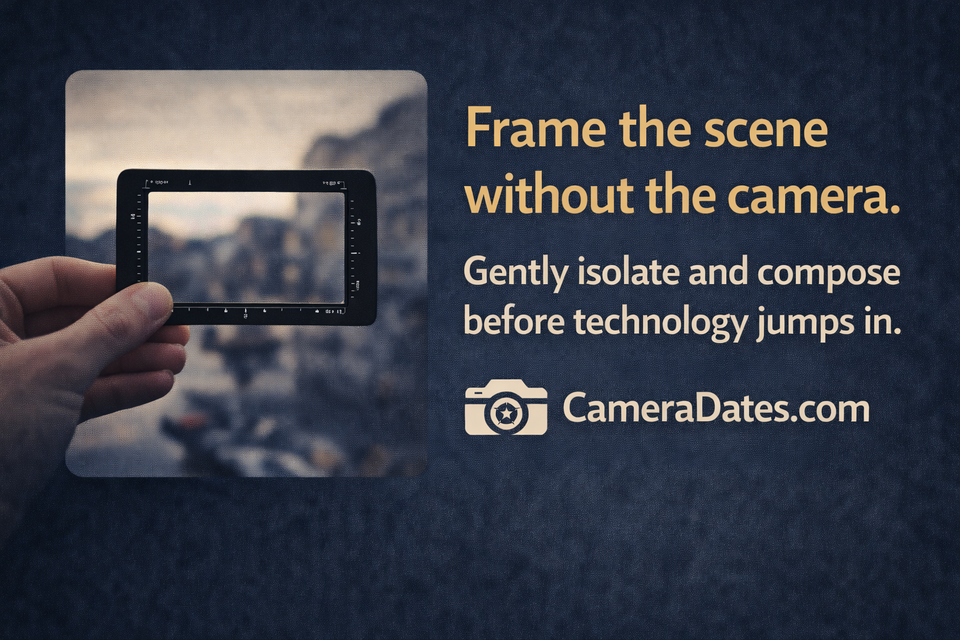
Choose one position and study the scene before raising the camera. You can even use your hands or a small cardboard rectangle to isolate the frame. The point is to temporarily separate seeing from shooting.
Look carefully at the edges. Notice objects that almost touch, shapes that merge, bright distractions, unnecessary foreground, and areas that feel too heavy or too empty. Ask whether the background supports the subject or competes with it. Pay attention to where your eye travels when you stop deliberately forcing it toward the subject.
That is composition in practice.
Let the Frame Change Without You
Once you have found a promising frame, sometimes the smartest thing you can do is wait. A person may walk into the right space. A car may leave and simplify the background. A cloud may soften the light. A shadow may move enough to separate the subject from its surroundings.
This is especially useful in street photography, wildlife, events, changing light, and any situation where you cannot control every element. Instead of chasing whatever moves, build the frame first and let the moment complete it.
You are no longer hunting for a photograph everywhere at once. You are deciding where the photograph could happen and giving it time to happen there.
A Camera Date for Composition
Choose a scene with enough visual information to make composition challenging. It does not need to be beautiful. Ordinary locations work well because they force you to rely on light, shape, spacing, and timing rather than spectacle.
Explore first. Make a few photographs from different positions and see what works. Then choose one position and stay there for at least five minutes. Study the background and edges before making another frame. Look for overlapping objects, bright distractions, awkward gaps, and elements that do not contribute.
Then decide what the photograph is actually about. It might be a relationship between two people, a patch of light, repetition, isolation, color, or one small subject surrounded by space. Once you know what matters, organize the frame around that idea and wait if necessary for the scene to settle.
When you raise the camera again, make one deliberate photograph. If you make another, have a reason for changing it.
Composition Is the Structure Underneath the Photograph
Beautiful light, an extraordinary subject, or a dramatic location can make an image interesting very quickly. Composition is what keeps the photograph working after the initial excitement is gone.
It determines where the eye travels, how the subject relates to its surroundings, whether the frame feels balanced or intentionally unsettled, and whether unnecessary elements weaken the idea. Learning composition improves more than framing. It changes how you choose backgrounds, how far you stand from the subject, when you move, when you wait, and even which lens you choose.
Eventually, composition stops feeling like something you apply after finding a subject. It becomes part of how you recognize the photograph in the first place.
Stop Trying to Force It
There is a time to explore a scene aggressively. Move around. Try several viewpoints. Find out what does not work. But once you have done that, stop long enough to really look.
Pay attention to the relationships inside the frame. Watch the edges. Notice the empty space. Remove what does not matter. Wait when waiting will improve the photograph.
The moment you stop trying to force a picture out of a scene is often the moment you finally become quiet enough to see the composition clearly.
Shoot What Matters.
Jonathan Charles
CameraDates.com