The Exposure Triangle Is Not a Rule. It's a Negotiation.
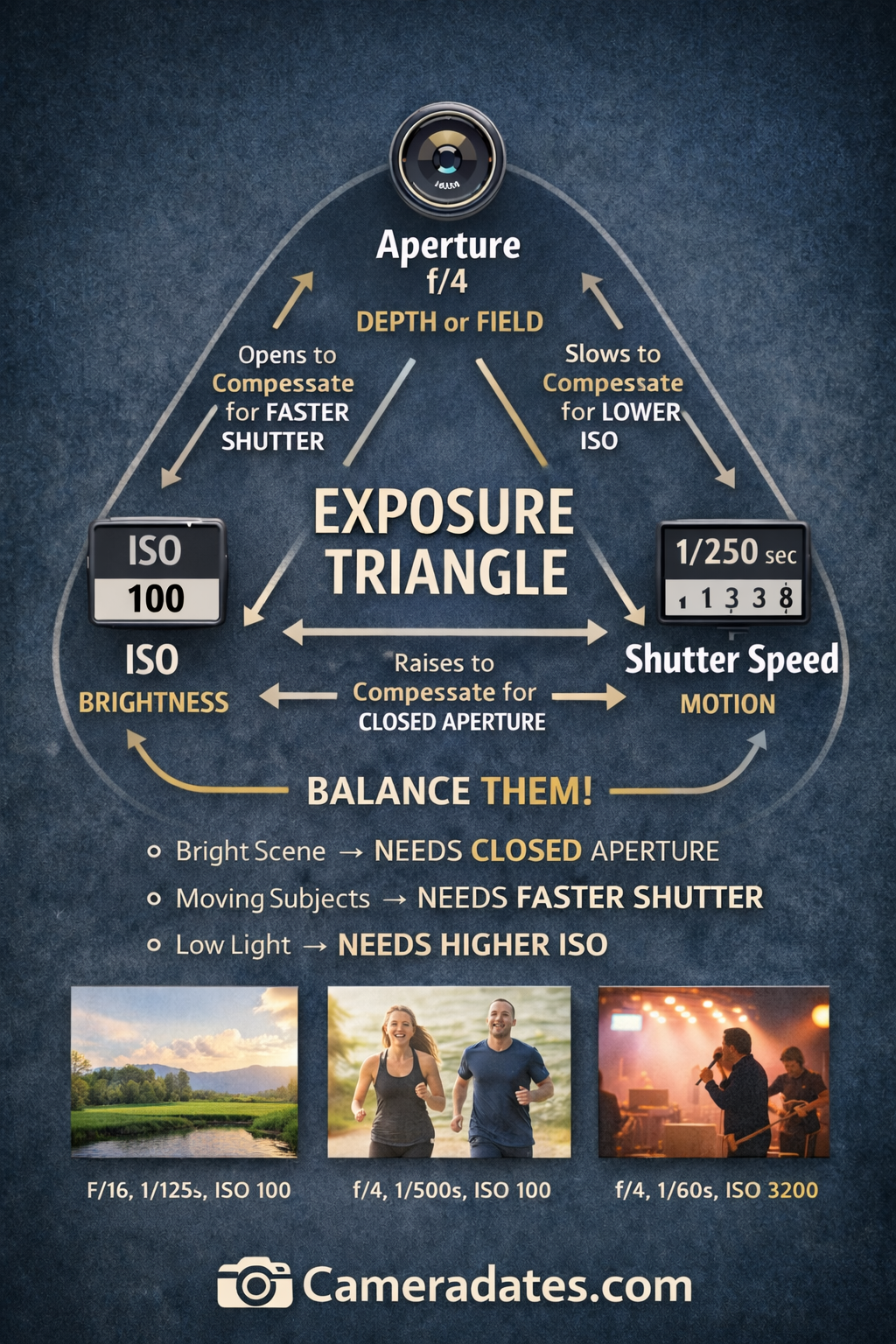
Every photograph requires a trade-off. You may want a fast shutter speed, deep depth of field, low noise, and plenty of light all at once. Sometimes the scene gives you enough light to have most of those things. Often it does not. That is where exposure stops being a formula and becomes a decision.
The exposure triangle is usually introduced as three settings that work together to control brightness: shutter speed, aperture, and ISO. That explanation is technically useful, but it is incomplete. Each setting also changes something about the photograph itself. Shutter speed changes how the camera records motion. Aperture changes depth of field. ISO changes how aggressively the camera responds to the light that reaches the sensor, with consequences for noise and dynamic range.
The important part is not memorizing that one setting goes up while another comes down. The important part is understanding which consequence matters most for the photograph you are trying to make.
Shutter Speed Is Your Decision About Time
Shutter speed determines how long the camera records the scene. A fast shutter speed can freeze a bird in flight, a runner in mid-stride, or an expression that lasts only a fraction of a second. A slower shutter speed can let water flow, people blur, wheels streak, or handheld movement show. Neither is automatically better. The question is what kind of time you want the photograph to contain.
If the subject is moving and that movement must be sharp, shutter speed becomes the priority. If motion itself is part of the story, a slower shutter may be exactly what the photograph needs. This is one reason motion blur should not automatically be treated as a mistake. Sometimes it is a mistake because the photographer wanted sharpness and failed to protect it. Other times it is an intentional part of the image. The camera cannot make that distinction for you. You have to decide.
Aperture Is Your Decision About Depth
Aperture changes how much of the scene appears acceptably sharp from front to back. A wider aperture can isolate a subject and simplify a busy background. A smaller aperture can bring more of the environment into focus and make the setting part of the story. But aperture does not work alone. Subject distance, focal length, and background distance also affect how depth of field looks. An f/4 photograph made from two feet away can feel very different from an f/4 photograph made from seven feet away.
That is why you should not choose a wide aperture just to blur the background. The better question is how much of this photograph needs to remain visually present. Sometimes the answer is very little, and a face, a flower, a bird, or a small detail may benefit from separation. Sometimes the answer is much more, and a landscape, an environmental portrait, an architectural scene, or a layered composition may depend on context. There is no universally correct aperture, only an aperture that supports what you want the photograph to say.
ISO Is Your Decision About How Much Compromise You Can Accept
ISO is often explained as making the camera more sensitive to light. That is a useful shortcut, but the important practical point is simpler. Raising ISO lets you use faster shutter speeds or smaller apertures in lower light, but usually at some cost to image quality. Higher ISO can introduce more visible noise and reduce some tonal flexibility, especially in shadows and highlights. Lower ISO generally gives you cleaner files and more room to work with later.
That does not mean low ISO is always better. If keeping ISO 100 forces you into a shutter speed that blurs a moving subject, the cleaner file is not much consolation. If raising ISO to 3200 gives you the shutter speed you need to capture the moment sharply, that may be the better photograph. This is where photographers sometimes get trapped by technical perfection. A slightly noisy photograph can still be excellent, while a missed moment is simply gone.
The Triangle Is Not Three Equal Decisions
This is the part that matters most. Shutter speed, aperture, and ISO do not deserve equal attention in every photograph. Usually one decision matters more than the others. If motion is critical, shutter speed leads. If depth of field is critical, aperture leads. ISO often becomes the setting that helps support those creative choices when the available light is not enough.
That is why the exposure triangle is not three dials that must be perfectly balanced. It is a negotiation. You decide what you are unwilling to sacrifice, and then the other settings have to work around that decision.
Imagine photographing a child running indoors. You may want f/8, ISO 100, and a perfectly clean file, but the light may not allow it. If sharp motion matters most, you protect shutter speed first, and maybe that means opening the aperture, raising ISO, or doing both. Now imagine photographing a landscape on a tripod at sunrise. Motion barely matters, and you can use a slower shutter speed because the camera is stable and the scene is not going anywhere. That gives you more freedom to choose aperture for depth of field and keep ISO low. Same triangle, different negotiation.
What This Looks Like in the Real World
Bright daylight gives you options. Usually there is enough light to keep ISO low while choosing shutter speed and aperture more freely. Indoors, those choices become tighter, and you may have to accept a wider aperture, a higher ISO, a slower shutter speed, or some combination of the three. At night, the compromises become even more obvious. A moving subject may force you to use a higher ISO than you normally would. A static scene on a tripod may let you use a much longer shutter speed. A handheld street photograph may require you to decide whether some motion blur is acceptable in exchange for keeping the atmosphere you saw.
Two photographers standing in the same place can make completely different exposure decisions, and both can be right. One may protect motion. Another may protect depth. Another may accept noise because the moment matters more. That is not inconsistency. That is authorship.
A Few Situations Worth Practicing
Reading about the triangle only goes so far. A few common scenes are worth deliberately practicing so the decision becomes instinct rather than math. A child or pet moving indoors under normal room light will test your patience with all three settings at once. Start by deciding the slowest shutter speed you can accept before motion blur becomes a problem, then let aperture and ISO fill the rest of the gap.
A sunset or golden hour landscape gives you more room to breathe. With the camera on a tripod, you can drop ISO to its base value and let shutter speed run as long as it needs to, using aperture purely for depth of field. A dim restaurant or living room at night is where most people give up and reach for flash. Before you do, try raising ISO further than feels comfortable. Modern sensors handle more noise than most photographers expect, and a usable photograph beats a technically clean one that never got taken.
The Part That Matters
The exposure triangle is not about getting everything perfect. It is about deciding what matters most when you cannot have everything. That is why learning exposure should eventually become less about remembering numbers and more about recognizing consequences. What happens if the shutter slows? What happens if the aperture opens? What happens if ISO rises? Which change hurts the photograph least, and which one protects the thing you care about most?
Once you begin thinking that way, exposure becomes far less intimidating. Instead of asking, "What are the correct settings?" you start asking, "What am I trying to protect?" That is a much better question.
Your camera can measure light. It can recommend exposure. In many modes, it can even choose one or two settings for you. What it cannot know is whether the moving subject matters more than the background, whether the background matters more than the noise, or whether a little blur would actually make the photograph better. That part still belongs to you.
The exposure triangle is not a rule. It is a negotiation. And the better you understand what each setting gives you, and what it takes away, the easier that negotiation becomes.
Shoot what matters
Jonathan Charles