The One Habit That Will Make You a Better Photographer Overnight
One habit can improve your photography without buying a lens, learning a new camera setting, traveling anywhere, or even taking another photograph: cull your work.
Not one day. Not someday when the hard drive gets full. Actually sit down, look at what you made, decide what deserves to stay, and let the weaker frames go. Most photographers spend a lot of time thinking about how to make better photographs. Far fewer spend enough time deciding which photographs are actually good. That second skill matters just as much.
Your Archive Can Hide Your Best Work
It is easy to keep everything. A slightly blurry version and the sharp version. Five frames from the same burst. Three compositions that are almost identical. A photograph you know does not work, but you keep it because maybe one day you will change your mind. Before long, one afternoon of shooting becomes hundreds of files, and thousands of those decisions accumulate across years.
The problem is not simply storage space. The bigger problem is attention. When strong photographs are buried among dozens of weaker versions, it becomes harder to see what is working. Every frame asks for a little bit of your time. Every near duplicate competes with the version that actually deserves your attention. Keeping everything can feel cautious, but sometimes it is just postponing a decision. Culling forces you to make one.
Culling Is Part of Photography
The creative process does not end when you press the shutter. Choosing which photographs survive is part of making the work. You may take ten frames of the same subject because expression changes, light shifts, people move, focus misses, or your composition improves as you work. That is normal. The important part comes afterward, when you decide which frame communicates the idea most clearly.
A photographer who can recognize their strongest work has learned something valuable about photography itself. Why does this frame work better? Is the composition cleaner? Did the timing improve? Is the expression more natural? Did the background become simpler? Is the light doing something more interesting? Did one tiny change make the photograph feel more complete?
Every time you answer one of those questions, you are training your eye. Culling is not housekeeping after photography. It is photography education using your own photographs.
Do Not Judge Every Photograph by the Same Standard
Being selective does not mean every image needs to belong in a portfolio. Some photographs are memories. Some document family, travel, an event, or something you simply want to remember. Their value may have nothing to do with whether they are technically perfect.
That is fine. The goal is not to turn your photo library into a ruthless competition where only masterpieces survive. The goal is to stop keeping unnecessary versions of the same photograph and to learn how to recognize which images actually matter. If you made six nearly identical photographs of the same moment, ask yourself which one tells it best. You probably do not need all six.
Compare Before You Delete
One of the easiest ways to improve at culling is to stop judging photographs one at a time. Compare similar frames directly. If you photographed the same scene several times, put those images beside one another. The differences become much easier to see.
One may have cleaner edges. Another may have better timing. One expression may feel more natural. One composition may give the subject just enough breathing room. One frame may simply feel more settled than the others. Pick the strongest one first, then ask whether any of the remaining photographs give you something genuinely different. If not, you have your answer.
This is much easier than asking whether each individual photograph is “good enough” to keep.
Learn to Recognize Your Almost Photographs
The most useful frames to study are not always the obvious failures. Pay attention to the photographs that almost worked. Maybe the light was right but the background was distracting. Maybe the composition was strong but you missed focus. Maybe the moment happened half a second later than you needed it to. Maybe you stayed too far away. Maybe the photograph contains everything it needs but also one thing it does not.
Those images tell you exactly where your photography is developing. Instead of simply deleting them and forgetting them, pause long enough to understand why they missed. Then delete them if you do not need them. The lesson is worth keeping even when the file is not.
A Simple Way to Cull a Shoot
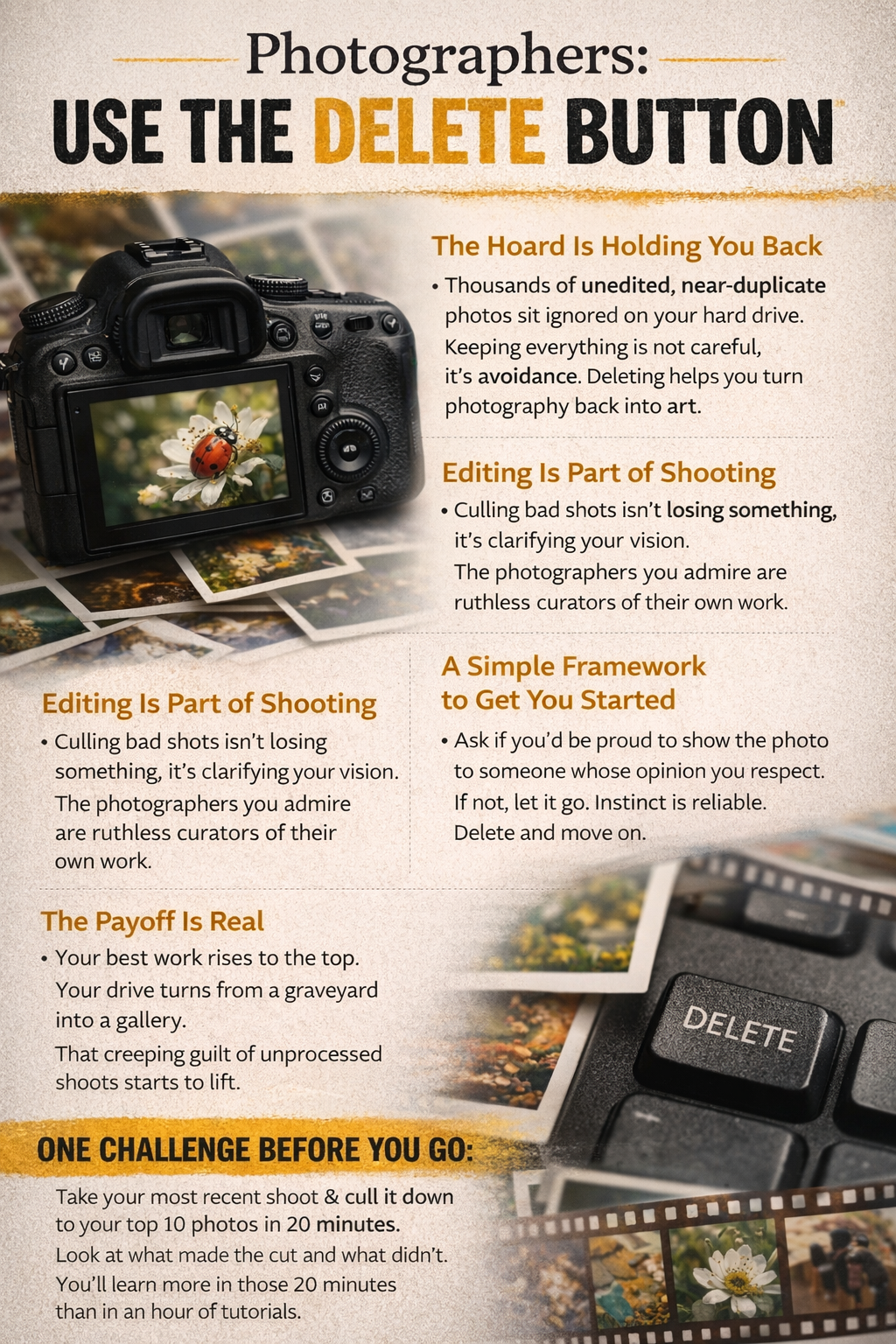
Start with something recent rather than attacking years of backlog. Open one shoot and make a quick first pass. Remove the obvious misses: accidental frames, severe focus failures, test shots, duplicates where another version is clearly stronger, and images you know immediately have no value to you.
Then make a second pass more slowly. Group similar photographs together and choose the strongest frame from each group. Pay attention to composition, timing, expression, focus, background, light, and whether the image communicates what interested you in the first place.
Now look at what remains as a group. This step matters. A collection of individually decent photographs can still contain repetition. If five images communicate essentially the same thing, decide whether you really need all five. You are not only selecting photographs anymore. You are editing a body of work.
The Twenty-Minute Camera Date
Take your most recent shoot and set a timer for twenty minutes. Your goal is to choose ten photographs. Not eleven. Ten. Do not start editing color, exposure, or cropping. This exercise is about selection, not processing.
When you have your ten, look at them together. What do they have in common? Do you consistently prefer a certain kind of light? Do your strongest photographs tend to be simpler? Are you drawn toward tighter compositions or environmental ones? Do people, texture, color, gesture, symmetry, or quiet moments keep appearing?
Now look back at the photographs you rejected. What kept going wrong? Busy backgrounds? Weak timing? Too much distance? Unclear subjects? Repeated compositions? That twenty-minute exercise can reveal patterns that are difficult to notice while you are actually shooting.
Your Rejects Can Teach You What to Practice
Once you begin culling regularly, your archive starts giving you feedback. If you repeatedly reject photographs because the backgrounds are messy, that tells you something to practice next time. If motion blur keeps ruining photographs you otherwise like, you may need to pay closer attention to shutter speed. If your strongest frames consistently come after you move closer, that is useful information.
If the first ten photographs from every shoot are weaker than the last ten, maybe you need more time to settle into a scene. Your own photographs can become one of your best teachers if you are willing to look at them critically.
Fewer Photographs Can Make the Good Ones Louder
There is a strange relief that comes from opening a folder and seeing only photographs you intentionally chose to keep. The best frames no longer have to fight through fifty nearly identical versions to get your attention. You can find your work, see patterns in it, recognize improvement, and perhaps most importantly, begin developing confidence in your own judgment.
That confidence follows you back into the field. The more clearly you understand why you keep one photograph and reject another, the easier it becomes to recognize those differences before pressing the shutter.
That is why culling can make you a better photographer surprisingly quickly. You are not just cleaning your hard drive. You are training yourself to see the difference between a photograph you made and a photograph worth keeping.
Start with one shoot. Find the strongest ten. Study what survived. Learn from what did not. Then go make the next photographs with that knowledge.
Shoot What Matters.
Jonathan Charles
CameraDates.com