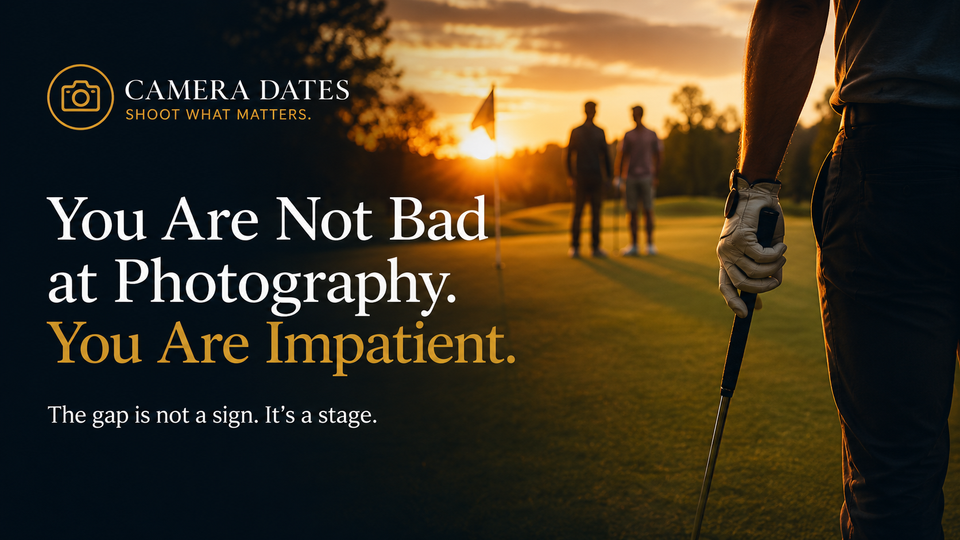
You Are Not Bad at Photography. You Are Impatient.
Nobody likes to hear this, but listen up.
Many photographers decide too early that they are not very good. They see something beautiful, raise the camera, press the shutter, and what comes back does not match what they felt in the moment. The light looked richer in person. The composition felt stronger in their head. The photograph falls short, and after enough of those disappointments, it becomes tempting to treat the result like a verdict.
Maybe I do not have the eye for this. Maybe I am missing whatever other photographers seem to have. Maybe I am just not naturally good at photography. I do not think that is usually the truth. More often, the truth is simpler. You are not bad at photography. You are impatient.
A Story About Golf
Years ago, some guys I worked with talked me into trying golf. I was not especially interested, but I went along with it. I bought a few clubs, showed up, swung badly, missed plenty, and honestly, I stunk at it. I did not suddenly discover some hidden talent. I did not have one magical afternoon where everything clicked. I was just bad at golf because I was new at golf. And here is the part that matters: I did not give it much time.
I played a little, got frustrated, decided I was not very good at it, and eventually stopped going. I never stuck around long enough to find out what might have happened if I had actually practiced. I never gave repetition a chance to turn awkward movements into familiar ones. I never gave myself enough rounds to recognize patterns, make adjustments, or experience those little breakthroughs that only show up after you have been bad at something for a while.
Looking back, that seems obvious. Nobody expects to become a strong golfer after a few afternoons. Golf takes time. You miss. You adjust. You hit one decent shot and then ruin the next three. Slowly, almost invisibly, your body begins to understand what your brain has been trying to tell it. I just wasn't very patient with it.
Photography works the same way.
The difference is that photographers often give themselves even less patience. We make a handful of disappointing images and critiques and start wondering whether we have the eye for it. We expect our instincts, timing, composition, and technical control to feel natural long before we have given them enough repetition to become natural. I quit golf before I ever got to find out what I could have become at it. I would hate for you to do the same thing with photography.
For some reason, photographers often forget that same principle when it comes to cameras. They expect their taste to be sophisticated long before their skill can possibly be mature. They expect consistency before they have built it. They expect the camera to obey instincts that are still being formed. That is not failure. That is the normal path.
The Gap Hurts Because Your Eye Is Working
One strange thing about photography is that your eye often develops faster than your ability. You are drawn to strong images before you fully understand how to make them yourself. You recognize beautiful light, clean composition, emotional timing, and meaningful moments long before you can consistently translate them into your own photographs. That creates a gap. You know what good feels like, but you cannot always produce it yet.
And that gap can be discouraging because it makes you aware of what is missing. You notice the distracting background. You see the bad edge. You realize the subject needed more separation. You understand the light was promising, but you didn't use it well. But that awareness doesn't mean you are failing. It proves your standards are becoming more refined. In other words, the frustration is not always a sign that you are worse than you thought. Sometimes it is a sign that your eye is getting better faster than your technique can keep up. That is actually a hopeful place to be.
Growth in Photography Is Usually Quiet
Most improvement in photography does not arrive with a trumpet blast. It happens quietly. You notice a messy background a little sooner than you used to. You move your feet instead of blaming the lens. You recognize that the subject needs more room. You wait a few extra seconds for the light to shift. You begin choosing stronger frames out of a group of similar ones. You understand your own mistakes a little more clearly. These are not dramatic moments. But they are real progress.
Many photographers miss this because they wait to feel suddenly transformed. They want a before-and-after moment. One day bad, next day good. One day confused, next day confident. But most real development does not work like that. It builds through repetition until one day you look back and realize you are seeing differently than you used to. That is why patience matters so much. Not because patience is a cute virtue to hang on a wall, but because photography is one of those skills where small gains compound over time.
The Photographers Who Improve Stay With It
When people talk about talented photographers, they often make it sound as if good photographers emerged fully formed, as though they were simply blessed with a better eye and everyone else is trying to catch up. I do not buy that. The photographers who improve are usually the ones who stick with it long enough for their effort to add up. They keep photographing. They keep noticing. They keep reviewing their own work. They keep learning from weak frames instead of treating those frames like personal insults. They return to similar problems and gradually solve them. That kind of steady repetition is powerful.
The photographer who keeps showing up learns what bad edges look like because they have made enough photographs with bad edges. They learn how different light behaves because they have seen it fail and succeed in different situations. They begin choosing better backgrounds because they got tired of ruining otherwise decent images with careless ones. That is not glamorous. But it is how skill is built.
Impatience Makes Everything Feel Heavier
The danger of impatience is not just that it makes you frustrated. It also makes photography feel heavier than it needs to feel. Every outing becomes a test. Every photograph becomes a verdict. Every weak frame becomes evidence. Every strong frame becomes something you feel pressured to repeat. And so on. That is exhausting. And worse, it can pull you away from the reason you picked up the camera in the first place.
Most people did not begin photography because they wanted one more arena in life where they could feel behind. They started because they liked looking at the world. They liked light. They liked memory. They liked shape, mood, story, gesture, timing, and beauty. They liked the strange joy of noticing something and trying to preserve it. That spirit matters. Yes, keep learning. Yes, keep improving. But do not let improvement become so tense that it pushes curiosity out of the room.
Practice Is Not Punishment
This is another point worth stating clearly. Practice is not punishment for not being good enough. It is simply how the eye, the hands, and the mind begin to cooperate. Every time you go out with the camera, you gain experience. Every frame teaches something, even when it is not a keeper. Each return to the same kind of scene helps you recognize patterns more quickly. Every round of culling teaches you more about what actually works and why. This is where Camera Dates has been pointing all along. Not toward perfection. Toward familiarity. Toward repetition with attention. Toward solving one problem at a time. Toward learning how photographs are actually made. That kind of practice is not drudgery. It is how photography becomes yours.
Compare Yourself Backward, Not Sideways
One of the fastest ways to feel impatient is to compare your current work to somebody else’s finished work. You are comparing your present to their highlight reel. Their strongest frame to your average day. Their years of experience to your current season of learning. That comparison almost always poisons the process.
A much better question is this: Are you seeing more clearly than you used to? Look back six months, a year, two years. Would you make the same framing choice today? Would you notice the background sooner? Would you move closer? Would you simplify more aggressively? Would you wait longer? Would you choose a different photograph from the set? If the answer is yes, progress is already underway. It may not be dramatic enough for your impatience, but it is real.
A Better Way to Think About the Gap
Instead of treating the gap between your taste and your ability as a sign that something is wrong, treat it as evidence that something is underway.
You care enough to notice the difference. Good. You want the photograph to be better. Good. You can see the image fell short of what you intended.
Good. That means your eye is alive. Now give your skill time to catch up. That is what patience is really for. Not sitting still and hoping. Not pretending frustration does not exist. Not lowering your standards.
Patience means continuing anyway. Continuing with honesty. Continuing with curiosity. Continuing with enough hope to let time do its work.
A Camera Date With No Score
I encourage you to try this: pick up your camera and photograph something you truly enjoy. Avoid shooting what you think you should or what might impress others on social media. Focus on capturing what genuinely interests you. Set aside an hour for this activity. During that time, don't judge your success based on the quality of the shot, pursue a perfect portfolio image, or critique yourself while shooting.
Just work. Move around. Watch the light. Notice the background. Try a few ideas. Wait a little longer. Make a few frames that fail. Make a few that surprise you. Then go home and ask a better question than “Did I prove I’m good?”
Ask instead: What did I notice? What improved? What still gives me trouble? What did this teach me? That is a much healthier way to build skills.
Let Better Sneak Up on You
The irony of photography is that improvement often becomes most visible when you stop demanding proof of it every five minutes. Spend time with the camera. Study your results honestly. Keep what works. Learn from what does not. Return to the work. Stay curious. Be patient enough to let repetition accumulate. And while you are at it, try to enjoy where you are. Not because you should settle there forever, but because growth usually happens more faithfully in people who are still willing to engage the process with joy. You are not bad at photography. You are in progress. That is a much better thing to be.
So go make something today. Not to prove yourself. Not to close the whole gap in one afternoon. Just to spend a little more time with the craft. If you stick with it, the better will come.
Shoot What Matters.
Jonathan Charles
CameraDates.com